
|
|
ECOSYSTEM
MAJOR
2026-11-03
Google turns AI off by default for K-12 — Search included, schools opt in
Google's school accounts will ship with Gemini and Search switched off until admins opt in.
What is it?
Google announced that Gemini, Gemini Notebook, Gemini in Classroom and Google Search will be fully off for K-12 student accounts until school administrators turn them on. The same post makes Guided Learning, a step-by-step study mode, available worldwide in Google Classroom.
How does it work?
Workspace for Education admins enable each product separately for students. Because Google treats Search and AI as one product, enabling Search also brings AI Mode and AI Overviews.
Why does it matter?
School IT teams must now plan for student accounts where Gemini and even Search start disabled. The Search-AI link drew criticism from Bernie Sanders, Zohran Mamdani and Lina Khan.
Who is it for?
School admins and edtech developers on Google Workspace for Education.
|
|

|
|
PAPER
MAJOR
2026-11-02
FlashProve — Anthropic's open-source proof of which model wrote a reply
A zero-knowledge proof that the model you asked for is the model that answered, checked on a normal CPU.
What is it?
Open-source code that lets an AI provider prove a reply came from one committed set of model weights, while keeping those weights hidden. Anthropic calls it intermediate progress, and the repository is labelled not maintained.
How does it work?
FlashProve is a zkSNARK with Lean 4 machine-checked properties. A single H100 proves Llama 4 Maverick replies at 110 tokens per second, and a CPU checks each proof in about 17 seconds.
Why does it matter?
Users can't tell today whether a provider quietly swapped in a cheaper model. The cost is still high: about 70 to 95 times normal GPU time, with a 1,024-token context limit.
Who is it for?
AI security researchers, model providers and auditors.
|
|

|
|
SECURITY
MAJOR
2026-11-03
Postman desktop auto-installed Codex and Claude Code plugins — users object
Postman's desktop app added AI agent plugins to developers' Codex and Claude Code setups without asking first.
What is it?
A GitHub issue reports that Postman desktop 12.33.4 added its plugin to Codex and Claude Code on its own, along with a remote MCP server and a CLI. A second user saw the same on 12.35.1, with a Cursor plugin too.
How does it work?
The plugin adds a SessionStart hook telling the coding agent to load a Postman API skill. The reporter says the installer also approves its own hook, so the agent host never asks the user to trust it.
Why does it matter?
An app that writes to agent config silently changes how the agent behaves on every project. There is no evidence data was uploaded, and Postman says it will make the opt-in clearer and review the hook.
Who is it for?
Developers who use Postman with Codex, Claude Code or Cursor.
|
|

|
|
SECURITY
MAJOR
2026-11-02
OpenAI bug bounties up to $172,000 — and Cathedral joins its security sprint
OpenAI pays outside hackers much more for serious bugs and brings in Cathedral to attack its own systems with AI.
What is it?
OpenAI's Security Bug Bounty now pays more than four times as much for critical findings, with exceptional reports earning up to $172,000. Cathedral Systems researchers will also use OpenAI models to challenge its defenses in the next internal security sprint.
How does it work?
Higher ranges apply to new reports and those awaiting review, and OpenAI pays the difference on bounties awarded in the past 30 days. Simple jailbreaks with no shown impact stay out of scope.
Why does it matter?
Models find vulnerabilities faster, so OpenAI is paying defenders to use that ability first. The partner is notable: Anthropic earlier accused Cathedral of breaking its bounty rules.
Who is it for?
Security researchers, bug bounty hunters and teams running AI agents.
|
|

|
|
REPO
MAJOR
2026-11-03
agent-desktop 1.1 — Vercel Labs' computer-use CLI for AI agents
A command-line tool that lets any AI agent see and click native desktop apps, without matching pixels.
What is it?
Version 1.1.0 of Vercel Labs' computer-use CLI fixes the Windows overlay and reaches the macOS Dock and menu bar. The repo gained 2,275 GitHub stars in one day.
How does it work?
It reads apps through the OS accessibility APIs and returns JSON with a ref for every element an agent can act on. The agent clicks or types on a ref, then takes a new snapshot to check the result.
Why does it matter?
Many desktop apps have no API, and pixel-based computer use is slow and fragile. About 60 commands work the same on macOS, Windows and Linux, though apps without an accessibility tree stay invisible.
Who is it for?
Developers building agents that operate desktop apps.
|
|
|
|
PAPER
MAJOR
2026-11-02
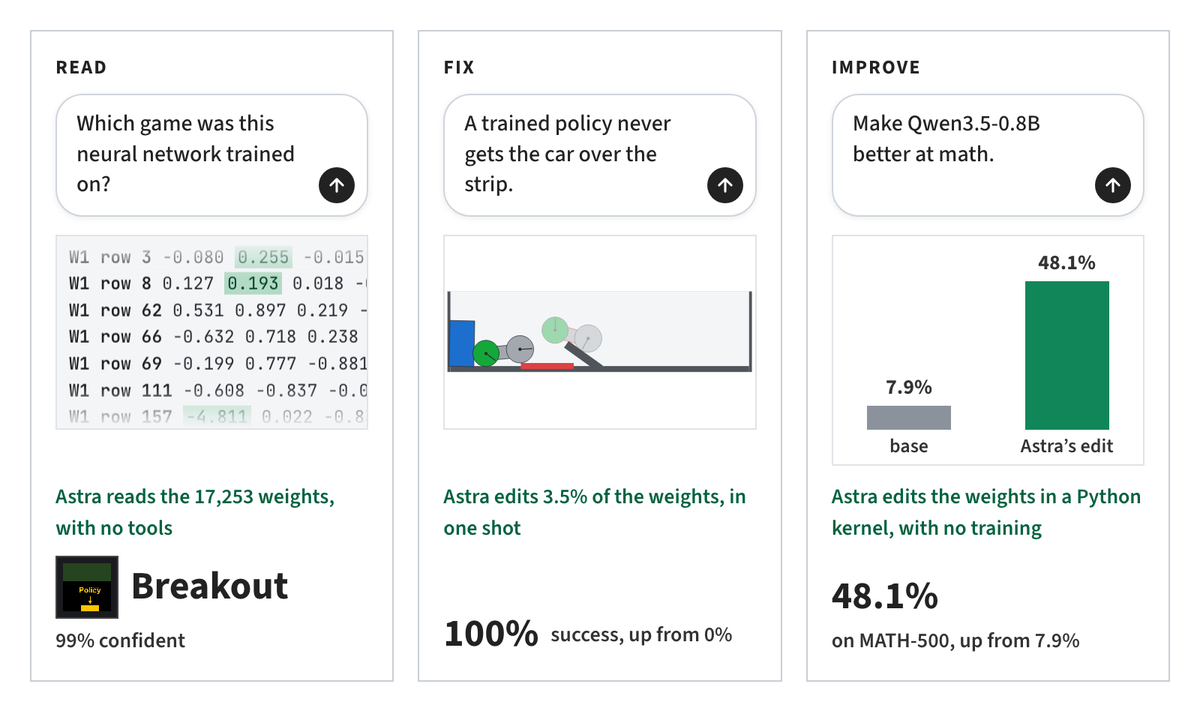
Weight-Space Programming — GPT-6 Astra reads and edits network weights
A frontier LLM looks at a network's weights, works out what they compute, and rewrites them without any training loop.
What is it?
MIT CSAIL researchers name it Weight-Space Programming: an LLM reasons about what each part of a neural network computes, then edits the weights directly. One edit to 0.016% of Qwen3.5-0.8B's weights lifted MATH-500 from 7.9% to 48.1%.
How does it work?
GPT-6 Astra gets the weights as text or in a sandbox where it can load tensors but not run the network. For Qwen it traced a math-looping habit to one direction in two layers and subtracted it.
Why does it matter?
It suggests auditing or repairing a model without data or gradient training. The limits are real: Astra could not find a sycophantic model from weights alone.
Who is it for?
Interpretability and ML researchers.
|
|
|
|
SHOWCASE
NOTABLE
2026-11-03
GPT-6 Astra designs a Codex device in a week — OpenAI's hardware push
OpenAI shows its models doing mechanical and electrical design work, and asks engineers to help test it.
What is it?
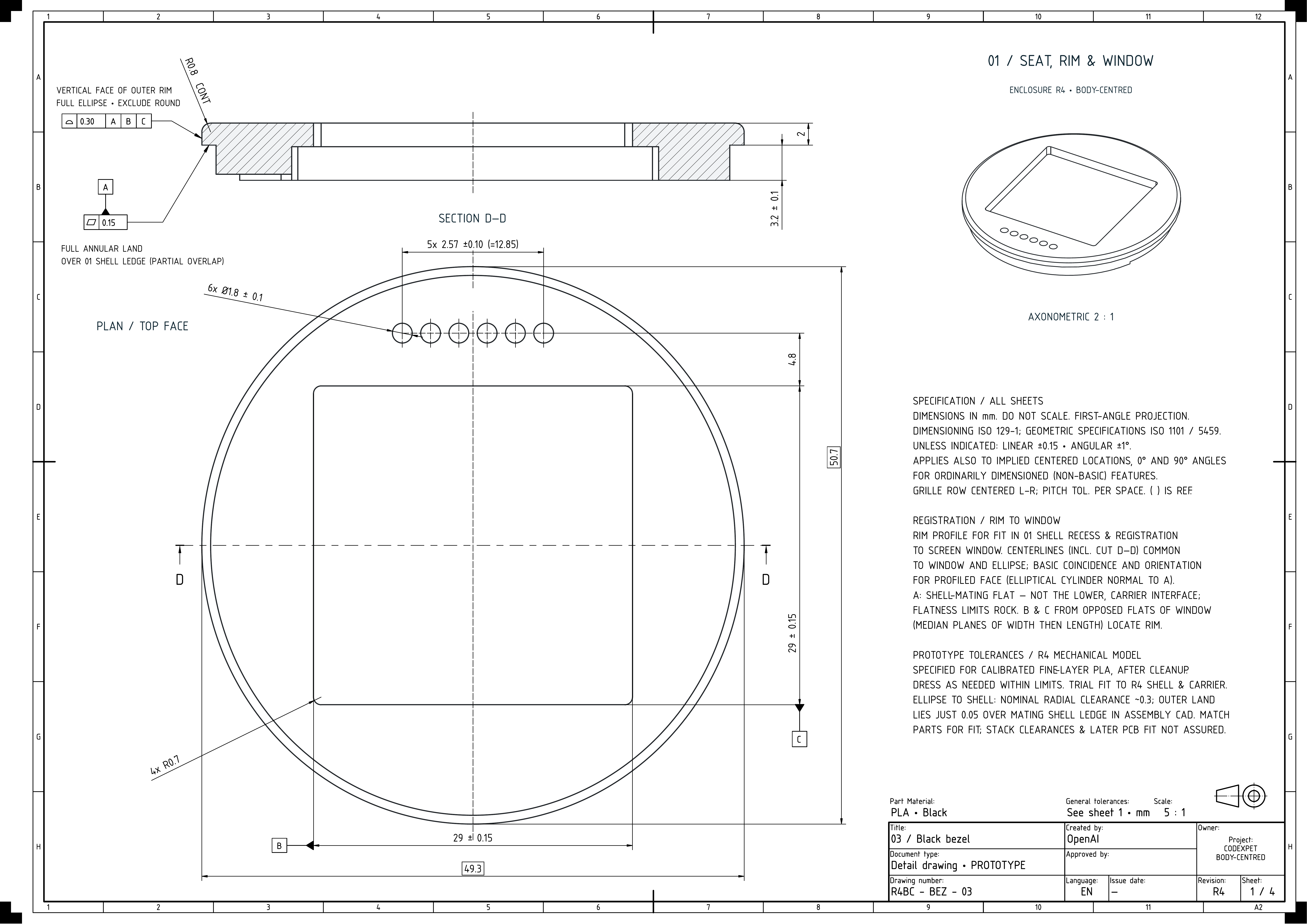
OpenAI reports a test device designed with GPT-6 Astra: the enclosure, circuit board and software for a gadget that lets people talk to Codex. Two team members finished the design in under a week, and prototypes were built in under a month.
How does it work?
Engineers use Codex and ChatGPT for CAD models, drawings, simulations and design reviews. The device still needed several review rounds, since the model missed production limits and tolerances.
Why does it matter?
A model that drafts parts, boards and drawings could shorten hardware prototype cycles. The best BenchCAD 2.0 score (0.875) comes from an unreleased model, so it can't be checked independently.
Who is it for?
Mechanical and electrical engineers, and hardware teams.
|
|
|
All releases at ai-tldr.dev
Simple explanations • No jargon • Updated daily
|
|