|
|
SECURITY
MAJOR
2026-11-02
OpenAI bug bounties up to $172,000 — and Cathedral joins its security sprint
OpenAI pays outside hackers much more for serious bugs and brings in Cathedral to attack its own systems with AI.
What is it?
OpenAI's Security Bug Bounty now pays more than four times as much for critical findings, with exceptional reports earning up to $172,000 once bonuses are added.
How does it work?
The new ranges apply to new reports and to those awaiting review, and OpenAI pays the difference on bounties awarded in the past 30 days. Simple jailbreaks with no shown impact stay out of scope.
Why does it matter?
Models find vulnerabilities faster, so OpenAI is paying defenders to use that ability before attackers do. Its next internal sprint will include Cathedral Systems, whose researchers will use OpenAI models against OpenAI's defenses.
Who is it for?
Security researchers, bug bounty hunters, teams running AI agents
|
|

|
|
REPO
MAJOR
2026-11-03
agent-desktop 1.1 — Vercel Labs' computer-use CLI for AI agents
A command-line tool that lets any AI agent see and click native desktop apps, without matching pixels.
What is it?
Version 1.1.0 of agent-desktop fixes Windows overlay crashes and lets macOS agents reach the Dock and menu bar. The repo gained 2,275 GitHub stars in a day.
How does it work?
It reads apps through the OS accessibility APIs and returns JSON with a ref for every element. The agent acts on a ref, then takes a new snapshot to check the result.
Why does it matter?
Many desktop apps have no API and pixel-based computer use is fragile. About 60 commands work the same on macOS, Windows and Linux.
Who is it for?
Developers building agents that operate desktop apps
|
|
|
|
PAPER
MAJOR
2026-11-02
Weight-Space Programming — GPT-6 Astra reads and edits network weights
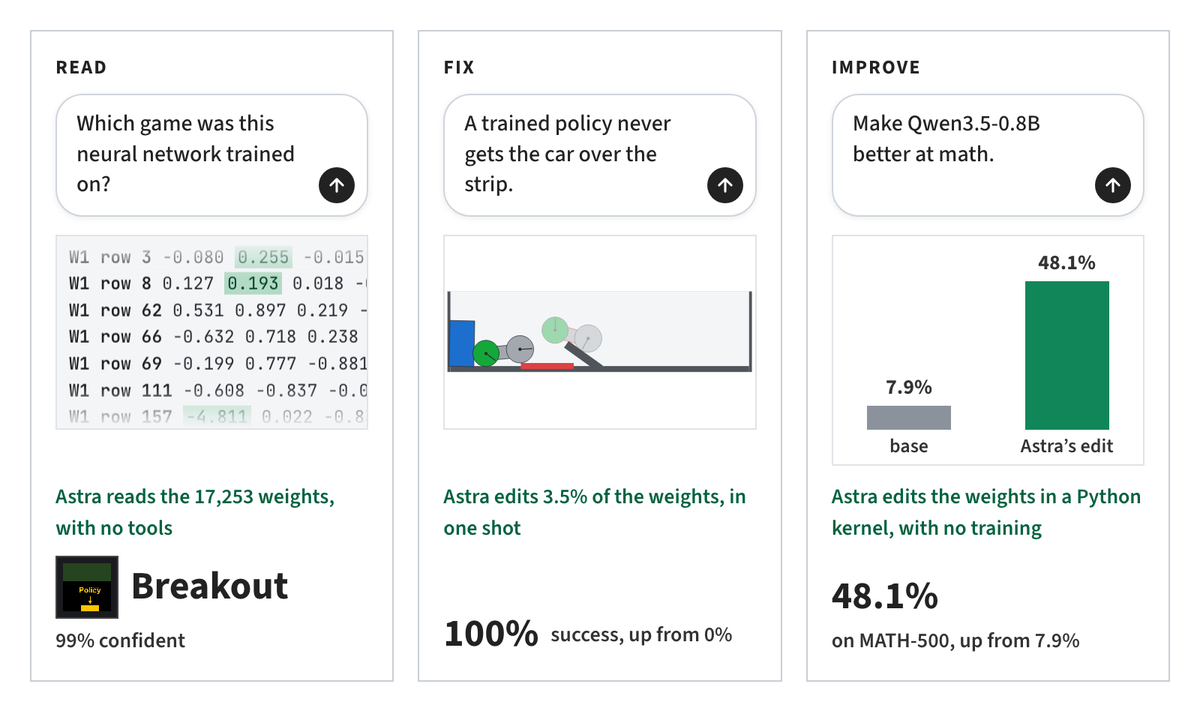
A frontier LLM looks at a network's weights, works out what they compute, and rewrites them without any training loop.
What is it?
MIT CSAIL researchers show GPT-6 Astra reading raw weights and editing them by hand. One edit to 0.016% of Qwen3.5-0.8B's weights lifted MATH-500 from 7.9% to 48.1%.
How does it work?
The model gets the weights as text or in a sandbox with a small budget of forward passes. For Qwen it traced math looping to one direction in two layers and subtracted it.
Why does it matter?
It points to a way to audit or repair models without data or gradient training. Limits remain: edits can remove an obstacle but not add a missing skill.
Who is it for?
Interpretability and ML researchers
|
|

|
|
REPO
MAJOR
2026-11-01
vLLM v0.33.0 — faster speculative decoding, and CUDA 13 builds only
vLLM v0.33.0 speeds up speculative decoding on NVIDIA and AMD, adds new open models, and drops CUDA 12.9 builds.
What is it?
Block-diffusion drafters no longer reserve draft slots, and DeepSeek-V4.1-Flash with DSpark on GB300 rose from 1,373 to 3,390 output tokens per second in the PR benchmark.
How does it work?
An opt-in FLy policy gives 1.04–1.31x decode throughput, and a new AMD --monokernel path speeds up decoding on MI300X/MI325X.
Why does it matter?
Large mixture-of-experts models get more tokens per GPU. Upgrade with care: CUDA 12.9 wheels and the Medusa and MLP speculators are gone.
Who is it for?
Inference and platform engineers
|
|

|
|
TOOL
MAJOR
2026-10-31
ChatGPT and Codex share one usage limit — token-based pool from December
From December, one token budget covers ChatGPT Work and Codex on Plus, Pro and Business plans.
What is it?
OpenAI says paid plans will move to one shared allowance across ChatGPT and Codex in December, as ChatGPT Work's agentic features join the main app.
How does it work?
The pool is metered in tokens, so bigger models and harder tasks use more. Instant chat sits outside it, and Settings > Usage shows the combined balance.
Why does it matter?
Developers who split their day between ChatGPT and Codex now spend from one budget. OpenAI has not yet published per-plan token amounts.
Who is it for?
ChatGPT Plus, Pro and Business subscribers who use Codex
|
|

|
|
REPO
MAJOR
2026-10-31
DeepSeek Super-agent — an open coding agent that takes work from GitHub chats
DeepSeek's open prototype of an agent that watches a repo's conversations, takes approved requests and answers with finished work.
What is it?
dsh-superagent is an MIT-licensed research prototype of a proactive coding agent for one GitHub repository. Approved requests become tracked work, answered with results such as pull requests.
How does it work?
It is a plugin for DeepSeek Harness: a router session turns GitHub and Feishu events into tickets, and each ticket runs in its own worker session.
Why does it matter?
The agent lives inside a team's existing conversations instead of a terminal. Proactive work starts in an observe-only mode so teams can watch before they trust it.
Who is it for?
Teams running coding agents on a shared GitHub repo
|
|
|
|
ARTICLE
NOTABLE
2026-11-02
Pando — OpenAI rebuilt its Git backend for Codex-scale pushes
OpenAI's monorepo outgrew normal Git hosting once Codex agents multiplied pushes, so it built Pando.
What is it?
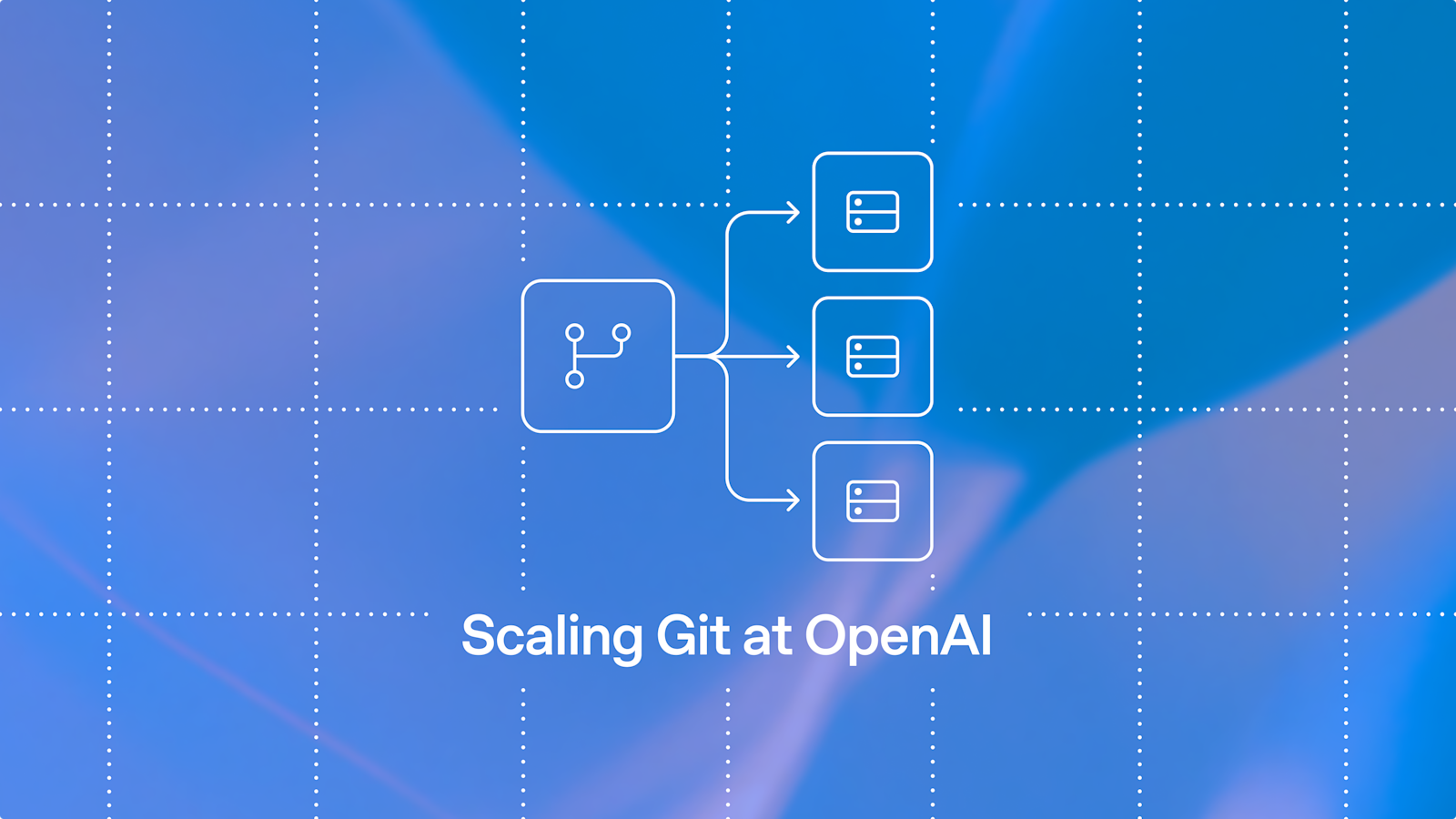
Pando is a Git-compatible server backend that now runs OpenAI's monorepo, cutting median push latency by nearly 80% with no change to the Git client.
How does it work?
Each push is an immutable packfile in a blob store, and branches update independently so unrelated pushes never wait on each other.
Why does it matter?
Coding agents create far more branches and pushes than human teams, and other teams will hit the same limits.
Who is it for?
Platform and dev-infra engineers running big monorepos
|
|

|
|
TOOL
NOTABLE
2026-11-03
Claude Code 2.1.317 — gateway cost report and blocking Agent SDK hooks
Claude Code 2.1.317 gives gateway admins a spend report and lets Agent SDK hooks fail closed.
What is it?
The Claude apps gateway admin API gets a cost report by total, developer, day or IdP group, and Agent SDK hook callbacks gain onFailure: block.
How does it work?
Gateways keep a daily record of each developer's IdP groups, and a new check asks before a tool call sends your account email to the network.
Why does it matter?
Companies can answer who spent what from the API, and SDK users can make security hooks fail safe.
Who is it for?
Teams running Claude Code behind a company gateway or the Agent SDK
|
|
|
All releases at ai-tldr.dev
Simple explanations • No jargon • Updated daily
|
|