|
|
SHOWCASE
MAJOR
2026-06-17
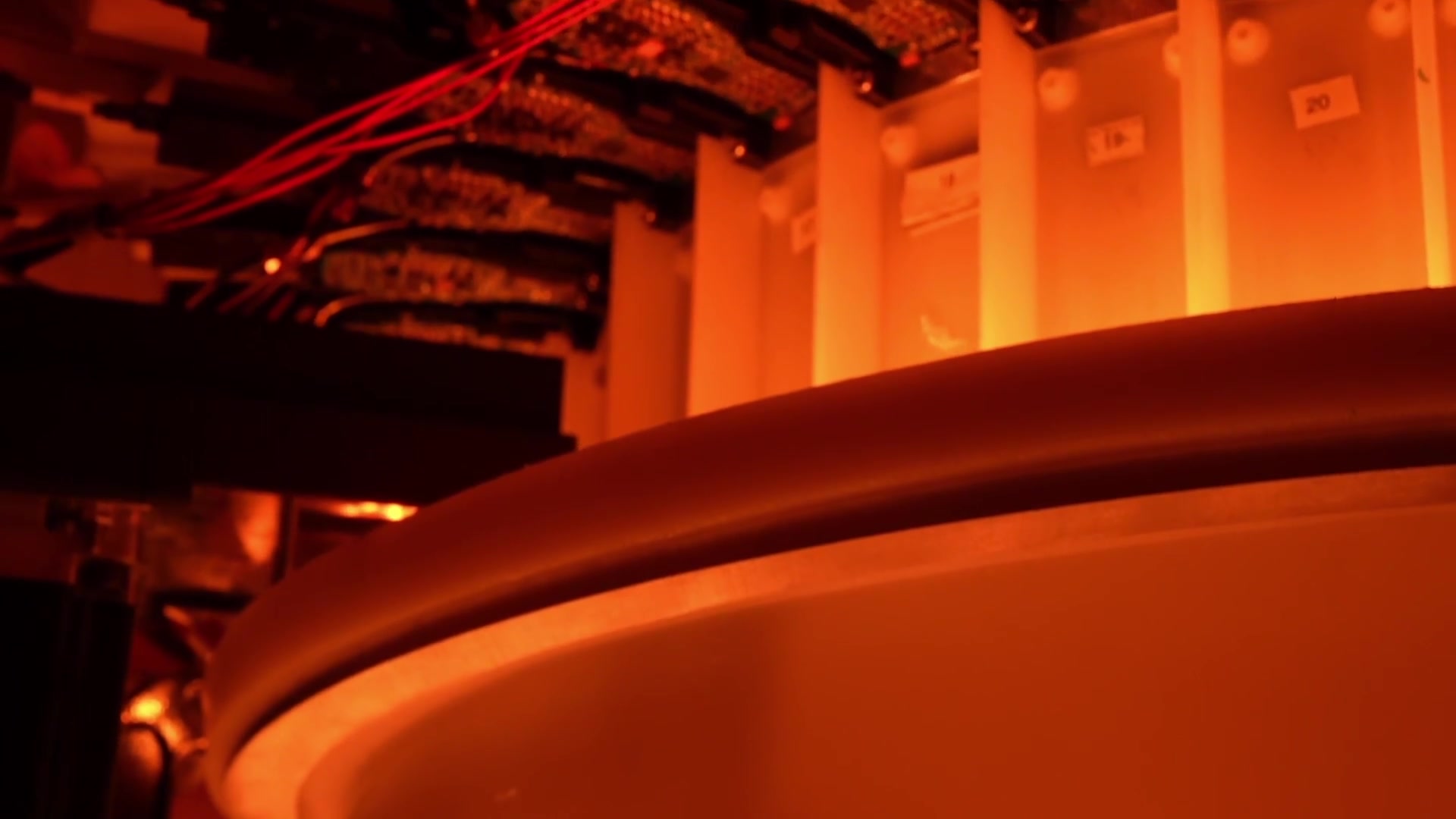
Midjourney Medical — full-body ultrasonic CT scanner, 60-second scan, SF spa in 2027
Midjourney spins up a hardware division and unveils a full-body ultrasound scanner inside a planned San Francisco spa.
What is it?
Midjourney Medical is a new division of Midjourney building Ultrasonic CT, a full-body ultrasound scanner that captures a 3D body image in about 60 seconds using sound waves in water. The first scanner will open inside the Midjourney Spa in San Francisco at the end of 2027.
How does it work?
The scanner uses 8,960 ultrasound transducers wrapped around 40 Butterfly Network ultrasound-on-chip modules per system. Patients descend into a shallow pool of water and pass through a ring of underwater sensors — no radiation, no magnets, licensed from Butterfly Network in November 2025 for $15M upfront.
Why does it matter?
Midjourney is the first major generative-AI company to ship a real hardware product, applying its imaging work in a medical setting. The spa-and-scan delivery model sells direct to consumers rather than hospitals — Midjourney's stated goal of 50,000 scanners and 1 billion scans per month by 2031 would rival the scale of global MRI rollouts.
Who is it for?
AI watchers, medical-imaging engineers, and consumer-health investors watching generative-AI labs expand into physical products.
|
|

|
|
ECOSYSTEM
MAJOR
2026-06-17
US Pauses DeepSeek Blacklist — 100+ Chinese AI firms spared Entity List
Commerce Department leaves DeepSeek and 100+ Chinese AI/chip firms off the Entity List despite interagency approval — the longest pause in over a decade.
What is it?
The US Entity List restricts US firms from selling chips and software to listed companies without a license. Reuters reported that an interagency committee approved DeepSeek, memory chipmaker CXMT, and 100+ other Chinese AI and chip firms for the list last year — but the Trump administration never published the names.
How does it work?
Under-Secretary Jeffrey Kessler reportedly "sought to avoid listing Chinese parties for fear of escalating tensions with Beijing." No new Entity List additions have been made since October 2025 — the longest gap in over a decade — leaving the 100+ firms eligible to receive US chips and software.
Why does it matter?
A blacklist would have cut US AI chip supply to DeepSeek and complicated any pipeline shipping DeepSeek derivatives. The listings stay pre-approved and could be activated at any time — Anthropic and OpenAI both accused DeepSeek of trying to extract capabilities from their models, so the delay is a loss for them.
Who is it for?
AI policy watchers and developers using Chinese open-weight models who need to track US export-control risk.
|
|

|
|
MODEL
MAJOR
2026-06-16
Grok Imagine Video 1.5 — xAI's image-to-video model goes GA at $0.14/sec 720p
xAI's image-to-video model — the engine behind Grok Imagine's video clips — is now generally available as a pay-per-second API.
What is it?
Grok Imagine Video 1.5 is xAI's image-to-video model, generally available on the Imagine API plus grok.com/imagine and the Grok iOS and Android apps. It accepts a text prompt, a reference image, or up to seven reference images and returns short clips with synchronized sound effects, ambience, and speech generated in the same pass.
How does it work?
The model generates 1–15 second clips at 480p ($0.08/sec) or 720p ($0.14/sec) in seven aspect ratios at 24 fps. A 6-second 720p clip renders in about 25 seconds — down from 40+ seconds in the prior model — with three modes: text-to-video, image-to-video, and reference-to-video.
Why does it matter?
Grok Imagine Video 1.5 takes a third generally-available slot alongside OpenAI Sora and Google Veo in the documented, pay-per-second video API market. Synchronized audio generated in the same pass is xAI's differentiating pitch versus rivals that require a separate audio step.
Who is it for?
App and creative-tool developers, marketing teams, social-media producers, and animation pipelines needing a fully-documented video generation API.
|
|
|
|
MODEL
MAJOR
2026-06-16
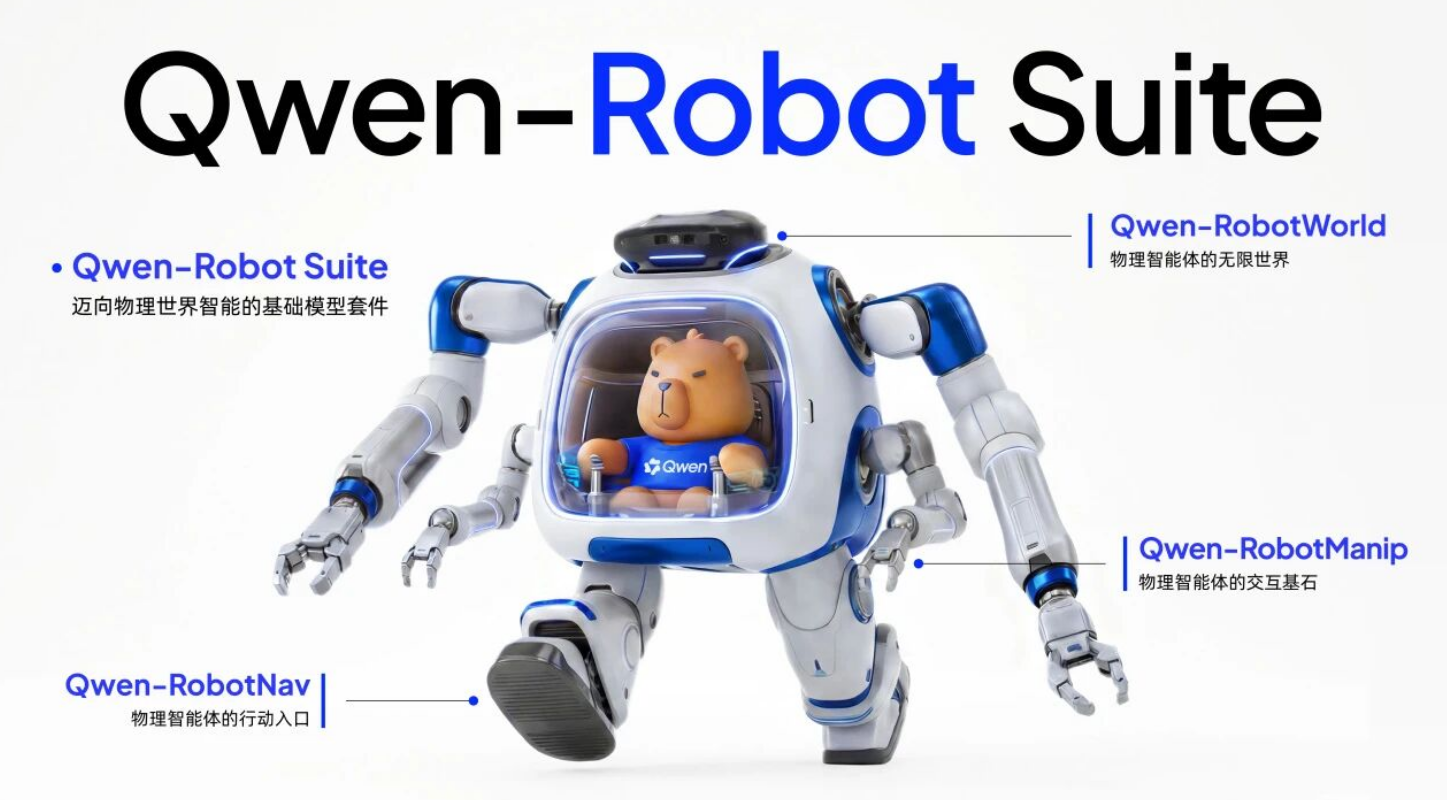
Qwen-Robot Suite — Alibaba's three foundation models for robots
Three open foundation models from Alibaba's Qwen team that move robot arms, navigate physical spaces, and predict what the world looks like next.
What is it?
Qwen-Robot Suite is Alibaba's first family of AI models built for robots instead of chatbots. The suite has three parts: Qwen-RobotManip for vision-language manipulation, Qwen-RobotNav for navigation (2B/4B/8B), and Qwen-RobotWorld — a video world model that predicts future frames given a natural-language goal.
How does it work?
Qwen-RobotManip (built on Qwen3.5-4B) maps heterogeneous robot training data into a shared 80-dimensional action space, letting one model train across different robot arms. Qwen-RobotNav ships with a controllable token budget to trade compute for accuracy at inference time; Qwen-RobotWorld uses a 60-layer MMDiT video model with a frozen Qwen2.5-VL encoder.
Why does it matter?
Most large LLM labs treat robotics as someone else's problem — Alibaba is now pushing Qwen into the physical world with public, reproducible components. Qwen-RobotManip ranks #1 on RoboChallenge Table30-v1 and Qwen-RobotNav posts 76.5% success rate on VLN-CE RxR.
Who is it for?
Robotics researchers and embodied AI teams looking for a public starting point for VLA, navigation, and world-model work.
|
|
|
|
PAPER
MAJOR
2026-06-16
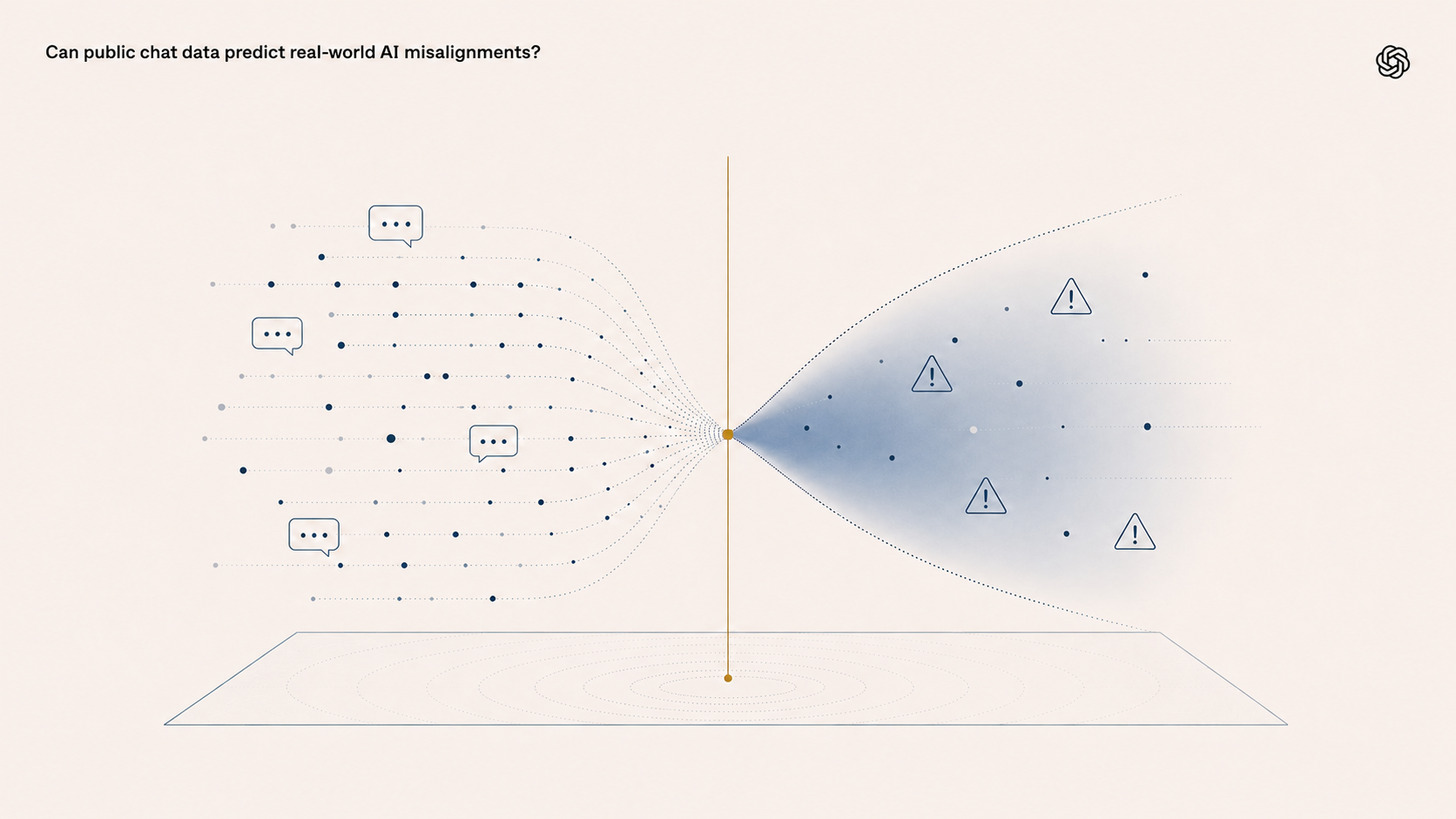
OpenAI Deployment Simulation — predict misbehavior before release
OpenAI estimates how a new model will behave in production by replaying real past conversations through it before release.
What is it?
Deployment Simulation is a pre-release safety evaluation method from OpenAI. It takes real production conversations, strips the assistant reply, and lets the candidate model answer in the same real context — then grades the new answers for undesired behavior across 20 misbehavior types.
How does it work?
OpenAI applied it to 1.3M de-identified conversations from GPT-5 Thinking through GPT-5.4 (August 2025 to March 2026), pre-registered predictions for GPT-5.4 Thinking, and compared simulated rates to post-launch production rates — reporting a median 1.5x multiplicative error and a detection floor of 1 in 200,000 messages.
Why does it matter?
Traditional evals like SWE-Bench are obviously tests — GPT-5.2 labels them as evaluations 100% of the time versus only 5.1% for Deployment Simulation traffic. Replaying real conversations catches behavior drift and reward hacking before they reach users.
Who is it for?
AI safety teams, evaluation researchers, and frontier-model auditors who need pre-deployment behavior forecasts they can actually trust.
|
|

|
|
REPO
MAJOR
2026-06-16
cuTile Rust v0.2.0 — NVIDIA Labs ships NVFP4 GPU kernels in safe Rust
cuTile Rust is NVIDIA Labs' safe tile-based GPU kernel DSL for Rust, now with NVFP4 packing and a new performance paper hitting 2 PFlop/s GEMM on B200.
What is it?
cuTile Rust is an open-source Rust DSL from NVIDIA Labs for writing safe, data-race-free GPU kernels with a tile-based memory model. v0.2.0 adds CUDA 13.3 low-precision support — NVFP4 packing, unpacking, and block-scaled matrix multiply — plus a new cutile-kernels crate of reusable inference primitives.
How does it work?
The release ships reproducibility artifacts for the Fearless Concurrency on the GPU paper (arXiv 2606.15991), which reports 7 TB/s element-wise and 2 PFlop/s GEMM throughput on NVIDIA B200. Rust code gets ownership-checked tensor handles, async kernel launches, and device pointers that can't outlive their lifetime.
Why does it matter?
Rust LLM runtimes can now compile their own GPU kernels using the same NVFP4 paths NVIDIA uses on Blackwell, without writing CUDA C++ or dispatching through a foreign-function boundary — closing a real gap for safety-critical inference systems.
Who is it for?
ML systems engineers, Rust GPU kernel authors, and NVFP4 inference researchers working on Blackwell hardware.
|
|

|
|
TOOL
NOTABLE
2026-06-17
CADAM v0.3.0 — open-source text-to-CAD web app from YC startup Adam
Describe a part in plain English, get a 3D CAD model back — runs entirely in your browser, GPL-3.0, 4.3k GitHub stars in a day.
What is it?
CADAM is an open-source browser tool from YC W25 startup Adam that turns a natural-language description (or a reference image) into a parametric 3D CAD model. It runs at adam.new/cadam with no install required and exports STL, SCAD, or DXF for printing, machining, or further editing.
How does it work?
CADAM sends the user's prompt to Claude via OpenRouter, which generates OpenSCAD code. The browser runs OpenSCAD compiled to WebAssembly to produce geometry, and Three.js renders the live 3D preview — users tweak parametric sliders and re-export without leaving the page.
Why does it matter?
Commercial text-to-CAD products are closed-source. CADAM gives makers and researchers a fully runnable, self-hostable reference stack for the entire client-side text-to-CAD pipeline — it hit 4.3k GitHub stars and 161 HN points within a day, signalling strong demand for an open base.
Who is it for?
Makers, mechanical designers, and CAD researchers who want a modifiable, self-hostable text-to-CAD pipeline they can wire into their own tools.
|
|
|
All releases at ai-tldr.dev
Simple explanations • No jargon • Updated daily
|
|