|
|
ECOSYSTEM
MAJOR
2026-06-16
SpaceX to Buy Cursor for $60B — stock deal days after blockbuster IPO
SpaceX is buying the maker of Cursor — the leading AI coding editor — in a $60B all-stock deal.
What is it?
SpaceX, fresh off its IPO, has agreed to acquire Anysphere — the company behind the Cursor AI coding editor — for $60 billion in stock. The deal is set to close in Q3 2026 if regulators clear it.
How does it work?
The purchase is structured entirely in SpaceX stock, with no cash component. SpaceX says Cursor will plug into its AI work, which is built around Elon Musk's xAI.
Why does it matter?
Cursor is the most-used AI coding editor among professional developers. A SpaceX/xAI owner changes the calculus for teams that picked Cursor for neutrality — and rivals like GitHub Copilot, Windsurf, and Continue are the immediate beneficiaries.
Who is it for?
Engineering leaders, Cursor users, and AI coding tool builders who need to decide whether to stay or switch.
|
|
|
|
SECURITY
MAJOR
2026-06-14
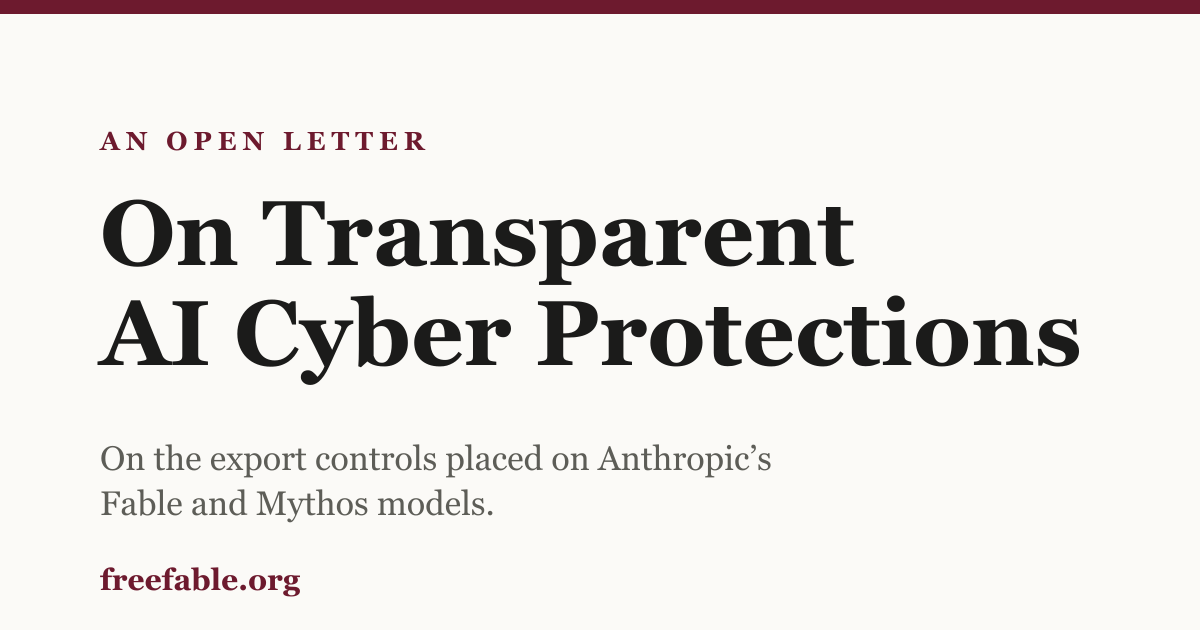
FreeFable — 300+ Security Leaders Ask the White House to Lift the Fable 5 Ban
Bruce Schneier, Alex Stamos, Katie Moussouris and 300+ security execs publicly ask the White House to reverse the Fable 5 and Mythos 5 export controls.
What is it?
An open letter signed by over 300 cybersecurity executives, researchers, and CISOs urging the White House to lift the export-control directive that took Anthropic's Fable 5 and Mythos 5 offline on June 12.
How does it work?
Moussouris — the only outside expert to read the third-party paper that triggered the ban — says the so-called jailbreak was researchers asking the model to "fix this code" after a "review for vulnerabilities" request was refused. The signatories argue this is standard defender work, not a novel exploit.
Why does it matter?
Cutting defenders off from frontier models while attackers can still reach equivalent systems is a strategic loss. This is the public counter-pressure on the directive — a major test of how AI export controls will be applied going forward.
Who is it for?
Security researchers, AI policy watchers, and anyone tracking the Fable 5 fallout from the June 12 suspension.
|
|

|
|
TOOL
MAJOR
2026-06-16
Android 17 Ships — Gemini Omni Video Editing, Lyria 3 Music, AudioLM
Android 17 lands on Pixel with three new Gemini capabilities: Omni video editing, Lyria 3 music generation, AudioLM translation.
What is it?
The next major Android release, paired with a Pixel Drop. Three new AI capabilities ship at the same time: Gemini Omni (edits videos inside chat), Lyria 3 (creates music from text and images), and AudioLM (on-device speech-to-translation on Pixel 10a).
How does it work?
Pixel devices get the update first on June 16. Gemini Omni edits clips you share into a chat, Lyria 3 generates short tracks from prompts and image references, and AudioLM handles real-time speech translation on-device.
Why does it matter?
Android 17 is the first OS release where a major model lineup ships as the OS update. Lyria 3 gives every Pixel user a music model in their pocket, and AudioLM translation runs entirely on-device — no cloud round-trip needed.
Who is it for?
Android developers, Pixel users, and mobile AI app builders who want to target these as platform features rather than separate apps.
|
|

|
|
TOOL
MAJOR
2026-06-15
Meta Launches 'AI Mode' on Facebook — Answers Built from Public Posts
Facebook now answers searches with AI summaries built from public posts, Groups, and Reels.
What is it?
A new search mode on Facebook where users ask questions in plain language and get an AI-written answer synthesized from public content — feed posts, Group discussions, and Reels — instead of a list of results.
How does it work?
When a user types a query, the system retrieves matching public posts and uses an LLM to write a short answer with links back to source posts. It follows the May 2026 launch of Forum, Meta's Reddit-style app, which already had its own 'Ask' AI tab.
Why does it matter?
This is Meta's first big consumer AI search surface outside of Meta AI itself, and stakes a claim that user-generated posts can power AI answers — very different from Google's web-index AI Overviews. Reliability concerns apply: the underlying posts are from everyday users, not vetted sources.
Who is it for?
Facebook users, social search teams, and AI safety researchers tracking how user-generated content gets wrapped into LLM answers.
|
|

|
|
MODEL
NOTABLE
2026-06-15
DreamX-World 1.0 — Alibaba AMAP Open-Sources an Interactive World Model
Open-source 5B world model that lets you steer the camera, revisit a scene, and stage events across photoreal, game, and stylized worlds.
What is it?
An interactive video world model from Alibaba's AMAP research group. Give it a starting image or prompt plus camera moves and event instructions, and it generates a coherent navigable video scene.
How does it work?
The model uses progressive training with camera-aware conditioning, geometry-guided memory for scene revisit, and a reinforcement-learning quality pass. A technique called Efficient PRoPE cuts inference latency by about 30% — reaching 16 fps on eight RTX 5090s.
Why does it matter?
World models combining free camera control with scene memory have mostly been closed (Genie, Oasis). Shipping a 5B Apache-2.0 checkpoint puts a comparable system in researchers' hands — 57–62% human-preference win rate over HY-WorldPlay 1.5 and LingBot-World.
Who is it for?
World-model researchers, robotics simulation teams, and game engine experimenters looking for an open, steerable video environment.
|
|

|
|
ALGORITHM
NOTABLE
2026-06-15
FastContext — Microsoft's Explore Subagent Cuts Coding-Agent Tokens by 60%
Small 4B subagent that searches the repo for a bigger coding model, lifting SWE-bench resolution by up to 5.5% while cutting main-agent tokens by 60%.
What is it?
A research release from Microsoft Research and Shanghai Jiao Tong University. It splits coding-agent work into two roles: a cheap exploration model that finds the right files and snippets, and a stronger model that does the actual reasoning over that focused context.
How does it work?
The explorer issues many code searches in parallel and returns short file-and-line evidence rather than full files. Trained from 4B to 30B parameters with SFT then RL, it's optimized to surface the right code with the fewest tokens — the main model then runs over only the distilled findings.
Why does it matter?
Coding agents hit a wall on large repos because context fills with irrelevant files. A specialized explorer raises SWE-bench Verified resolution by up to 5.5% while cutting 60% of the main model's token bill — it slots in as a callable tool for existing coding agents.
Who is it for?
Coding-agent builders and SWE-bench researchers running multi-step LLM agents over large codebases who want to cut costs without sacrificing resolution.
|
|
|
|
ARTICLE
NOTABLE
2026-06-15
Vicki Boykis: 'Running Local Models Is Good Now'
A working ML engineer says open-weights local models are finally usable for real coding work.
What is it?
An essay from Vicki Boykis, a founding ML engineer who builds recommendation systems at a startup. She walks through her current local-model setup and argues the on-device side has crossed a usability line in the last year.
How does it work?
She runs open-weights models — Gemma 4, Mistral 7B, several Qwen variants — through llama.cpp, Ollama, LM Studio, and Docker. She estimates they reach about 75% of frontier cloud accuracy on her agentic coding tasks.
Why does it matter?
The post hit 653 points on Hacker News. For developers who care about privacy, offline work, or avoiding API bills, the practical answer flipped from "not really" to "yes, with some patience." It also confirms the impact of recent Gemma 4 open-weights releases.
Who is it for?
Indie developers, privacy-conscious teams, and ML hobbyists who want a practitioner's honest take on the current state of local inference.
|
|
|
All releases at ai-tldr.dev
Simple explanations • No jargon • Updated daily
|
|