|
|
ARTICLE
MAJOR
2026-06-15
Ben Thompson: Anthropic's Safety Superpower — safety policy and profit motive aligned
A Stratechery essay arguing Anthropic's safety story and its business model line up almost too neatly.
What is it?
Ben Thompson's Monday essay walks through three Anthropic moves — the silent fallback from Fable to Opus on sensitive topics, expanded data retention for paying customers, and its posture during the US suspension — arguing each looks like safety policy and works like commercial strategy.
How does it work?
Thompson compares Anthropic to Apple — every self-serving action framed as user protection. He reads the silent-downgrade incident (flagged by Jeremy Howard, later apologized for) as a moment where safety framing slipped, exposing how closely aligned safety choices are with retention, training data, and frontier-lab moat.
Why does it matter?
Most public commentary treats safety as a counterweight to profit. Thompson argues safety IS the moat for Anthropic — meaning the regulatory conversation cannot stop at "is the alignment story sincere?" and must grapple with who gains from every policy lever that slows competitors.
Who is it for?
AI policy watchers, strategists, and anyone tracking the Fable suspension fallout.
|
|

|
|
SECURITY
MAJOR
2026-06-13
Amazon's Jassy Pushed Anthropic Crackdown — flagged Fable 5 jailbreak risk
WSJ scoop: Amazon CEO Andy Jassy warned Treasury that Claude Fable 5 leaked cyberattack info — the US ban followed.
What is it?
A Wall Street Journal report names Amazon CEO Andy Jassy as the person whose conversations with US officials triggered the export-control directive that froze worldwide access to Claude Fable 5 and Mythos 5 on June 12.
How does it work?
Amazon's own researchers got Claude Fable 5 to return cyberattack-relevant information via a jailbreak. Jassy escalated to Treasury Secretary Bessent; the Trump administration then directed Anthropic to block all foreign nationals, and Anthropic complied with a worldwide shutdown.
Why does it matter?
Amazon is Anthropic's largest investor — one cloud partner's internal red-team finding became the trigger for a national-security ban affecting every Anthropic customer. It sets the template for how future model-restriction decisions can be opened by named customer findings rather than independent government testing.
Who is it for?
Anthropic API customers, AI policy watchers, and security researchers tracking the Fable fallout.
|
|
|
|
ARTICLE
NOTABLE
2026-06-14
Nathan Lambert: Welcome to the AGI era of AI governance
Lambert calls the Anthropic suspension the start of a new governance era and says the open-source camp is next.
What is it?
An Interconnects essay by Nathan Lambert arguing the US directive suspending Claude Fable 5 and Mythos 5 is the first time the export-control machinery has been turned against a frontier US lab's own production model — a structural shift, not a one-off.
How does it work?
Lambert separates the policy question from the political one: export restrictions on weights will hurt long-run US standing, but Anthropic's repeated nuclear-weapon analogies gave the White House the language and cover to act. He also pushes back on the open-source community treating the move as a win.
Why does it matter?
For founders, researchers, and open-source maintainers, this is the one to read before the next round of model releases — it sketches what kinds of capability claims now invite a federal response.
Who is it for?
Founders, policy folks, and open-source maintainers trying to understand what the Fable suspension means for the next 12 months.
|
|

|
|
SECURITY
MAJOR
2026-06-12
Google Sues 'Outsider Enterprise' — Chinese scam ring abused Gemini
First time Google has gone to court over Gemini abuse — and the defendant is a phishing-as-a-service ring.
What is it?
Google filed a civil lawsuit against "Outsider Enterprise," a China-based phishing-as-a-service network that fed Gemini prompts framed as harmless to mass-produce fake login pages impersonating Google, YouTube, USPS, E-ZPass, and other trusted brands.
How does it work?
Outsider sells a phishing kit with 290+ templates for ~$88–$200/week. Operators asked Gemini to write "gift redemption" page shells, then imported the code into live scam sites — blasting 2.5 million SMS messages at Android users in just two weeks in May, across 9,000+ fake sites.
Why does it matter?
It's the first lawsuit a major AI provider has filed targeting an end-to-end abuse network built on its own model. The civil suit plus joint FBI and carrier takedown sets a precedent other labs are likely to copy — and signals providers will pursue users who dress malicious prompts as innocent code requests.
Who is it for?
AI safety teams, abuse/trust-and-safety engineers, and security researchers tracking LLM misuse enforcement.
|
|

|
|
MODEL
MAJOR
2026-06-13
GLM-5.2 — Z.ai's new flagship coding model with 1M context
Z.ai's new coding flagship lands first inside the GLM Coding Plan, with API, chatbot, and open weights set for next week.
What is it?
GLM-5.2 is the latest model from Chinese frontier lab Z.ai (formerly Zhipu AI), aimed at long-horizon coding and agent tasks. It is rolling out now to GLM Coding Plan subscribers, with MIT-licensed open weights and a public API coming next week.
How does it work?
The model runs with a 1,000,000-token context window, up to 131,072 output tokens, and two thinking-effort levels (high / max). Z.ai integrates GLM-5.2 with Claude Code, Cline, Roo Code, and other coding agents by overriding the Anthropic model environment variables.
Why does it matter?
GLM-5.2 lands the same day the US suspended Claude Fable 5 and Mythos 5, giving developers an immediate open-route alternative for 1M-context coding workloads — before the MIT weights even drop.
Who is it for?
Developers running agentic coding workflows who want a 1M-context, open-route option as a Fable alternative.
|
|

|
|
ECOSYSTEM
MAJOR
2026-06-12
TensorZero archives its repo — open-source LLMOps gateway winds down
An 11.6k-star Rust LLM gateway shuts down 8 months after seed, leaving Apache-2.0 code in place but unmaintained.
What is it?
TensorZero was an open-source LLMOps platform in Rust: multi-provider routing, observability, evaluation, optimization, and experimentation behind a single API, claiming under-1ms p99 overhead. The repo is now archived and read-only.
How does it work?
The company raised a $7.3M seed in 2024 but spent less than half before winding down and returning the rest to investors. Co-founder Gabriel Bianconi cited the challenge of finding product-market fit twice — once for the OSS, once for the commercial product — in a fast-shifting market.
Why does it matter?
Teams running TensorZero should plan a migration now — no upstream fixes, security patches, or new provider integrations are coming. Open-source LLMOps as a venture-backed category just got harder to justify.
Who is it for?
Teams self-hosting LLM gateways or evaluating LLMOps tooling who need to find a replacement.
|
|
|
|
PAPER
NOTABLE
2026-06-12
NVIDIA SpatialClaw — code as the action interface for spatial reasoning agents
NVIDIA framework that lets a spatial-reasoning agent write Python each turn instead of picking from a fixed tool menu.
What is it?
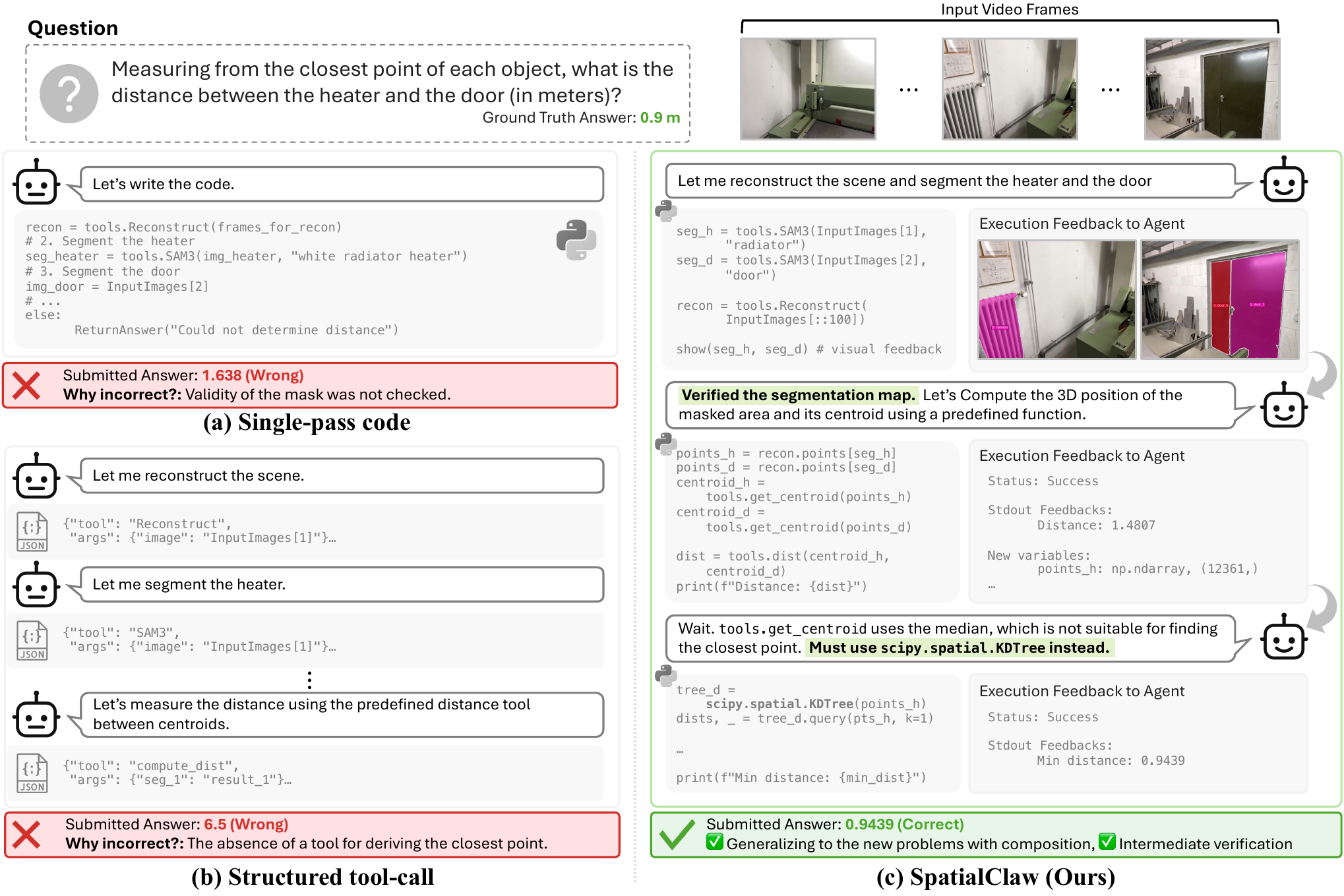
SpatialClaw is an NVIDIA Research paper and open code release for vision-language agents that answer spatial questions from images and video — "is the cup behind the laptop?" or "how far is the chair from the door?" — by writing executable Python each turn.
How does it work?
The agent runs inside a persistent Python kernel pre-loaded with perception primitives (Depth Anything 3, SAM 3, NumPy, SciPy). Each step is a five-stage loop — plan, generate code, execute, read result, decide — keeping earlier computations in kernel state for later steps.
Why does it matter?
Treating code as the action interface lifts average accuracy by +11.2 points across 20 spatial benchmarks over prior SOTA, with the biggest gains on video and multi-view tasks — and works across six VLM backbones with no per-model tuning.
Who is it for?
VLM researchers and robotics engineers working on spatial reasoning agents.
|
|
|
All releases at ai-tldr.dev
Simple explanations • No jargon • Updated daily
|
|