
|
|
ARTICLE
MAJOR
2026-06-04
When AI Builds Itself — Anthropic Publishes Internal Numbers on Recursive Self-Improvement
Anthropic argues AI is already automating its own development cycle, and full recursive self-improvement may arrive before any verification regime exists.
What is it?
An Anthropic Institute essay by Marina Favaro and Jack Clark laying out three near-future scenarios — wide diffusion, compounding human-supervised efficiency gains, and full recursive self-improvement — where AI systems design, debug, and ship the next generation of AI.
How does it work?
The authors back the argument with internal data: engineers now merge ~8× more code per quarter vs 2024, over 80% of merged production code in May 2026 was authored by Claude, and Claude shipped 800+ PRs in April that cut a class of API errors by a factor of one thousand.
Why does it matter?
It's the first time a frontier lab has published concrete internal productivity numbers alongside a near-term recursive self-improvement timeline — Jack Clark separately gave >50% odds by end of 2028, reframing the safety conversation around timelines policymakers haven't begun preparing for.
Who is it for?
AI policy researchers, lab leadership, governance funders, and engineers tracking labor-displacement curves.
|
|
|
|
MODEL
MAJOR
2026-06-04
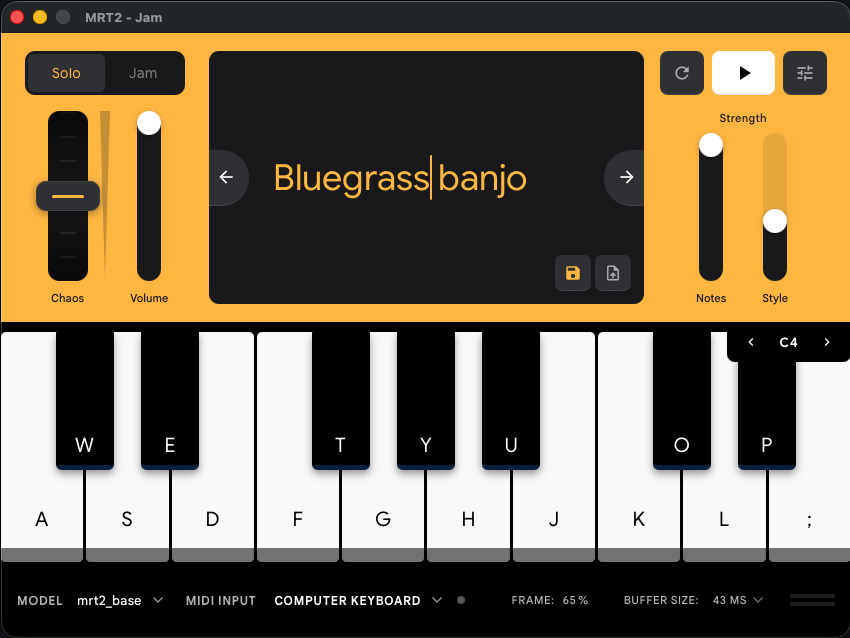
Magenta RealTime 2 — Google's Open-Weights Live Music Model With ~200ms Control Latency
An open-weights live music model that responds to MIDI, text, and audio in ~200ms and runs entirely on your MacBook.
What is it?
Magenta RealTime 2 (MRT2) is Google DeepMind's open-weights model for continuous, low-latency musical audio generation, available in 2.4B and 230M variants under CC BY 4.0 with Apache 2.0 code and a DAW plugin bundle.
How does it work?
MRT2 switches from v1's 2-second chunks to 40ms frames with frame-level autoregression and sliding-window attention, cutting end-to-end control latency from ~3s to ~200ms; a new C++/MLX engine runs the base model natively on M3 Pro / M2 Max MacBooks.
Why does it matter?
It's the only open-weights model supporting real-time continuous music generation at instrument-class latency — musicians can play it live via MIDI or use it inside a DAW without sending audio to a cloud API.
Who is it for?
Musicians, producers, music-software developers, and generative audio researchers.
|
|

|
|
MODEL
MAJOR
2026-06-03
Ideogram 4.0 — 9.3B Open-Weight Text-to-Image Model, #1 on DesignArena Open-Weight Leaderboard
Ideogram's first open-weight image model — 9.3B params, native 2K output, JSON-controlled layouts, and SOTA text rendering for design.
What is it?
Ideogram 4.0 is a 9.3B-parameter flow-matching diffusion transformer — the company's first downloadable open-weight model — with Apache 2.0 inference code; weights are gated behind a non-commercial license, with commercial use kept on Ideogram's paid API.
How does it work?
The model uses Qwen3-VL-8B-Instruct as its text encoder, supports resolutions from 256 to 2048px in multiples of 16, and accepts structured JSON prompts with bounding-box element placements and hex color palettes alongside natural language.
Why does it matter?
It ranks #1 among open-weight entries on DesignArena and beats models up to 80B parameters on text rendering at roughly a third of the parameter count — the strongest open-weight design image model to date.
Who is it for?
Designers, ML researchers, and image-tooling builders who want to run a near-SOTA text-render model on their own GPU.
|
|

|
|
TOOL
MAJOR
2026-06-04
Apple Approves Poke — First Third-Party AI Agent on iMessage, Four Days Before WWDC
Apple finally cleared an outside AI agent for iMessage — Poke users can now ping the assistant from the native Messages app on iPhone.
What is it?
Poke, a personal AI assistant from the Interaction Company of California, became the first third-party consumer AI agent approved on Apple's Messages for Business platform — opening iMessage distribution to outside AI agents for the first time.
How does it work?
Apple required Poke to identify itself as an AI on first contact and support human handoff; Poke can now be added as an iMessage contact alongside SMS, Telegram, and Signal channels, with Apple charging a per-user fee that von Hagen says is lower than what Meta AI pays.
Why does it matter?
This is the first time Apple has let a third-party consumer AI agent into iMessage — the platform with the deepest US distribution — arriving four days before WWDC 2026 and giving indie agent startups a credible distribution path that doesn't require a stand-alone app.
Who is it for?
iPhone users, AI agent startups, and product teams building consumer messaging AI.
|
|

|
|
SECURITY
MAJOR
2026-06-03
U of T CleverHans Lab: AI Agents Enable Adaptive Worms That Compromise ~75% of a Network With Zero Human Input
U of T's CleverHans Lab shows an open-weight LLM running locally on a captured host can power a worm that pivots through a corporate network, no humans needed.
What is it?
A new arXiv paper from six U of T CleverHans Lab researchers demonstrates a worm that installs an open-weight LLM on each captured host, using that local model to plan tailored attacks on subsequent targets — compromising ~75% of a 33-machine simulated network in one week with no human input.
How does it work?
The worm harvests credentials, fingerprints each device, ingests live public vulnerability advisories to exploit flaws the model never saw in training, and tailors per-host attacks across Linux, Windows, and IoT targets — with marginal infection cost approaching zero once a single host is captured.
Why does it matter?
Adaptive reasoning-based malware is now operationally feasible on commodity open-weight models, meaning centralized API gating and provider-side safety controls cannot stop it — the paper changes the threat model for the entire security industry.
Who is it for?
Security researchers, blue teams, AI safety and misuse policy researchers, frontier-lab safety teams, and CISOs.
|
|

|
|
ECOSYSTEM
MAJOR
2026-06-03
NVIDIA Acquires Kumo AI for >$400M — Predictive Foundation Model for Enterprise Data Warehouses
NVIDIA buys predictive-foundation-model maker Kumo AI to bolt structured-data inference onto its enterprise stack — customers include Reddit, DoorDash, and Walmart.
What is it?
Kumo AI built KumoRFM, a relational foundation model that answers predictive questions — churn risk, fraud likelihood, lifetime value — directly on a customer's Snowflake or Databricks warehouse; NVIDIA acquired the four-year-old startup for more than $400M and absorbed all three cofounders.
How does it work?
KumoRFM pretrains on billions of relational patterns by treating a warehouse schema as a graph of nodes and edges, then fine-tunes to a customer's specific schema; it claims 89% accuracy on the SAP SALT benchmark vs 75% for an XGBoost baseline and 63% for GPT-4 with AutoML.
Why does it matter?
NVIDIA already sells GPUs to every enterprise running predictive analytics — owning the foundation model on top lets it package the inference layer alongside hardware for Snowflake, Databricks, and SAP shops, adding a customer list that includes Reddit, DoorDash, and Walmart.
Who is it for?
Enterprise data teams, NVIDIA partners on Snowflake and Databricks, and predictive-analytics buyers.
|
|

|
|
ECOSYSTEM
MAJOR
2026-06-03
Lovable Locks Multi-Year 5× Google Cloud Deal — Claude + Gemini Access, Wiz Security, Enterprise Agent Gallery
Lovable bets its enterprise growth on Google Cloud — 5× compute footprint, Claude + Gemini access, Wiz security plumbing, and a slot in the Gemini Enterprise Agent Gallery.
What is it?
Lovable, a Stockholm AI app-building platform at $400M+ ARR, signed a multi-year deal to grow its Google Cloud footprint fivefold — gaining access to Anthropic Claude and Google Gemini models via Vertex AI and a listing in the Gemini Enterprise Agent Gallery.
How does it work?
Lovable agents get Claude and Gemini models through Vertex AI; the Lovable Agent is listed in Google's Enterprise Agent Gallery for Cloud Marketplace billing; and a Wiz integration scans and remediates vulnerabilities in Lovable-generated apps in real time.
Why does it matter?
It's the clearest sign yet that hyperscalers are willing to host coding agents that route to a rival lab's model — Google Cloud is now happy to charge for Claude traffic — while giving Lovable a Cloud Marketplace billing path that removes key enterprise-procurement friction.
Who is it for?
Enterprise engineering and procurement leads evaluating AI coding tools; founders watching distribution dynamics between hyperscalers and model labs.
|
|

|
|
ECOSYSTEM
MAJOR
2026-06-04
Canada Launches 'AI for All' — $1B+ Compute Fund, Public Supercomputer, 250,000-Job Target by 2031
PM Mark Carney's first AI strategy puts more than $1B behind sovereign compute, a public supercomputer, and a 250,000-job target by 2031.
What is it?
AI for All is Canada's first national AI strategy, announced by PM Mark Carney on June 4, 2026 — organized around six pillars covering sovereignty, trust, adoption, and global alliances, with a five-year target of $200B in additional GDP and 250,000 AI jobs.
How does it work?
Ottawa adds $700M to the AI Compute Access Fund (bringing it to ~$1B), launches a C$500M tech fund for homegrown AI firms, commits $200M to an AI Missions Program for health outcomes, and begins building a public AI supercomputer alongside expanding sovereign cloud and talent programs like the CIFAR AI Chairs.
Why does it matter?
Canada hosts Vector Institute, MILA, and Amii, but corporate AI adoption sits at ~12% — the strategy sets an explicit 60%-by-2034 target and draws a sovereignty line on compute, joining the UK and US as the third major Western government AI move in two weeks.
Who is it for?
Policymakers, Canadian AI builders, researchers, founders, and enterprises tracking sovereign AI strategy.
|
|
|
All releases at ai-tldr.dev
Simple explanations • No jargon • Updated daily
|
|