|
|
MODEL
MAJOR
2026-06-03
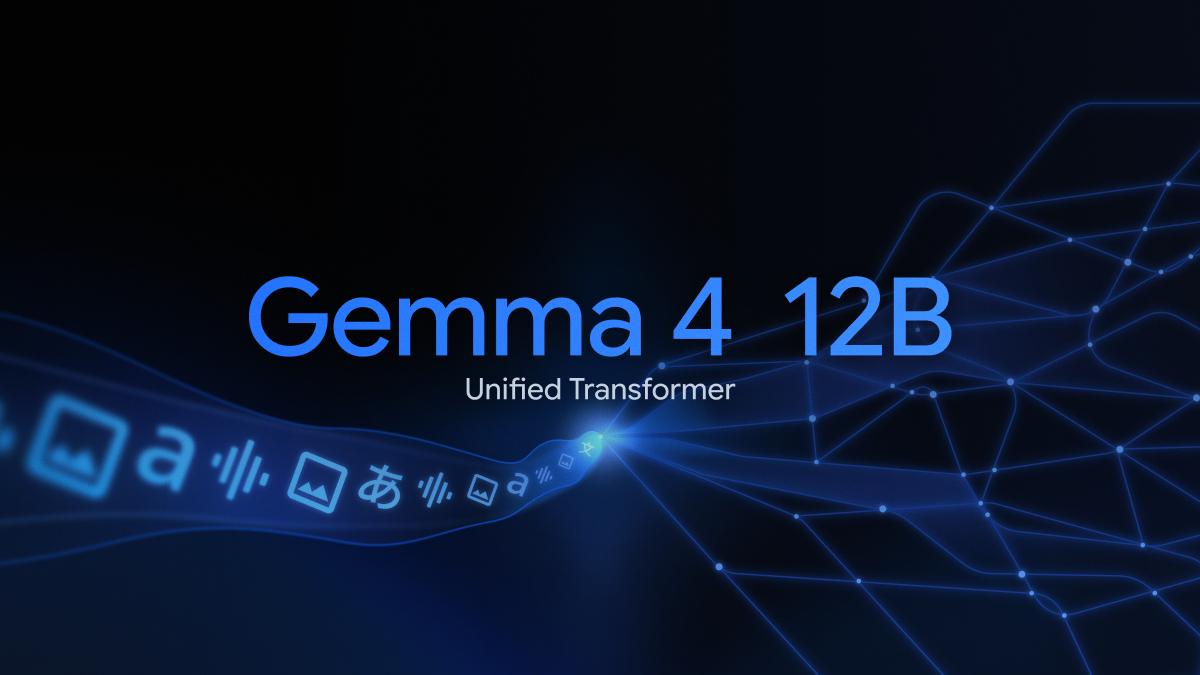
Gemma 4 12B — Google's Encoder-Free Open Multimodal Model
A 12B open multimodal model that lets raw audio and video patches skip the encoder and hit the LLM directly.
What is it?
Gemma 4 12B is Google DeepMind's first medium-sized model that ingests text, image, audio, and video without separate encoders. Weights are on Hugging Face under Apache 2.0, designed to fit a 16GB laptop GPU.
How does it work?
A 35M-parameter vision embedder projects raw 48×48 RGB patches and 40ms audio frames straight into the LLM's hidden dimension — no vision tower, no speech encoder. The 48-layer transformer supports 256K context and multi-token prediction for faster decoding.
Why does it matter?
Removing encoders cuts memory and latency for multimodal pipelines. Benchmarks include 77.2 MMLU-Pro, 77.5 AIME 2026, and 78.8 GPQA Diamond — close to the larger Gemma 4 26B MoE at less than half the memory.
Who is it for?
On-device app builders, agent developers, and labs that want a permissively licensed multimodal model that runs on commodity hardware.
|
|

|
|
ECOSYSTEM
MAJOR
2026-06-03
NVIDIA Acquires Kumo AI for Over $400M
NVIDIA buys predictive-foundation-model maker Kumo AI for >$400M to bolt structured-data inference onto its enterprise stack.
What is it?
Kumo AI built KumoRFM, a relational foundation model that answers predictive questions — churn risk, fraud likelihood, lifetime value — directly on a customer's data warehouse. NVIDIA acquired the four-year-old startup for more than $400M and absorbed all three cofounders.
How does it work?
KumoRFM pretrains on relational patterns by treating a warehouse schema as a graph of nodes and edges. It fine-tunes to a specific Snowflake or Databricks schema, then answers SQL-like natural-language queries with calibrated predictions — hitting 89% on the SAP SALT benchmark vs. 75% for XGBoost.
Why does it matter?
NVIDIA already sells GPUs to every enterprise running predictive analytics. Owning the foundation model on top lets it package the inference layer for Snowflake, Databricks, and SAP shops — plus inherit a customer list including Reddit, DoorDash, and Walmart.
Who is it for?
Enterprise data teams, NVIDIA partners on Snowflake/Databricks, and predictive-analytics buyers evaluating structured-data AI.
|
|
|
|
TOOL
MAJOR
2026-06-02
Cognition Renames Windsurf to Devin Desktop
Windsurf becomes Devin Desktop — an agent-first IDE where a Kanban Command Center, not the editor, is the home view.
What is it?
Cognition rebranded the Windsurf IDE as Devin Desktop. All editor settings, extensions, and pricing carry over via OTA update, but the surface is now rebuilt around managing multiple AI coding agents at once.
How does it work?
The home view is the Agent Command Center — a Kanban of every running agent sorted by status. Devin Local replaces Cascade, rewritten in Rust for ~30% better token efficiency. Agent Client Protocol (ACP) lets Claude Agent, Codex, and OpenCode plug into the same UI alongside Devin.
Why does it matter?
This is the first major IDE to make agent management the default view rather than a side panel — codifying the bet that coding tools are agent-management tools. Cascade sunsets July 1, 2026.
Who is it for?
Teams running multiple AI coding agents in parallel who want a single UI to triage in-flight work across local, cloud, and third-party agents.
|
|

|
|
ECOSYSTEM
MAJOR
2026-06-03
UK CMA Hits Google With World-First AI Search Opt-Out Requirement
The first regulator on Earth to force a frontier AI Search opt-out — UK publishers can now refuse AI Overviews, AI Mode, and fine-tuning without a ranking penalty.
What is it?
The UK Competition and Markets Authority finalized its first Conduct Requirement against Google under the Digital Markets regime, specifically targeting generative-AI search features including AI Overviews, AI Mode, and AI fine-tuning.
How does it work?
Within nine months, Google must add controls in Search Console letting UK publishers opt out of AI Overviews, AI Mode, and fine-tuning — separately — without ranking penalties. Google must also attribute content with clear links, and submit compliance reports every six months.
Why does it matter?
Until now publishers faced a binary: opt out of Google entirely or accept AI scraping. The UK broke that. The CMA explicitly framed this as a global precedent, and EU DMA and AI Act enforcement regimes have similar tools ready.
Who is it for?
UK publishers, news organizations, and AI lab licensing teams — and antitrust regulators in the EU and US watching for a template.
| UK Competition and Markets Authority |
DETAILS → |
|
|

|
|
MODEL
MAJOR
2026-06-02
H Company Open-Sources Holo3.1 — Computer-Use VLM at 0.8B–35B
An Apache 2.0 computer-use VLM family that runs locally on consumer GPUs and now drives mobile as well as desktop.
What is it?
Holo3.1 is H Company's open-weights vision-language model family for computer-use agents — models that look at a screen and decide where to click or type. Four sizes: 0.8B, 4B, 9B, and 35B-A3B (MoE), all Apache 2.0.
How does it work?
Each model takes a screenshot plus an instruction and emits structured click/type/scroll actions via native function-calling. Training extended to Android, lifting the 35B's AndroidWorld score from 67% to 79.3%. NVFP4 quantization delivers 1.74× throughput, cutting step time from 6.8s to 3.3s on a DGX Spark.
Why does it matter?
A 4B variant that fits on a 12GB consumer GPU and a 35B-A3B that runs on a single workstation move local desktop and phone automation out of demo territory — critical for enterprises that can't stream screenshots to a cloud API.
Who is it for?
Agent builders, RPA teams, and on-device automation researchers who need an offline, permissively licensed computer-use model.
|
|

|
|
SECURITY
MAJOR
2026-06-03
Anthropic Frontier Red Team: 67% of Banned Operators Used Claude to Write Malware
Anthropic's threat-intel team mapped a year of Claude misuse to MITRE ATT&CK and found AI is now lifting low-skill attackers into deep post-compromise work.
What is it?
A research write-up from Anthropic's Frontier Red Team examining 832 accounts banned for malicious cyber activity between March 2025 and March 2026, with findings contributed to the Verizon 2026 DBIR.
How does it work?
Researchers tagged each banned session against MITRE ATT&CK techniques. 67.3% of operators used Claude to write malware; 6.5% used it for lateral movement inside compromised networks. Medium-or-higher-risk operators climbed from 33% to 56% over the year.
Why does it matter?
AI is being used in the later, autonomy-heavy stages of attacks — not just phishing emails. That erodes the old skill-based risk gradient and exposes gaps in MITRE ATT&CK's vocabulary for agentic orchestration that defenders rely on for detection engineering.
Who is it for?
CISOs, threat-intel teams, SOC engineers, and AI safety researchers tracking the real-world misuse trajectory of frontier models.
|
|
|
All releases at ai-tldr.dev
Simple explanations • No jargon • Updated daily
|
|