|
|
MODEL
MAJOR
2026-06-01
NVIDIA Nemotron 3 Ultra
NVIDIA's biggest open-weights model: a 550B Mamba-Transformer MoE that beats every other US open model on intelligence and inference speed.
What is it?
Nemotron 3 Ultra is NVIDIA's flagship open-weights model — a 550B total / 55B active Mamba-Transformer mixture-of-experts targeting coding, research, and long-running agentic workflows. It ships with a 1M-token context window and NVFP4 quantization.
How does it work?
Mamba blocks handle long sequences with linear-cost attention while Transformer MoE layers route tokens to ~10% of the 550B parameters per step, hitting 300+ tokens/sec on DeepInfra and natively post-training for agent frameworks like LangChain Deep Agents and OpenHands.
Why does it matter?
At 48 on the Artificial Analysis Intelligence Index, it's now the smartest US open-weights model — well ahead of Gemma 4 31B (39) — and 5× faster than comparable open models, making it viable for latency-sensitive production agent loops.
Who is it for?
Agent builders and inference platforms that want open weights with frontier intelligence but can't afford GPT-5.5 or Claude Opus pricing.
|
|
|
|
ECOSYSTEM
MAJOR
2026-06-01
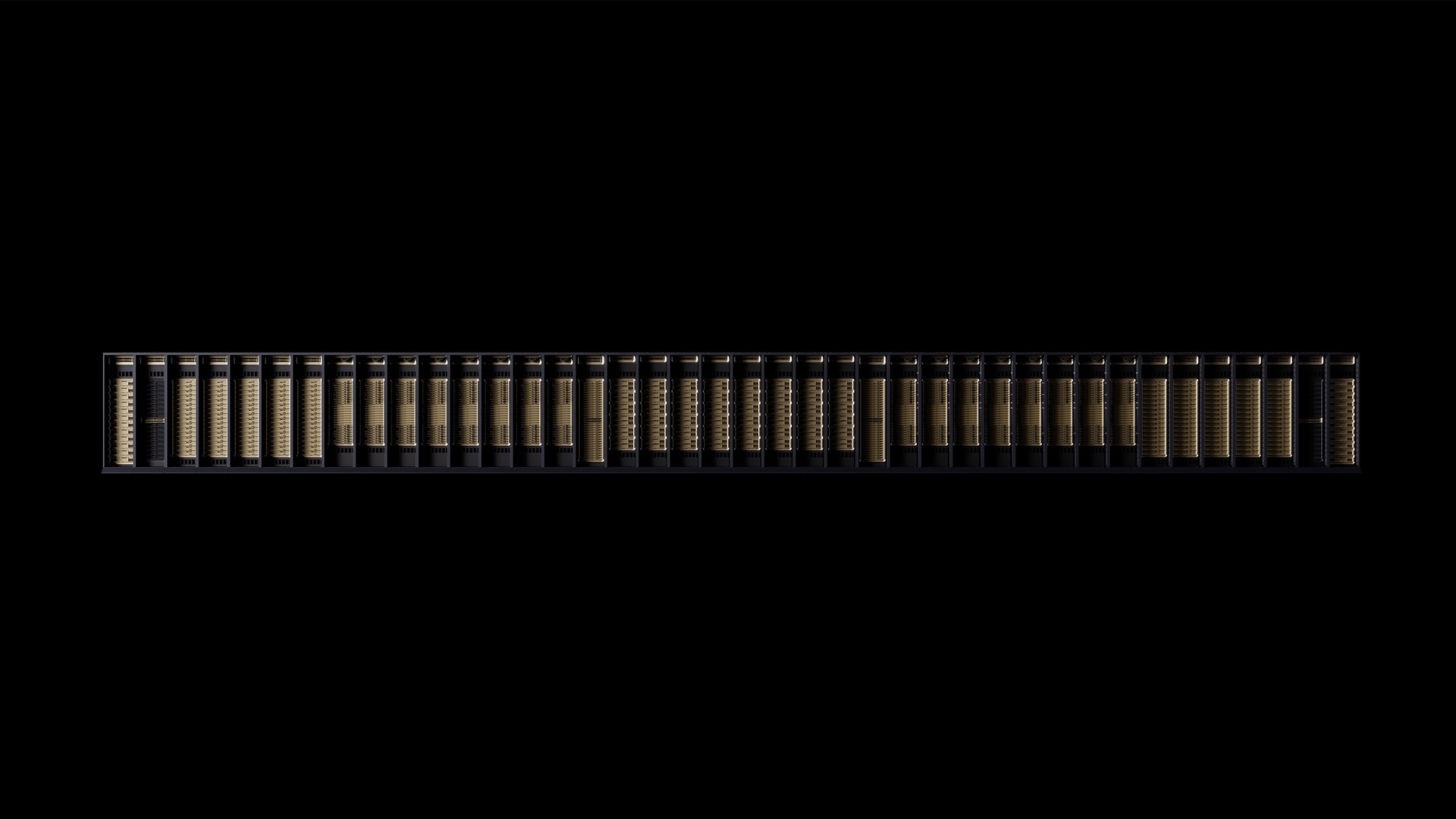
NVIDIA Vera Rubin Hits Full Production
NVIDIA's Vera Rubin AI factory platform is now in volume production, with NVL72 racks shipping fall 2026.
What is it?
Vera Rubin is NVIDIA's next-generation rack-scale AI compute platform succeeding Grace Blackwell. The flagship NVL72 combines 72 Rubin GPUs, 36 Vera CPUs, NVLink 6, BlueField-4, and Spectrum-X in one liquid-cooled rack delivering 3,600 PFLOPS of NVFP4 inference and 20.7 TB of HBM4 memory.
How does it work?
Five NVL72 racks compose into a single agentic AI supercomputer via 260 TB/s NVLink Switch bandwidth. NVIDIA's third-gen MGX reference design lets 150+ Taiwanese suppliers build the platform across 350+ factories.
Why does it matter?
NVIDIA claims Vera Rubin trains MoE models with one-quarter the GPUs of Blackwell and 10× lower inference cost per token — production ramping now means hyperscalers can start ordering next-gen factory capacity for 2027.
Who is it for?
Hyperscalers and frontier AI labs planning 2026–2027 capacity expansions.
|
|

|
|
TOOL
MAJOR
2026-06-02
Microsoft Scout — Always-On M365 Autopilot Agent
Microsoft's first Autopilot agent: an always-on M365 worker with its own identity, audit trail, and OpenClaw foundation.
What is it?
Scout is Microsoft's first persistent background agent with its own Entra identity that acts on the user's behalf across Teams, Outlook, OneDrive, and SharePoint. It ships today to M365 Frontier customers and extends to the browser and any MCP-connected app via a desktop app.
How does it work?
Built on the open-source OpenClaw framework, Scout uses a Work IQ memory layer that tracks user habits and priorities over time. A built-in policy conformance system continuously checks Scout's behavior against org guardrails and emits an audit trail per check.
Why does it matter?
It's Microsoft's first "always-on agent with its own identity" packaged for enterprise IT rather than developers — a direct shot at Anthropic Cowork and OpenAI Workspace Agents, betting Entra identity and Purview audit trails win procurement over raw capability.
Who is it for?
Microsoft 365 admins, F500 IT teams, and enterprise agent-platform evaluators.
|
|
|
|
MODEL
MAJOR
2026-06-01
MiniMax M3
M3 packages frontier coding, a million-token context, and native multimodality into one open-weight model.
What is it?
M3 is MiniMax's new open-weights model with a 1M-token context window, 59% on SWE-Bench Pro, and native multimodality (image, video, desktop operation) trained in from the start — the first open-weight model claiming all three at once.
How does it work?
MiniMax Sparse Attention (MSA) pairs softmax expressiveness with top-k block selection for sub-quadratic complexity at long contexts — reporting 9× prefill and 15× decoding speedups over M2 at 1M tokens, using roughly 1/20th the per-token compute.
Why does it matter?
Open-weight models with real 1M-token context and multimodal grounding have been nearly nonexistent. If the weights ship as advertised, M3 handles long-repo coding, computer use, and visual grounding in a single self-hosted checkpoint.
Who is it for?
Open-weight enthusiasts, agentic-coding builders, and long-context power users who want a single self-hosted model for multimodal work.
|
|

|
|
TOOL
MAJOR
2026-06-02
OpenAI Codex Goes White-Collar
Codex stops being a coding tool — six new role plugins ship Codex into the analyst, banker, and sales workflow.
What is it?
OpenAI shipped six Codex role plugins — Data Analytics, Creative Production, Sales, Product Design, Public Equity Investing, and Investment Banking — bundling 62 apps and 110 skills so non-engineers can pull Codex into a real job without any setup. Codex now reports 5M+ weekly users, 20% non-developer.
How does it work?
Each plugin bundles skills, app integrations (Gmail, Slack, Drive, GitHub), and MCP servers. The Public Equity Investing plugin wires Codex to Moody's, FactSet, LSEG, PitchBook, and Hebbia so the agent can review earnings and stress-test theses without the user gluing pipelines together.
Why does it matter?
It's the first concrete sign OpenAI is verticalizing Codex into finance and consulting — the same surface Anthropic has been pushing with Claude for Financial Services. Enterprise procurement shifts from "pick a chat model" to "pick a role-specific agent."
Who is it for?
Equity analysts, investment bankers, sales teams, and data analysts evaluating agent platforms.
|
|

|
|
ECOSYSTEM
MAJOR
2026-06-02
Uber Caps Employee AI Coding Spend at $1,500/Tool/Month
Uber blew through its annual AI coding budget in four months and now caps every engineer at $1,500/tool/month on Claude Code and Cursor.
What is it?
Uber became the first large public-company case study in agentic-coding budget overruns. Engineers were billing $500–$2,000/month on Claude Code and Cursor, exhausting the full 2026 AI budget by April. The new policy caps spend at $1,500/tool/month tracked on an internal dashboard.
How does it work?
Caps apply only to agentic coding tools. Engineers can exceed the cap with manager approval. Token usage is logged centrally so finance can attribute cost back to specific teams and projects.
Why does it matter?
It's the first time a Fortune 500 company put a public ceiling on engineer-facing AI spend — spooking Uber stock (-3.1%) and amplifying the ROI debate. COO Andrew Macdonald said it's "very hard to draw a line" between token usage and shipped features.
Who is it for?
Engineering leaders, finance teams, and AI tool vendors negotiating enterprise contracts.
|
|

|
|
MODEL
MAJOR
2026-06-02
Microsoft Aion 1.0 — On-Device Windows AI Model Line
Microsoft ships a Windows-native AI model line: a small Instruct SLM for everyday text tasks and a 14B agentic Plan model that runs in-box.
What is it?
Aion 1.0 is Microsoft's new on-device Windows AI model family debuted at Build 2026. Aion 1.0 Instruct is a small, fast SLM for everyday text intelligence; Aion 1.0 Plan is a 14B reasoning and tool-calling model with a 32K context window built for fully agentic on-device workflows.
How does it work?
Instruct runs across CPUs, GPUs, and NPUs (Edge Insider preview now, Hugging Face in July 2026). Plan ships in-box on capable Windows PCs and exposes structured outputs and tool-call orchestration so apps can reason over user intent and invoke local tools without a cloud API key.
Why does it matter?
Aion makes a frontier-class agent loop a first-party Windows capability, shipping across the Windows install base. For app developers it means a Windows-guaranteed agentic runtime without a cloud API key; for users it shifts file orchestration and app automation onto the PC.
Who is it for?
Windows app developers, on-device agent builders, and enterprise IT planning local AI deployments.
|
|
|
All releases at ai-tldr.dev
Simple explanations • No jargon • Updated daily
|
|