|
|
ARTICLE
MAJOR
2026-07-02
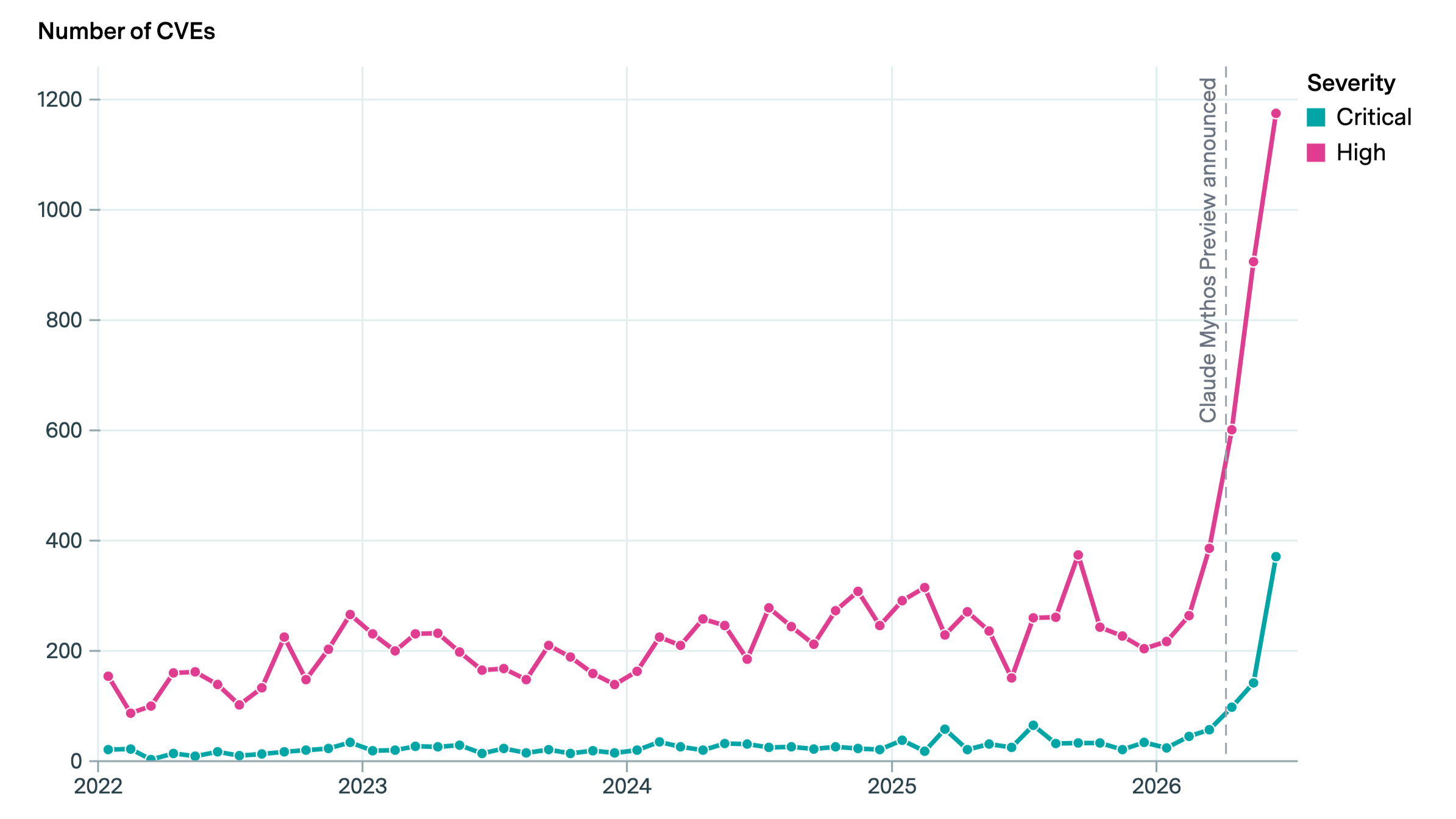
Epoch AI — CVE severity spike after Claude Mythos Preview
Epoch AI tracks a 3.5× jump in serious CVE fixes at 21 top vendors after Anthropic put Claude Mythos on autonomous vulnerability hunting.
What is it?
A data-insights post by Epoch AI arguing that Anthropic's Claude Mythos Preview and its Project Glasswing vulnerability effort are now visible in the world's CVE feeds. The team counted high- and critical-severity CVE fixes from 21 major vendors — Microsoft, Google, Apple, Adobe, Cisco — from 2024 into June 2026 and charted monthly totals.
How does it work?
Epoch focused on 21 notable organizations to filter out low-signal advisories, counting only high- and critical-severity fixes. June 2026 stands out sharply: roughly 1,500 fixes in a single month — more than 3.5× the previous monthly record — arriving right as Anthropic ramped Mythos-based vulnerability discovery through Project Glasswing.
Why does it matter?
AI-assisted vulnerability finding appears to have broken out of internal reports and into public CVE feeds. If Project Glasswing already found 10,000+ serious bugs and most are still undisclosed, June's spike is likely only the leading edge of a sustained wave of patch traffic.
Who is it for?
Security teams, vendor PSIRTs, policy watchers, and AI safety researchers tracking the real-world impact of autonomous vulnerability hunting.
|
|
|
|
TOOL
MAJOR
2026-07-02
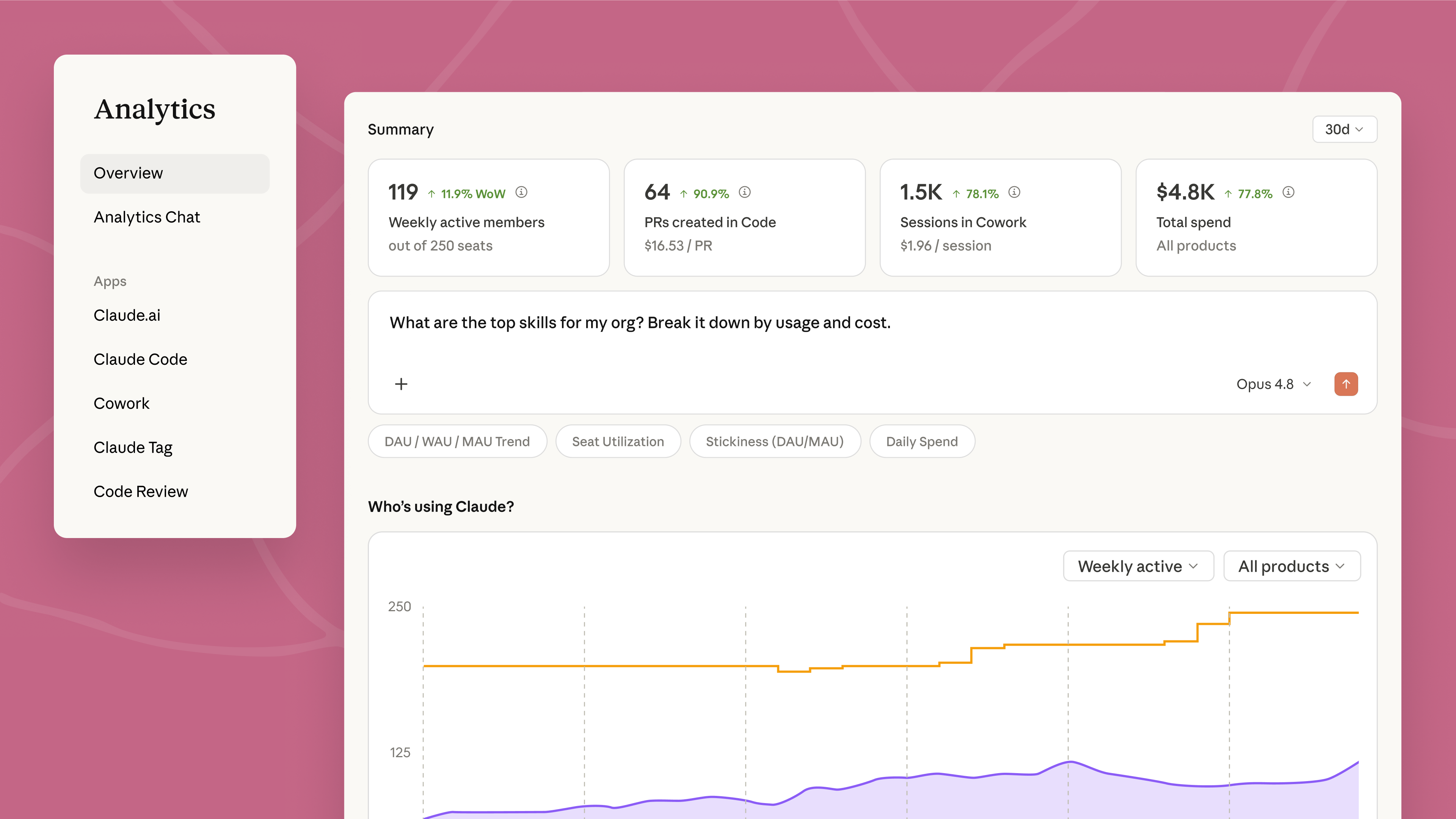
Claude Enterprise — spend alerts, model entitlements, and admin API
Claude Enterprise gets the cost knobs large orgs kept asking for — role-scoped model choice, spend alerts before people get blocked, and an Admin API.
What is it?
A four-feature admin release for Claude Enterprise: a redesigned analytics dashboard breaking usage and cost down by group and by user, threshold alerts on org spend, model defaults and per-role entitlements across chat, Cowork, and Claude Code, plus a public Admin API and Analytics API.
How does it work?
Spend alerts fire at 75% and 90% of the org limit for admins, and at 75% and 95% for individual users with in-app increase requests. Entitlements let admins pick which Claude models each role can access, and the Admin API turns that workflow into automatable scripts.
Why does it matter?
Large orgs were hitting bill shock and mid-task blocks. Admin API access plus role-scoped model gating are the two features enterprise procurement teams have been requesting since Claude Code shipped — they now land together.
Who is it for?
Claude Enterprise admins, procurement, security and finance teams, and dev-tools ops managing org-wide Claude usage.
|
|

|
|
REPO
MAJOR
2026-07-03
Hugging Face Transformers 5.13.0 — nine new architectures and unified HfExporter
The reference AI library gains nine architectures in one drop plus one export command for every runtime.
What is it?
The July 3 release of Hugging Face Transformers, the reference Python library that defines how thousands of open-weight models load, run, and export. This drop widens the supported-model roster by nine architectures and folds three previously separate exporters into a single HfExporter API.
How does it work?
Transformers 5.13.0 adds first-class classes for Kimi K2.5–K2.7, MiMo-V2-Flash, ZAYA, VideoPrism, RADIO, MiniCPM3, and two Nemotron/Qwen3 speech models. HfExporter routes a single call through DynamoExporter, OnnxExporter, or ExecutorchExporter with dynamic shapes on by default and prefill/decode splitting handled automatically.
Why does it matter?
Native-class support in Transformers is what turns "there's a paper and weights" into "you can call from_pretrained today." The single-command HfExporter cuts the multi-step porting work teams do to ship the same model to server GPUs, ONNX runtimes, and phones.
Who is it for?
ML engineers, model producers, and teams porting models to ONNX / ExecuTorch or on-device inference targets.
|
|

|
|
BENCHMARK
MAJOR
2026-07-02
EdgeBench — ByteDance's 134-task long-horizon agent benchmark
ByteDance Seed's new agent benchmark clocks 12+ hours per task to measure how fast models learn on the job.
What is it?
A benchmark of 134 real-world tasks spanning scientific ML, systems engineering, combinatorial optimization, knowledge work, formal theorem proving, and interactive games. ByteDance Seed released 51 tasks publicly on Hugging Face and GitHub on July 2, with a technical paper.
How does it work?
Each task runs 12+ hours of continuous agent operation inside an executable environment (some exceeding 72 hours), with human experts averaging 57.2 hours per task. EdgeBench scores the full learning trajectory and fits a log-sigmoid curve to show how agent performance improves with interaction time.
Why does it matter?
Most agent benchmarks reward single-shot correctness, hiding whether a model can improve on a hard task over time. EdgeBench's headline finding — agent learning speed roughly doubles every three months from Sep 2025 to May 2026 — is one of the first concrete scaling curves for agents rather than raw pretraining.
Who is it for?
Agent researchers, evaluation teams, and RL/agentic-tools builders who need a benchmark that reflects long-horizon real-world tasks.
|
|
|
|
RESOURCE
MAJOR
2026-07-02
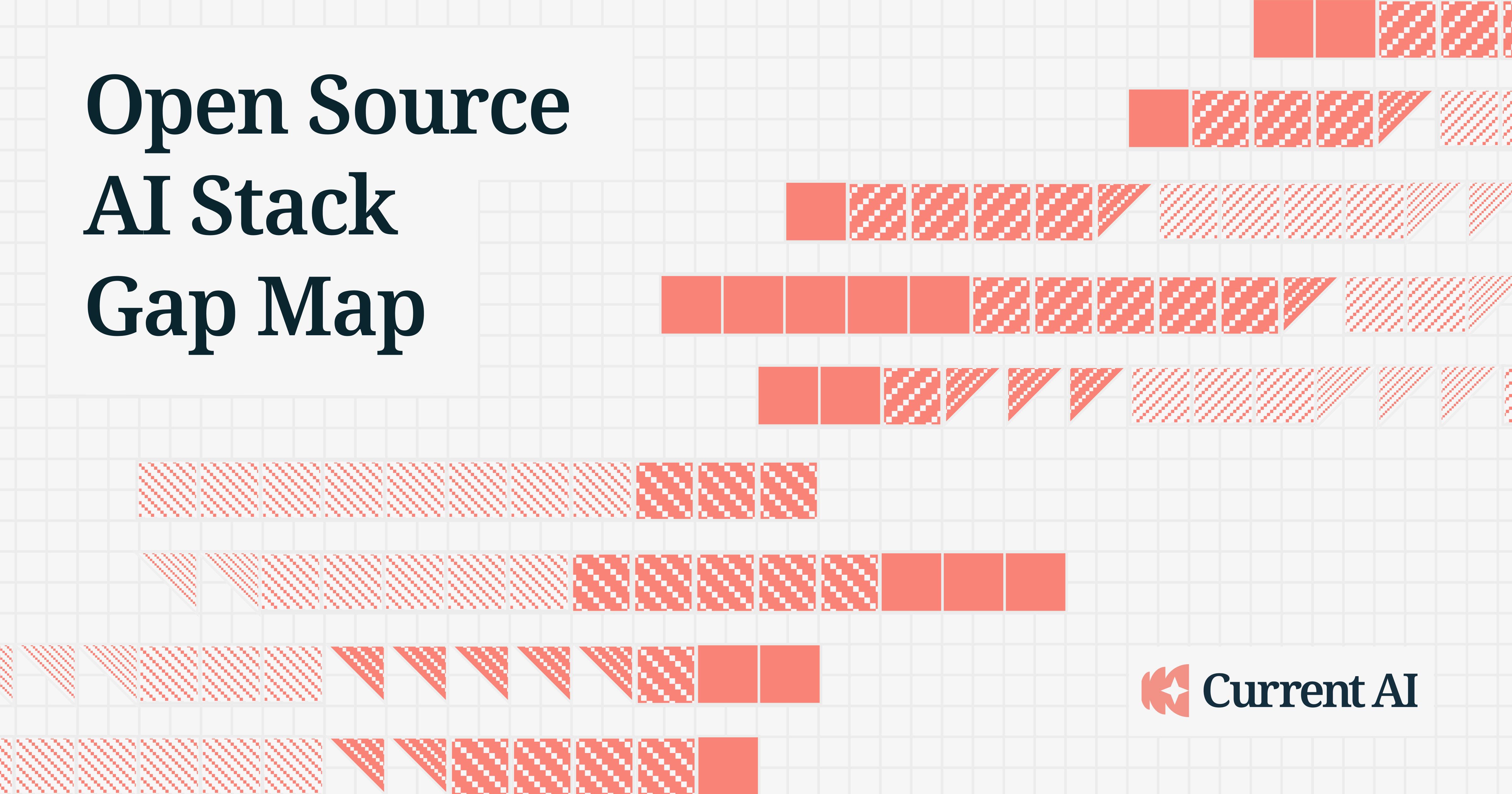
Open Source AI Gap Map — Current AI charts 421 open-source AI products in one place
A living, MIT-licensed atlas of the open-source AI stack with 421 scored products across 9 layers.
What is it?
A public catalog at map.currentai.org naming every meaningful open-source project across the AI stack, from base models and inference code to agent frameworks and hardware. Version 0.1 covers 421 products from 228 organizations, scoring each on openness, capability, and adoption — unlike an awesome-list, gaps are visible.
How does it work?
Each entry lives as a YAML file in a public GitHub repo with three independent scores plus links to primary sources. Current AI groups the 421 products into 9 stack layers rendered on the map — thin layers such as training or synthetic datasets are immediately visible as holes.
Why does it matter?
For researchers, funders, and policy teams, the Gap Map turns "is there a real open alternative to X?" from vibes into a scored comparison. It is also the first artifact from Current AI, a $400M non-profit from the Paris AI Action Summit aiming for a vendor-independent open-source AI stack.
Who is it for?
OSS AI maintainers, funders, policy teams, and researchers picking dependencies or looking for where to contribute.
|
|
|
|
ARTICLE
NOTABLE
2026-07-05
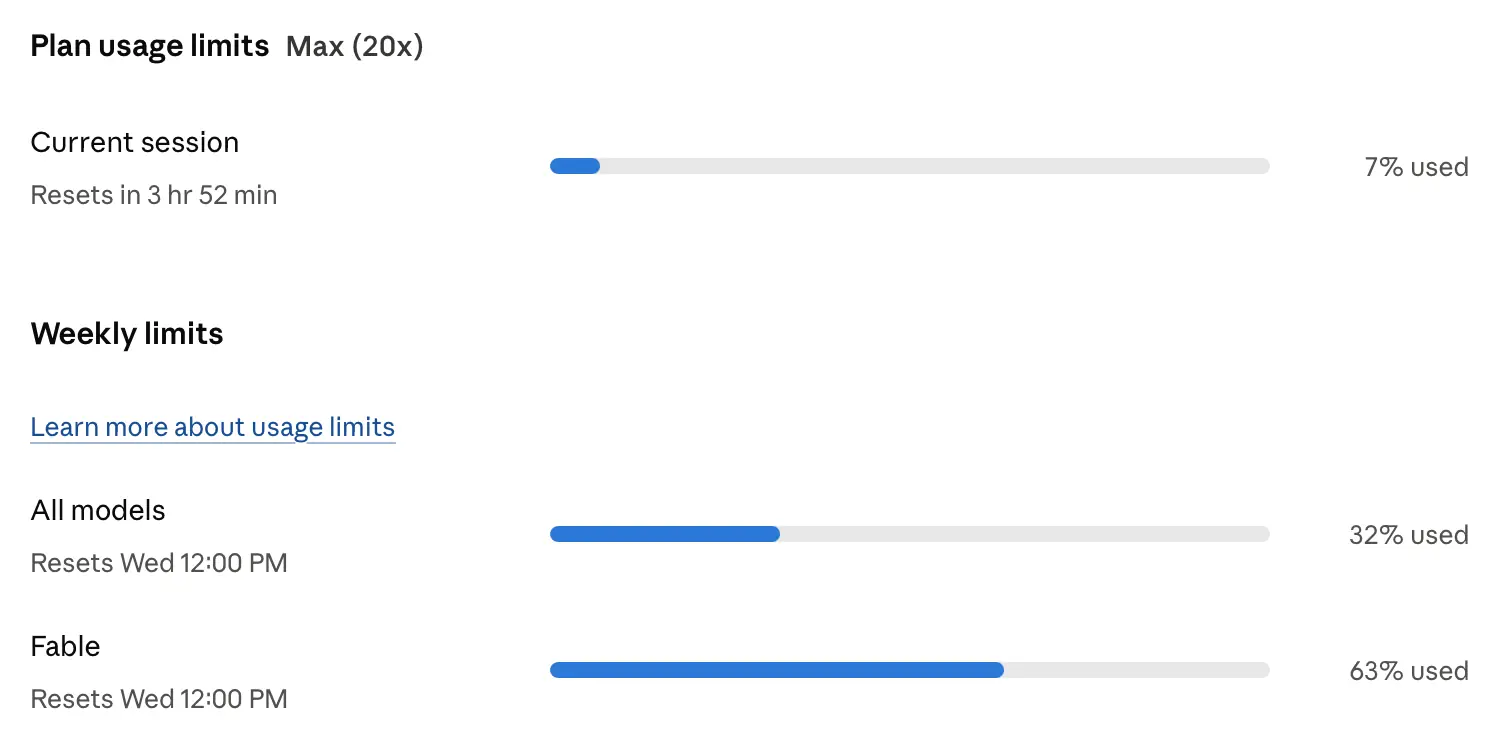
Simon Willison — sqlite-utils 4.0rc2, mostly written by Claude Fable
37 prompts, 34 commits, one data-loss bug caught — Simon Willison's field report on shipping a real library with Claude Fable.
What is it?
The release candidate for the next major version of Simon Willison's sqlite-utils library, plus a post documenting how most of the pre-release work — code review, refactors, docs, and the release notes — was done by Claude Fable rather than by hand.
How does it work?
Across 37 conversation turns, Claude Fable ran the full test suite, hunted for missing transaction guards, and landed 34 commits across 30 files. One commit fixed a data-loss bug in delete_where() where a failed batch could silently drop rows outside its own transaction — a bug Simon had not spotted in his own review.
Why does it matter?
$149.25 at unsubsidized Anthropic API rates is a concrete price tag on "have an agent review your library before you cut a release" — a rare public data point with prompts, diffs, and cost all shown.
Who is it for?
Open-source maintainers, Python developers, and teams evaluating coding-agent spend on real pre-release review work.
|
|
|
|
ARTICLE
NOTABLE
2026-07-04
Armin Ronacher — Better Models: Worse Tools
Anthropic's newest models produce invalid tool calls outside Claude Code — because the RL harness that trained them fixed the mistakes for free.
What is it?
A post by Armin Ronacher (Flask/Rye author) on a regression he keeps hitting: Claude Opus 4.8 and Claude Sonnet 5 produce a correct tool call, then append extra JSON fields that were never in the schema. Older Claude models and models from other labs do not do this.
How does it work?
The failure traces to reinforcement learning on Claude Code's harness, which quietly repairs sloppy tool calls before the model sees the error. Trained against that forgiving loop, the newer models learned extra keys are harmless — breaking any harness with strict JSON parsing, including Pi and the OpenAI Harmony framework.
Why does it matter?
Anyone building agents on Anthropic models outside Claude Code will hit these silent failures. Armin's practical fix — grammar-constrained decoding so the sampler cannot emit fields outside the schema — is one of the more actionable recommendations in the current tool-use debate.
Who is it for?
Agent developers and anyone building on Anthropic models outside the Claude Code harness — particularly those with strict JSON schema validation.
|
|
|
All releases at ai-tldr.dev
Simple explanations • No jargon • Updated daily
|
|