|
|
ECOSYSTEM
MAJOR
2026-07-03
Alibaba bans Claude Code — cites Chinese-timezone fingerprinting
Alibaba tells staff to drop Claude Code on July 10 after finding it checked for Chinese timezones; Anthropic pulled the code July 1.
What is it?
Alibaba has ordered employees to stop using Anthropic's Claude Code from July 10, after engineers found the tool had been checking whether the machine's timezone was Asia/Shanghai or Asia/Urumqi and probing proxies against a list of Chinese cloud, tech, and AI-lab hostnames since April 2.
How does it work?
The code ran client-side inside Claude Code and, if it matched a timezone or hostname pattern, marked the request so Anthropic servers could react. Anthropic called it an anti-abuse experiment to detect unauthorized resellers and distillation traffic, and removed it on July 1 after roughly three months in production.
Why does it matter?
Claude Code runs with full read/write access to a developer's repo, so silent client-side telemetry is a real supply-chain risk — this incident becomes exhibit A for enterprise vetting of coding agents. It also escalates the ongoing spat where Anthropic told US senators that Qwen operators used ~25,000 fake accounts to distill Claude.
Who is it for?
Chinese engineering teams (forced migration to Qwen-Code before July 10) and every enterprise vetting coding agents for outbound telemetry.
|
|

|
|
ECOSYSTEM
MAJOR
2026-07-01
Cloudflare — separate AI crawler controls for Search, Agent, and Training bots
Cloudflare replaces its single "Block AI Bots" toggle with three per-purpose switches — Search, Agent, and Training.
What is it?
Cloudflare's new AI Traffic Controls give every site owner three independent switches for Search, Agent, and Training bots — replacing the old blanket "Block AI Bots" toggle that treated a search crawler and a training scrape identically. All tiers, including free, get the controls immediately.
How does it work?
Each crawler is expected to declare its purpose in a Forwarded header (RFC 7239) with a use= parameter — use=reference for cited retrieval, use=immediate for real-time agent action. New defaults blocking Training and Agent bots on ad-supported pages take effect September 15.
Why does it matter?
Publishers can now keep their SEO traffic flowing to Google Search while blocking OpenAI, Anthropic, and Google from training on their content — a split that wasn't possible with a single toggle. AI labs must tag crawlers by purpose or risk being blocked as unlabeled traffic after September 15.
Who is it for?
Publishers, AI labs running crawlers, and platform engineers who operate bots at scale.
|
|
|
|
TOOL
MAJOR
2026-07-01
Gemini Interactions API GA — Google's unified endpoint for models and agents
One endpoint for Gemini model calls and agent runs, now stable and the default across Google's AI stack.
What is it?
The Interactions API is Google's new primary interface for Gemini, replacing generateContent as the default across AI Studio, docs, and partner integrations. A single endpoint handles both model inference (by model ID) and managed agents like Deep Research (by agent ID).
How does it work?
Each call creates an Interaction resource stored server-side, so follow-up turns only need previous_interaction_id instead of resending the full chat history. Managed Agents run in remote Linux sandboxes with background execution and observable step traces; state is retained 55 days on paid, 1 day on free.
Why does it matter?
New Gemini frontier models, tools, and agent features will ship here first — teams on generateContent won't get them by default. Multi-turn calls also get cheaper because server-side state means fewer input tokens per turn.
Who is it for?
Gemini API developers, agent builders, and anyone using Deep Research programmatically.
|
|
|
|
TOOL
MAJOR
2026-07-01
Safari MCP server — Apple lets AI agents drive Safari to debug websites
Apple gives coding agents a direct line into Safari — 17 MCP tools for the DOM, network, console, screenshots and clicks.
What is it?
Safari MCP is an MCP server bundled with Safari Technology Preview 247 that lets AI coding agents connect to a live Safari window. The server exposes 17 tools — screenshots, DOM reads, JavaScript evaluation, network inspection, page navigation, and typing/clicking — through the Model Context Protocol.
How does it work?
The server runs locally on top of safaridriver; an MCP client like Claude Code or Codex spawns it with the --mcp flag. All page data goes straight to the agent — no data leaves to Apple.
Why does it matter?
Coding agents can now test against the real Safari WebKit engine — not Chromium — so agents can catch compatibility bugs and layout regressions on Apple's stack without a human clicking around.
Who is it for?
Web developers using Claude Code, Codex, or other MCP-aware coding agents on macOS.
|
|
|
|
RESOURCE
MAJOR
2026-07-02
Open Source AI Gap Map — Current AI charts 421 open-source AI products in one place
A living, MIT-licensed atlas of the open-source AI stack with 421 scored products across 9 layers.
What is it?
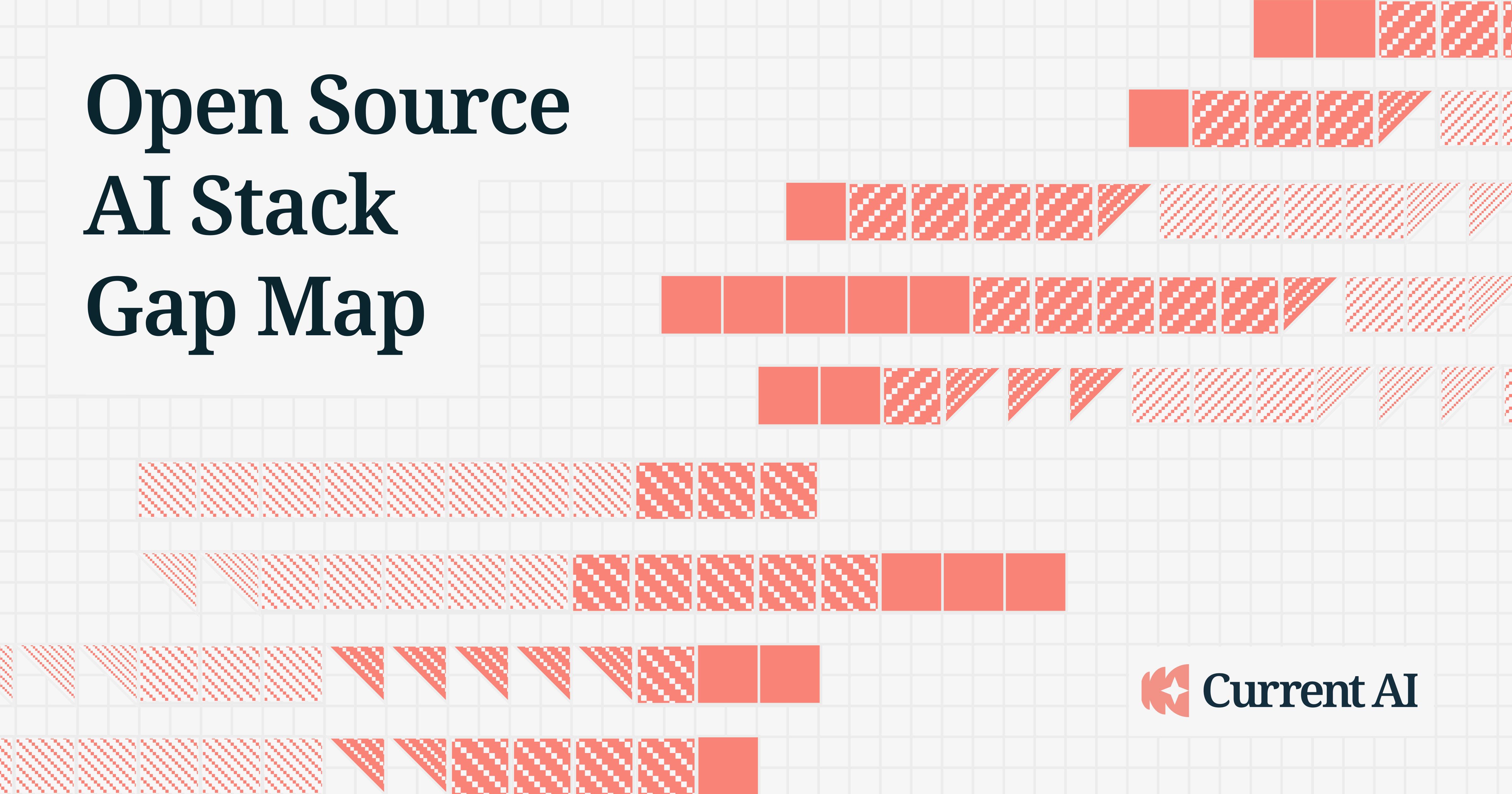
The Open Source AI Gap Map is a public catalog of every meaningful open-source project across the AI stack — from base models and inference code to agent frameworks and hardware. Version 0.1 covers 421 products from 228 organizations, and unlike an awesome-list, scores each on openness, capability, and adoption so gaps stand out.
How does it work?
Each entry lives as a YAML file in a public GitHub repo (MIT-licensed) with three independent scores plus links to primary sources. Current AI groups the 421 products into 9 stack layers, making thin layers — like training or synthetic datasets — immediately visible as holes.
Why does it matter?
It turns "is there a real open alternative to X?" from vibes into a scored comparison across 421 projects. It's also the first artifact from Current AI, a $400M non-profit whose goal is a vendor-independent open-source AI stack.
Who is it for?
OSS AI maintainers, funders, policy teams, and researchers picking dependencies.
|
|

|
|
BENCHMARK
MAJOR
2026-07-02
EdgeBench — ByteDance's 134-task long-horizon agent benchmark
ByteDance Seed's new agent benchmark clocks 12+ hours per task to measure how fast models learn on the job.
What is it?
EdgeBench is a benchmark of 134 real-world tasks spanning scientific ML, systems engineering, combinatorial optimization, professional knowledge work, formal theorem proving, and interactive games. ByteDance Seed released 51 tasks publicly on Hugging Face and GitHub on July 2.
How does it work?
Each task runs 12 or more hours of continuous agent operation inside an executable environment (some extend past 72 hours), scoring the full learning trajectory rather than a single answer using a log-sigmoid curve. Human experts average 57.2 hours per task.
Why does it matter?
Most benchmarks reward one-shot correctness; EdgeBench measures how fast agents learn from real environments over time. Its headline finding: AI agents' learning speed roughly doubles every three months from September 2025 to May 2026 — a concrete scaling curve for agents, not just pretraining.
Who is it for?
Agent researchers, evaluation teams, and RL and agentic-tools builders.
|
|

|
|
SECURITY
MAJOR
2026-07-02
Anthropic CJS — a 0-to-4 severity scale for AI cyber jailbreaks
A draft severity scale for AI cyber jailbreaks, paired with a bounty program, so researchers can grade and report attacks against Claude.
What is it?
Anthropic's Cyber Jailbreak Severity (CJS) framework is a proposed rating system that scores an AI jailbreak on a 0-to-4 scale (CJS-0 informational through CJS-4 critical), developed with Project Glasswing partners. It fills a real gap: the industry has no agreed language for saying how bad a given jailbreak actually is.
How does it work?
CJS combines four dimensions — capability gain, breadth, ease of weaponization, and discoverability — into a 0–10 score bucketed into five levels. The bands are exponential, so each level represents a much larger risk than the last. Researchers can now report jailbreaks against Claude Fable 5 through a new HackerOne program.
Why does it matter?
CJS gives the AI safety community a common vocabulary for jailbreaks — the way CVSS did for software vulnerabilities. If frontier labs adopt it, disclosures can be triaged, priced, and prioritized against a shared scale instead of each vendor eyeballing severity independently.
Who is it for?
AI safety researchers, red-teamers, and security engineers at frontier labs.
|
|
|
All releases at ai-tldr.dev
Simple explanations • No jargon • Updated daily
|
|