|
|
ECOSYSTEM
MAJOR
2026-07-01
Cloudflare — separate AI crawler controls for Search, Agent, and Training bots
Cloudflare replaces its single 'Block AI Bots' toggle with three per-purpose switches — Search, Agent, and Training.
What is it?
Cloudflare's new AI Traffic Controls give site owners three independent switches for Search, Agent, and Training bots on every zone. The previous option was a blanket 'Block AI Bots' toggle that treated a Google search crawler and an OpenAI training scrape the same way.
How does it work?
Each crawler declares its purpose via a Forwarded header (RFC 7239) with a use= parameter — reference for cited retrieval, immediate for agent actions, or Training for data collection. Cloudflare's managed robots.txt now emits use=reference by default.
Why does it matter?
Publishers can now keep their content in Google Search while blocking OpenAI, Anthropic, and Google from training on it. New defaults land September 15 — ad-monetized pages will block Training and Agent bots automatically unless an owner opts out.
Who is it for?
Publishers, AI labs running crawlers, and platform engineers who operate bots — available free to all Cloudflare customers immediately.
|
|
|
|
TOOL
MAJOR
2026-07-01
Gemini Interactions API GA — Google's unified endpoint for models and agents
One endpoint for Gemini model calls and agent runs, now stable and the default across Google's AI stack.
What is it?
The Interactions API is Google's new primary interface for building on Gemini, replacing generateContent as the default across AI Studio, docs, and partner integrations. A single endpoint accepts either a model ID for inference or an agent ID for Deep Research and other managed agents.
How does it work?
Each call creates an Interaction resource stored server-side, so a follow-up turn only needs previous_interaction_id instead of the full chat history. Data is retained 55 days on paid plans, 1 day on free, and callers can opt out with store=false.
Why does it matter?
New Gemini models, tools, and agent features will land on the Interactions API first — generateContent stays supported but won't be where frontier capabilities ship. Cached server-side state also means fewer input tokens per multi-turn call.
Who is it for?
Gemini API developers, agent builders, and anyone using Deep Research programmatically — Python and JavaScript SDKs available at ai.google.dev.
|
|

|
|
TOOL
MAJOR
2026-07-01
Claude Code 2.1.198 — subagents run in the background by default
Claude Code's subagents now run in the background by default and Claude in Chrome reaches general availability.
What is it?
Subagents in Claude Code 2.1.198 flip from foreground to background by default: the main conversation keeps running while a subagent works, and Claude is notified when it finishes. The release also moves Claude in Chrome from beta to GA and adds a /dataviz skill for chart and dashboard design.
How does it work?
Background agents launched from claude agents automatically commit, push, and open a draft PR when they finish worktree code work. The built-in Explore agent now inherits the main session's model (capped at Opus) instead of running on Haiku.
Why does it matter?
Foreground subagents used to stall the main chat while research ran; making them background-first turns Claude Code into a fan-out orchestrator without blocking the user. Auto-commit-and-draft-PR on background agents makes hands-off ticket work practical.
Who is it for?
Claude Code power users and agentic-coding teams running long-lived subagents. Update with claude update or npm i -g @anthropic-ai/claude-code.
|
|
|
|
TOOL
MAJOR
2026-07-01
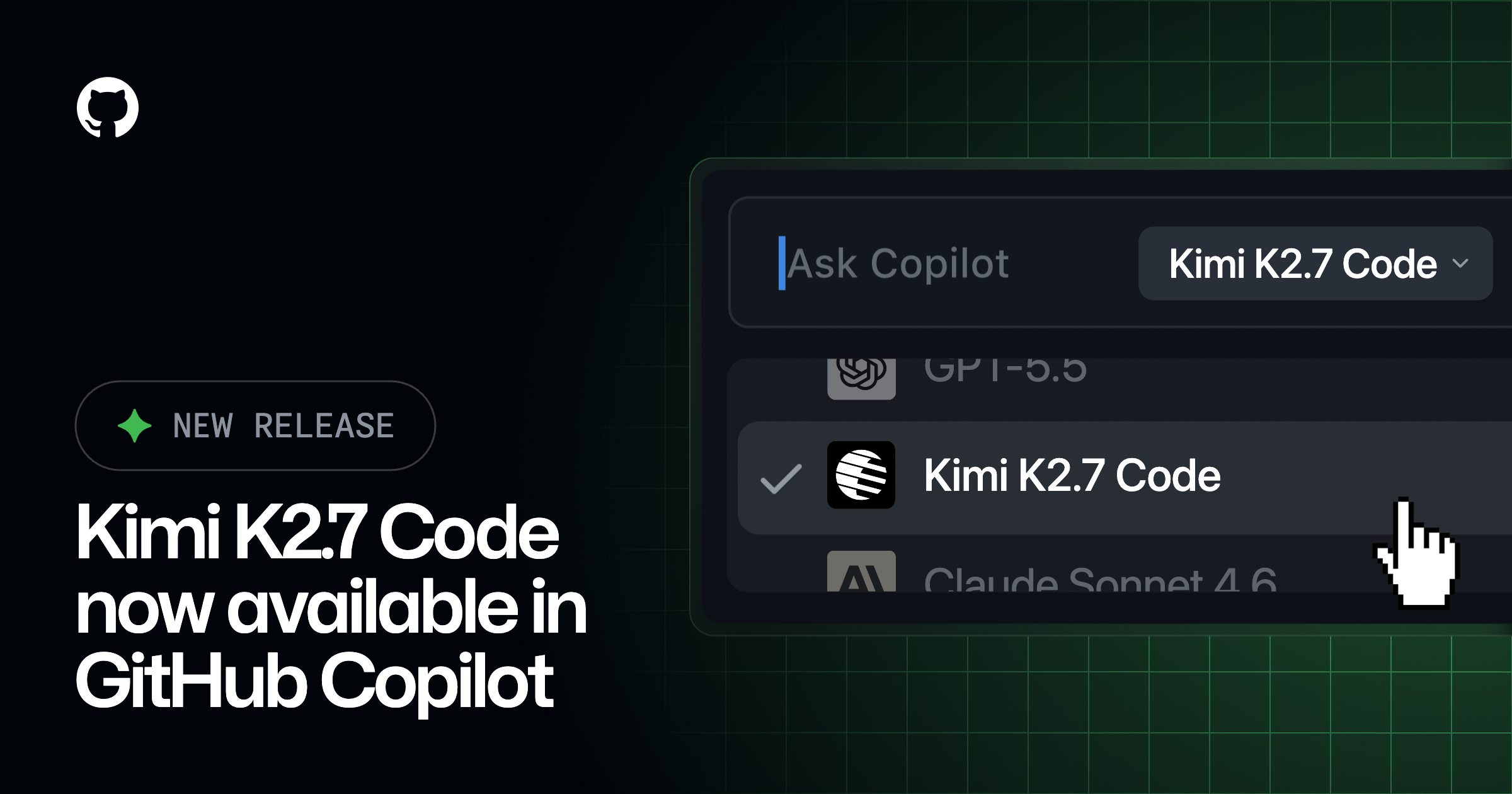
Kimi K2.7-Code in GitHub Copilot — first open-weight model in the picker
GitHub Copilot's model picker now ships Kimi K2.7-Code — the first open-weight option, hosted on Azure.
What is it?
Kimi K2.7-Code is Moonshot AI's trillion-parameter open-weight coding model, now selectable inside GitHub Copilot. The Copilot picker previously listed only proprietary APIs — this is the first model with published weights sitting alongside them.
How does it work?
GitHub hosts Kimi K2.7-Code on Microsoft Azure and bills it at Moonshot's provider list pricing under Copilot's usage-based billing. The model handles chat, edits, and agent turns everywhere Copilot ships — VS Code, JetBrains, Xcode, Eclipse, the CLI, and GitHub Mobile.
Why does it matter?
A team on Copilot Pro can now A/B test Kimi against Claude or GPT on real tickets without leaving the editor. And because the weights are public, a team that likes the results can self-host the same model for offline or regulated work — something no earlier Copilot pick allowed.
Who is it for?
GitHub Copilot Pro, Pro+, and Max users today; Business and Enterprise follow in coming weeks (off by default — admins must enable).
|
|
|
|
TOOL
MAJOR
2026-07-01
xAI Voice Agent Builder — no-code builder for production voice agents
xAI's Voice Agent Builder is a no-code way to ship production voice agents on Grok Voice, priced by the minute.
What is it?
Voice Agent Builder is xAI's no-code console for wiring up production voice agents on top of the Grok Voice model. Developers pick a voice, add tools and a knowledge base, hook up telephony, and have a running agent in about two minutes — no glue code between STT, LLM, and TTS.
How does it work?
The builder wraps xAI's grok-voice-latest speech-to-speech model in a WebSocket runtime with sub-second turn-taking. SIP support lets an agent answer an existing phone number; MCP servers, custom HTTP tools, and a knowledge-base layer are built in.
Why does it matter?
The flat $0.05/min agent-audio rate (plus $0.01/min for provisioned telephony numbers) undercuts the typical vendor stack that bills STT, LLM, and TTS separately. Real voice-agent deployment — support, sales, scheduling — opens up to teams that couldn't budget legacy speech stacks.
Who is it for?
Product teams shipping voice agents for support, sales, or telephony workflows. Public beta, available at docs.x.ai.
|
|

|
|
SECURITY
MAJOR
2026-07-02
Anthropic CJS — a 0-to-4 severity scale for AI cyber jailbreaks
A draft severity scale for AI cyber jailbreaks, paired with a bounty program, so researchers can grade and report attacks against Claude.
What is it?
Anthropic's Cyber Jailbreak Severity (CJS) framework is a proposed 0-to-4 rating system for AI jailbreaks, developed with Project Glasswing partners. It fills a real gap: the industry has no agreed language for saying how bad a given jailbreak actually is.
How does it work?
CJS combines four dimensions — capability gain, breadth, ease of weaponization, and discoverability — into a single 0–10 score bucketed from CJS-0 (informational) to CJS-4 (critical). The bands are exponential. Researchers can now report jailbreaks against Claude Fable 5 through a new HackerOne program.
Why does it matter?
CJS gives the AI safety community a common vocabulary for jailbreaks, the way CVSS did for software vulnerabilities. If frontier labs adopt it, jailbreak disclosures can be triaged and prioritized against a shared scale instead of every vendor eyeballing severity.
Who is it for?
AI safety researchers, red-teamers, and security engineers at frontier labs — feedback open at [email protected].
|
|
|
|
TOOL
MAJOR
2026-07-01
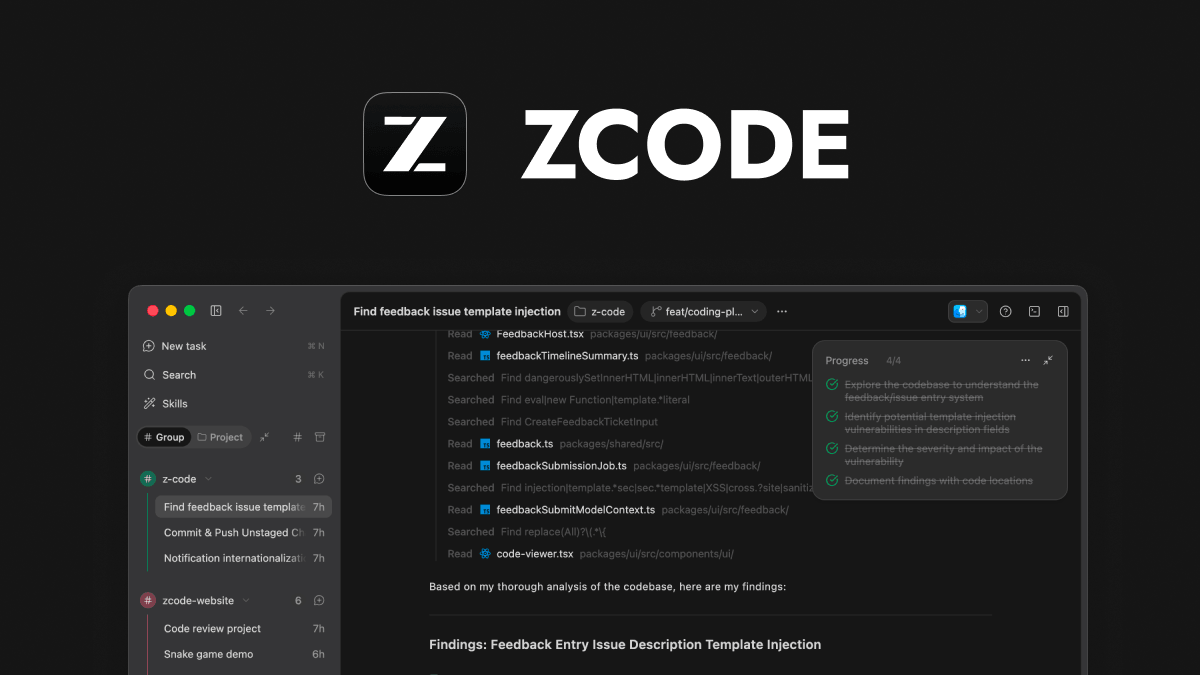
ZCode — Z.ai's official coding harness for GLM-5.2
GLM-5.2 gets an official desktop harness that plans, codes, and takes orders from your phone.
What is it?
ZCode is Z.ai's own desktop coding agent for its open-weight GLM-5.2 model. The app packages GLM-5.2 with a multi-agent system, a terminal, and "Goals" — long-horizon tasks that keep planning, executing, and verifying while the developer is away.
How does it work?
Multiple agents inside ZCode share the same repo and tools: one drafts a plan, another writes code, a third reviews and runs tests. Goals track each long task's state so a user can start it on desktop and steer it from WeChat, Feishu, or Telegram while away.
Why does it matter?
Every serious coding model now has a first-party harness: Claude has Claude Code, Codex has Codex Remote, and GLM-5.2 has ZCode. Teams betting on an open-weight coding model no longer have to graft it into a third-party wrapper to get the polished agent experience.
Who is it for?
Developers who already use GLM-5.2 and want an official desktop workflow. Lite starts at $16.20/mo; native installers for macOS, Windows, and Linux.
|
|
|
All releases at ai-tldr.dev
Simple explanations • No jargon • Updated daily
|
|