|
|
ECOSYSTEM
MAJOR
2026-06-30
Claude Fable 5 redeployed — Anthropic ships globally after US lifts export controls
Claude Fable 5 goes global again on July 1, this time behind a defense-in-depth safety stack.
What is it?
Claude Fable 5 is Anthropic's general-purpose flagship, paused in June after a jailbreak went public. US export controls came off on June 30, and global rollout to Claude.ai, Claude Code, Claude Cowork, and the Claude Platform started July 1.
How does it work?
Anthropic layered four defenses on the relaunched model: safety training, retroactive misuse pattern analysis, cybersecurity classifiers, and a new targeted classifier that blocks the specific jailbreak in over 99% of tested cases.
Why does it matter?
Fable 5 access unblocks the daily-driver Claude experience for millions of Pro, Max, Team, and Enterprise users — and sets a template for how frontier labs can pause, patch, and return a model under an audited safety stack.
Who is it for?
Claude users on Pro, Max, Team, and Enterprise plans (up to 50% of weekly limits through July 7), plus developers on the Claude API and Claude Code users who lost Fable 5 access in June.
|
|
|
|
TOOL
MAJOR
2026-07-01
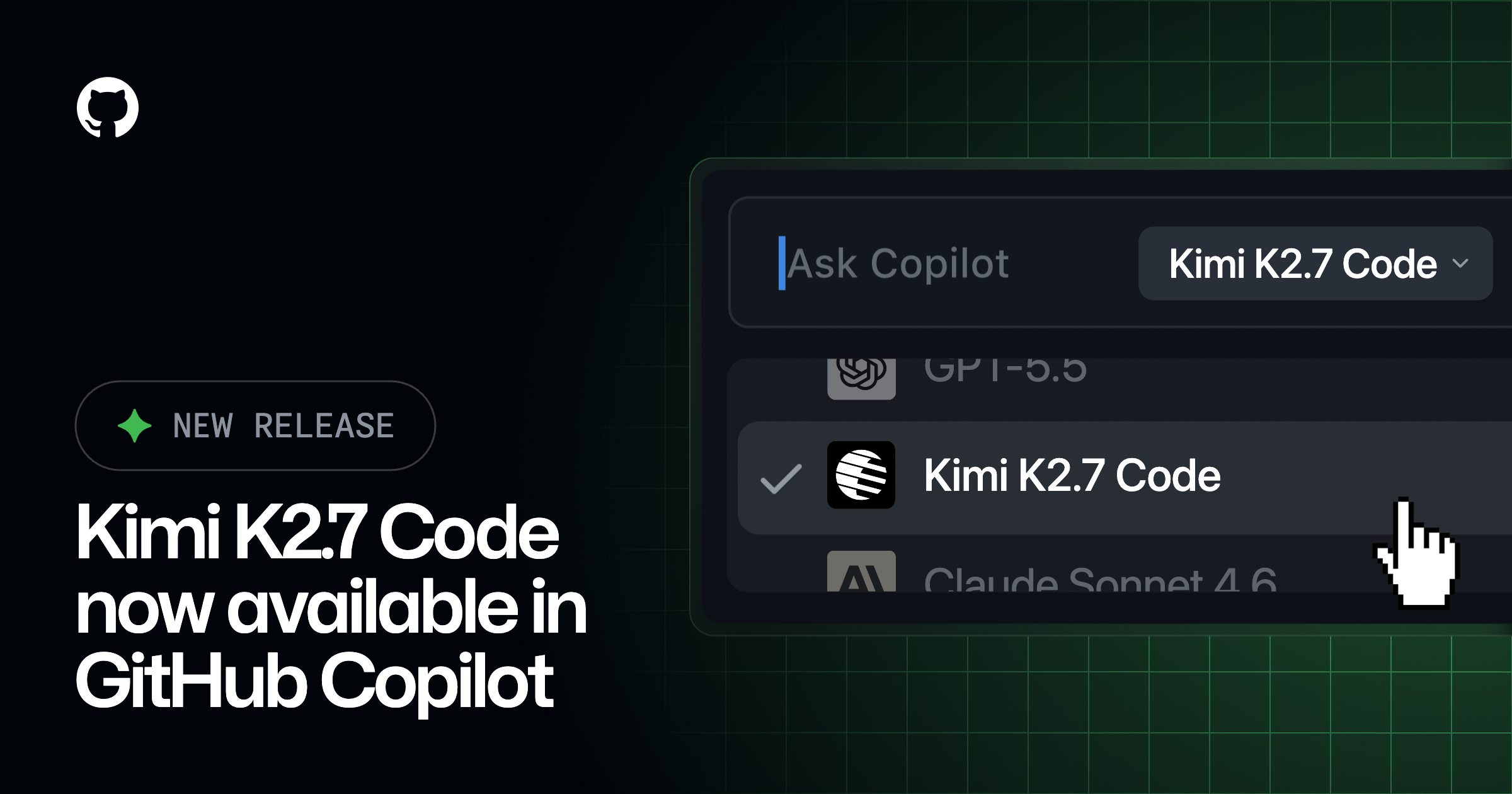
Kimi K2.7-Code in GitHub Copilot — first open-weight model in the picker
GitHub Copilot's model picker now ships Kimi K2.7-Code — the first open-weight option, hosted on Azure.
What is it?
Kimi K2.7-Code is Moonshot AI's trillion-parameter open-weight coding model, now selectable inside GitHub Copilot — the first model with published weights in the picker, sitting alongside proprietary APIs from Anthropic, OpenAI, Google, and xAI.
How does it work?
GitHub hosts Kimi K2.7-Code on Azure under Copilot's usage-based billing; once selected, it handles chat, edits, and agent turns in VS Code, JetBrains, Xcode, Eclipse, the Copilot CLI, github.com, and GitHub Mobile.
Why does it matter?
Teams can now A/B test Kimi against Claude or GPT on real tickets without leaving the editor — and the open weights mean teams that like what they see can self-host the same model for offline or regulated work, something no earlier Copilot pick allowed.
Who is it for?
GitHub Copilot Pro, Pro+, and Max users today; Business and Enterprise plans in coming weeks (off by default, admins must enable).
|
|
|
|
TOOL
MAJOR
2026-07-01
xAI Voice Agent Builder — no-code builder for production voice agents
xAI's Voice Agent Builder is a no-code way to ship production voice agents on Grok Voice, priced by the minute.
What is it?
Voice Agent Builder is xAI's no-code console for wiring up production voice agents on top of the Grok Voice model. Pick a voice, add tools and a knowledge base, hook up telephony, and have a running agent in about two minutes — no glue code between STT, LLM, and TTS.
How does it work?
The builder wraps grok-voice-latest in a WebSocket runtime with sub-second turn-taking. SIP support lets an agent answer an existing phone number, MCP servers and custom HTTP tools give it hands, and a knowledge-base layer grounds answers on your own docs.
Why does it matter?
At $0.05/min for agent audio plus $0.01/min for telephony on xAI-provisioned numbers, it undercuts the typical vendor stack that bills STT, LLM, and TTS separately — opening real voice-agent deployment to teams that couldn't budget legacy speech stacks.
Who is it for?
Product teams building voice agents for support, sales, scheduling, or outbound calls — available now in public beta.
|
|
|
|
TOOL
MAJOR
2026-07-01
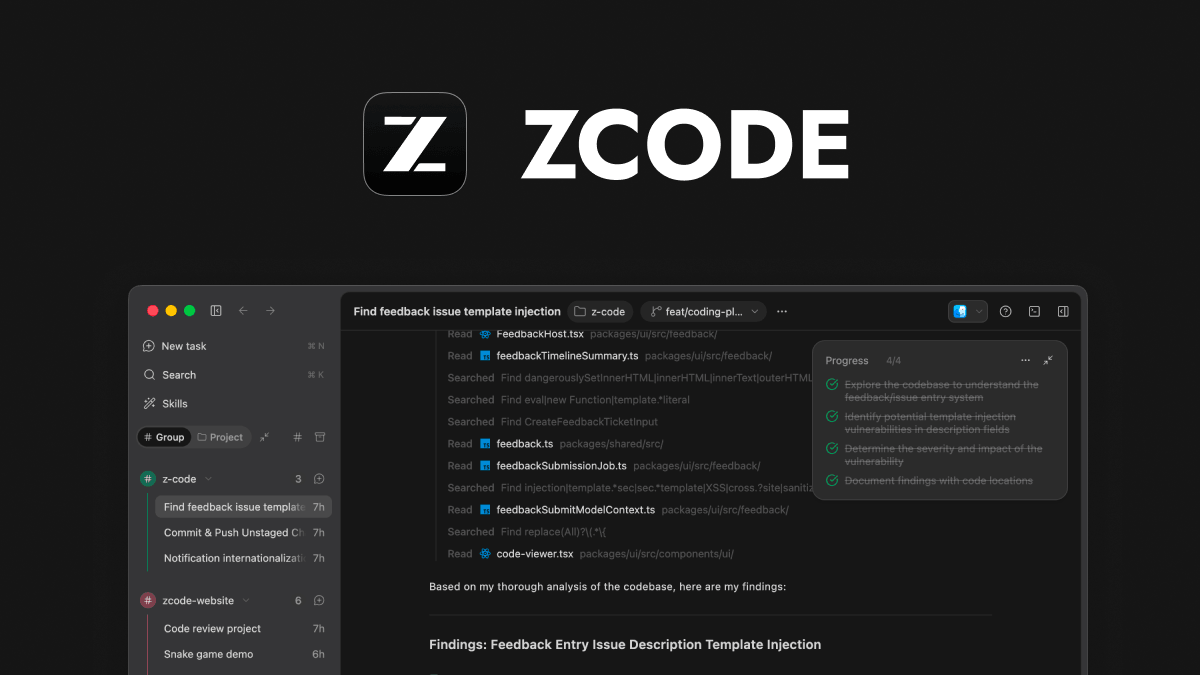
ZCode — Z.ai's official coding harness for GLM-5.2
GLM-5.2 gets an official desktop harness that plans, codes, and takes orders from your phone.
What is it?
ZCode is Z.ai's own desktop coding agent for its open-weight GLM-5.2 model, packaging it with a multi-agent orchestrator, a terminal, and "Goals" for long-horizon tasks that keep planning and executing while the developer is away.
How does it work?
Multiple agents share the same repo and tools — one drafts a plan, another writes code, a third reviews and runs tests. Goals track long-task state so users can steer them from WeChat, Feishu, or Telegram while away from the machine.
Why does it matter?
Every serious coding model now has a first-party harness — Claude Code, Codex Remote, and now ZCode. Teams betting on an open-weight coding model no longer have to graft it into a third-party wrapper to get a polished agent experience.
Who is it for?
Developers using GLM-5.2 who want an official desktop workflow; available for macOS, Windows, and Linux starting at $16.20/month.
|
|

|
|
ECOSYSTEM
MAJOR
2026-06-29
Claude in Microsoft Foundry — Opus 4.8 and Haiku 4.5 go GA on Azure
Claude Opus 4.8 and Haiku 4.5 are now production-ready inside Azure, billed on the customer's Microsoft agreement.
What is it?
Microsoft Foundry — Azure's model catalog — moves Claude Opus 4.8 and Claude Haiku 4.5 from preview to general availability, letting enterprises call the Anthropic Messages API from inside their own Azure tenant with Azure identity, networking, and billing.
How does it work?
Two paths ship together: "hosted on Azure" runs inference on NVIDIA GB300 Blackwell Ultra GPUs in the customer's own Azure environment with a US data zone; "hosted on Anthropic" exposes the full Messages API. Both options can draw down Microsoft Enterprise Agreement Azure commitments.
Why does it matter?
GA gives Azure customers a first-party procurement and governance path to Claude Opus 4.8 without routing through third parties — removing the last commercial and compliance friction for enterprise teams already on Azure.
Who is it for?
Enterprise Azure customers building agents and coding tools on Claude, especially those with data-residency requirements or existing Microsoft Enterprise Agreements.
|
|

|
|
BENCHMARK
MAJOR
2026-06-30
GeneBench-Pro — OpenAI's 129-problem computational-biology benchmark
A research-level bio benchmark where top frontier models still fail more than two thirds of the time.
What is it?
GeneBench-Pro is a 129-problem benchmark from OpenAI that hands an AI agent synthetic-but-realistic tasks from genomics, quantitative biology, and translational medicine — targeting real research judgment, not exam-style recall.
How does it work?
The agent gets data files, a Python + PLINK 2.0 workspace, and a target estimand; every answer is graded against a known ground truth. GPT-5.6 Sol Pro tops the leaderboard at 31.5%; Claude Opus 4.8 lands second at 16.0%.
Why does it matter?
Coding evals are saturating — GeneBench-Pro reopens the gap. With 82 of 129 tasks vetted by grad students, postdocs, and industry scientists, scores here map to real research competence rather than benchmark gaming.
Who is it for?
AI evaluation researchers and bio/AI labs; a 10-question public subset is available on Hugging Face under CC-BY-4.0.
|
|
|
|
ECOSYSTEM
MAJOR
2026-06-29
DeepSeek V4 gets peak-hour pricing — API doubles 9am–12pm and 2pm–6pm Beijing time
First large LLM API to introduce time-of-day pricing.
What is it?
DeepSeek V4 will charge double during two Beijing-time windows — 9 AM to noon and 2 PM to 6 PM — on both V4 Pro and V4 Flash, taking effect when V4 officially launches in mid-July 2026.
How does it work?
The API splits the day into peak (2×) and off-peak (1×) blocks in Beijing local time, seven days a week. Both output and cache-miss input tokens double at peak; users get an email 24 hours before their meter switches.
Why does it matter?
This is a first for any major LLM API — mirroring how power grids handle demand. Teams running batch workloads outside peak windows (before 9 AM, 12–2 PM, or after 6 PM Beijing time) can cut costs in half; expect other providers to take note.
Who is it for?
Teams running production DeepSeek V4 workloads — especially those with schedulable batch jobs like nightly code review, document ingest, or offline evaluations.
|
|
|
All releases at ai-tldr.dev
Simple explanations • No jargon • Updated daily
|
|