|
|
MODEL
SEISMIC
2026-08-03
Qwen3.8-Max — Alibaba's 2.4T flagship ships official with a full benchmark table
Qwen3.8-Max lands as Alibaba's official 2.4T-parameter, 95B-active MoE flagship with published benchmarks and $2/$6 per-million-token pricing.
What is it?
Qwen3.8-Max is Alibaba's flagship large language model — 2.4 trillion parameters, 95B active per request, with a 983,616-token input window and native text, image, video, and document handling in a single call. API access is live on QwenCloud today; open weights land next week alongside a smaller Qwen3.8-27B model.
How does it work?
Sparse mixture-of-experts routing keeps active compute low while total capacity climbs — only 95B of 2.4T parameters fire per token. The API speaks both the OpenAI and Anthropic wire formats, and Alibaba highlights a 10-day autonomous coding trace as the headline demo.
Why does it matter?
Qwen3.8-Max scores 86.6 on Terminal-Bench 2.1 — right between GPT-5.6 Sol (88.8) and Claude Opus 4.8 (84.6) — at $2 in / $6 out per million tokens, roughly a third of Fable 5's list rate. Open weights follow next week.
Who is it for?
Coding agents, autonomous-workflow builders, and teams evaluating a frontier alternative to Sol or Opus at Chinese-lab pricing.
|
|

|
|
TOOL
MAJOR
2026-08-03
Cloudflare Workers AI — FP8 doubles Kimi K2.6 context, INT4 cuts GLM 5.2 40%
FP8 KV cache and INT4 weights land on Workers AI, doubling context and shrinking checkpoints for Kimi K2.6 and GLM 5.2.
What is it?
Cloudflare quantized how Workers AI serves Kimi K2.6 and GLM 5.2 — two of the biggest open MoE models. FP8 KV cache doubles Kimi's context from 686K to 1.37M tokens; INT4 weights shrink GLM's checkpoint from 705 GB to 421 GB.
How does it work?
The FP8 KV cache halves per-token memory during attention so the same GPUs hold twice as many tokens. GLM 5.2's INT4 compression speeds decode up to 55% at low concurrency — all as backend changes that require no code edits from developers.
Why does it matter?
Anyone calling Kimi K2.6 or GLM 5.2 on Workers AI now gets longer context, faster responses, and roughly 30% lower cost automatically — with no code change. Two of the largest open models get cheaper to serve at scale on the same hardware.
Who is it for?
Developers using Workers AI who call Kimi K2.6 or GLM 5.2 — the upgrade is automatic and free.
|
|

|
|
SECURITY
MAJOR
2026-08-02
Apple caps bug-bounty submissions — AI-slop reports buried a real $200K macOS flaw
Apple's bug-bounty inbox filled up with AI-generated 'flaws,' so Apple capped submissions — and then a real macOS root exploit couldn't get through.
What is it?
Apple quietly added a per-researcher submission cap and 30-day cool-off on its Feedback Assistant bug-bounty channel after a flood of AI-generated reports overwhelmed reviewers. The same rate-limit blocked Italian firm Bynario from filing a real macOS root exploit (CVE-2026-43760, worth an estimated $100K–$200K on the grey market).
How does it work?
Under the new rules, a reporter who hits the cap must wait 30 days or request a quota bump before filing again. The cap doesn't distinguish between an AI-generated fake report and a genuine critical vulnerability — Bynario had to contact Apple directly before CVE-2026-43760 was acknowledged.
Why does it matter?
AI-generated reports can now effectively DDoS a bug-bounty intake channel — a new class of infrastructure harm. Apple itself uses Anthropic and OpenAI models to hunt bugs internally, and its latest macOS update shipped five times more fixes than usual as a result.
Who is it for?
iOS/macOS security researchers, bug-bounty program owners, and vulnerability-disclosure policy people tracking the collision between AI tooling and responsible disclosure.
|
|

|
|
REPO
NOTABLE
2026-08-03
Swiftlet — 80B Qwen runs in 4.3 GB on a Mac, 35B on an iPhone
Swift and Metal runtime that runs Qwen 35B on an iPhone and 80B on a Mac by streaming MoE experts from local storage.
What is it?
Swiftlet is an Apache-2.0 Swift and Metal runtime that hosts Qwen3-Next and Qwen3.5/3.6 hybrid MoE models on Apple devices. Only a small dense core sits in RAM; the routed mixture-of-experts weights stream from local storage as tokens need them.
How does it work?
Every token routes through a small subset of experts, so Swiftlet only needs the active experts in memory and streams the rest from disk on demand. This drops an 80B model's RAM footprint from tens of gigabytes to about 4.3 GB peak.
Why does it matter?
A 35B model now runs on an iPhone 17 at about 2.5 GB peak RAM and ~1 token/second; 80B runs on a Mac at 4.3 GB and 4.5–5 tokens/second decode — no cloud call, no data leaves the device.
Who is it for?
iOS and macOS developers, on-device AI hobbyists who want to run large open models without a server.
|
|

|
|
TOOL
NOTABLE
2026-08-03
MiniMax H3 Day-0 Support in ComfyUI — 2K video generation on an RTX 3060
Day-0 ComfyUI workflows plus a pruned + quantized H3 that fits on an RTX 3060.
What is it?
Comfy-Org shipped day-0 workflow templates for MiniMax H3 inside ComfyUI — covering text-to-video, image-to-video, first-and-last-frame control, and reference-to-video. The release ships alongside pruned and quantized model weights on Hugging Face.
How does it work?
Pruning and quantization shrink H3's memory footprint from 123.6 GB to 42.5 GB — a 66% reduction. Dynamic VRAM offloading then lets consumer GPUs like an RTX 3060 run the model by paging weights between GPU memory and system RAM.
Why does it matter?
H3 generates up to 15-second clips at 2K resolution with native stereo audio. The ComfyUI path removes both the workflow plumbing and VRAM barriers so local video generation on consumer hardware is now viable without paying for a hosted API.
Who is it for?
ComfyUI users and local video-generation creators who want to run H3 on hardware they already own.
|
|
|
|
MODEL
RUMOR
2026-08-02
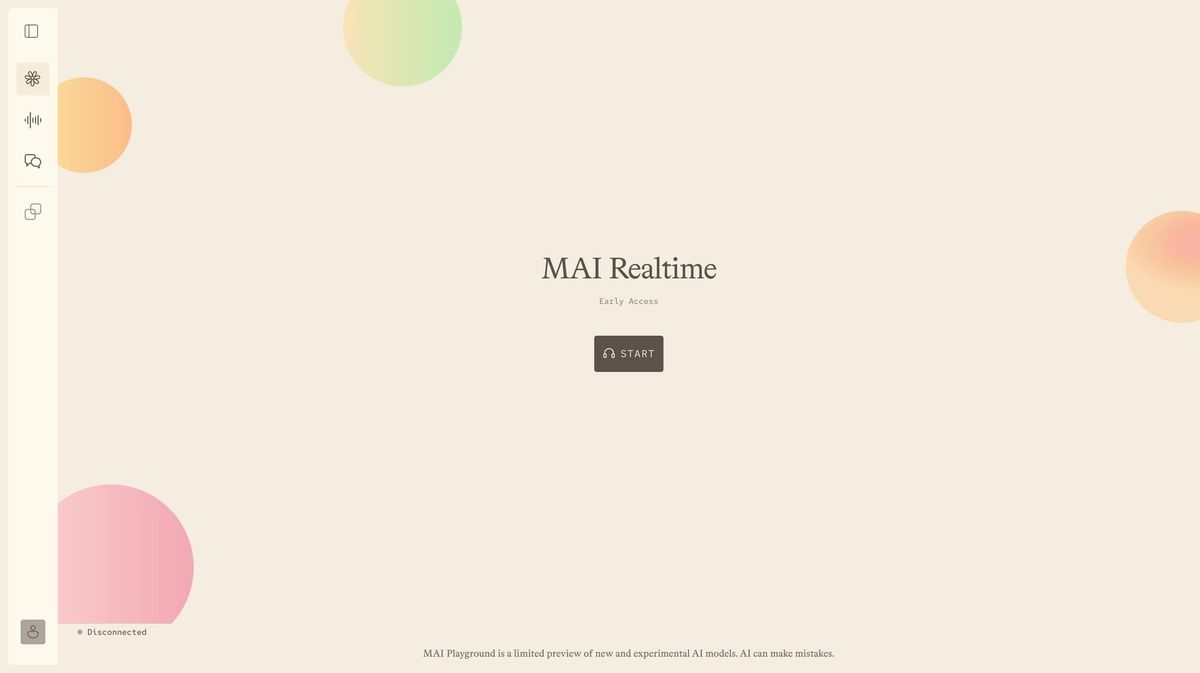
MAI-Realtime rumor — Microsoft's full-duplex voice model hidden in MAI Playground
TestingCatalog spotted an unannounced Microsoft voice model — MAI-Realtime — running as a hidden preview alongside the public MAI models.
What is it?
MAI-Realtime is an unannounced bidirectional voice model from Microsoft's in-house MAI team, discovered as a hidden entry in the MAI Playground. Unlike MAI-Voice-1 and MAI-Transcribe-1.5, this is a single native speech-to-speech model that listens and speaks simultaneously.
How does it work?
The preview panel exposes 17 languages and two voices (Victoria and Grant), with a configurable Switchboard turn-taking mode and the ability to call web search tools mid-conversation. TestingCatalog frames it as a tightly controlled partner preview.
Why does it matter?
A native full-duplex model would give Microsoft its own answer to OpenAI's realtime voice API — the last piece Copilot needs to run voice agents end-to-end without leaning on OpenAI infrastructure.
Who is it for?
Microsoft-ecosystem developers watching Copilot's move away from OpenAI voice, and voice-agent builders tracking the competitive landscape.
|
|
|
|
TOOL
NOTABLE
2026-08-03
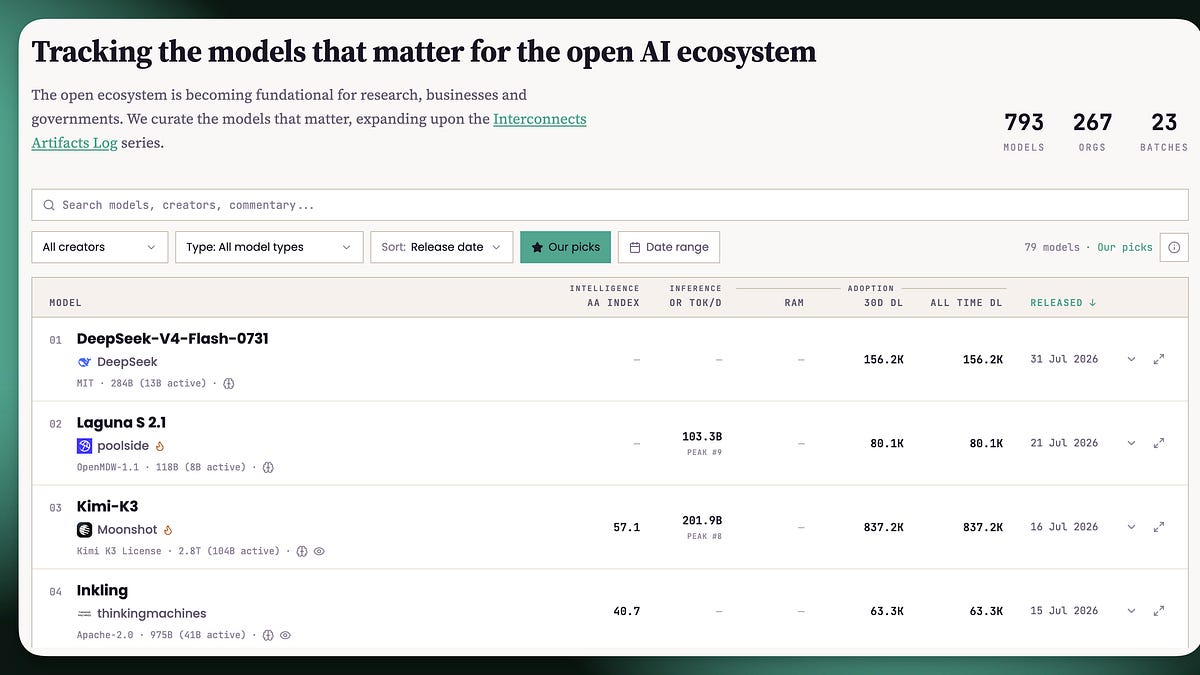
Artifacts Hub — Interconnects launches open-model tracking dashboards
Interconnects ships two free tools that track open-model releases and adoption across geographies and organizations.
What is it?
Artifacts Hub is a free, curated view of the open-model ecosystem — 794 models from 267 organizations across 23 monthly batches, with performance metrics, downloads, and inference usage shown side by side. Built by Nathan Lambert's Interconnects with Project VAIL.
How does it work?
The hub pulls model metadata from Hugging Face, layers in benchmark scores from Artificial Analysis and inference-token counts from OpenRouter, then adds curated adoption metrics. A paired Adoption Dashboard breaks usage down by geography and lab.
Why does it matter?
Tracking open-model adoption previously required stitching together Hugging Face downloads, OpenRouter usage, and eval scores from separate sites. The hub puts all three in one filterable place for 267 labs at once — with a geographic layer for the US-China open-weights race.
Who is it for?
AI researchers, open-model analysts, and journalists tracking which labs and geographies are pulling ahead in the open-weights ecosystem.
|
|
|
All releases at ai-tldr.dev
Simple explanations • No jargon • Updated daily
|
|