|
|
MODEL
MAJOR
2026-08-04
LFM2.5-2.6B — Liquid AI's 2.6B on-device agent competes with 4x-larger models
A 2.6B open-weight agent that plans, calls tools, and runs entirely on phones, laptops, and robots.
What is it?
LFM2.5-2.6B is Liquid AI's new 2.6B-parameter open-weight language model, built for agentic workflows that run entirely on-device. It ships with base and instruction-tuned checkpoints on Hugging Face, a 128K context window, and support for 16 languages.
How does it work?
The 30-layer hybrid stacks 22 double-gated convolution blocks with 8 grouped-query attention layers, pre-trained on ~34T tokens. Post-training turns the base into an agent through supervised fine-tuning, per-domain teacher distillation, and a final agentic reinforcement-learning stage.
Why does it matter?
LFM2.5-2.6B lets developers deploy planning, tool calling, and multi-step reasoning without a cloud round-trip — 30 tok/s on a phone and 220 tok/s on an M5 Max CPU — while beating Gemma-4 and Qwen3.5 4.7B on tool use and instruction following.
Who is it for?
Developers shipping local agents on phones, laptops, or robots; anyone needing capable agentic inference with zero cloud cost.
|
|
|
|
TOOL
MAJOR
2026-08-04
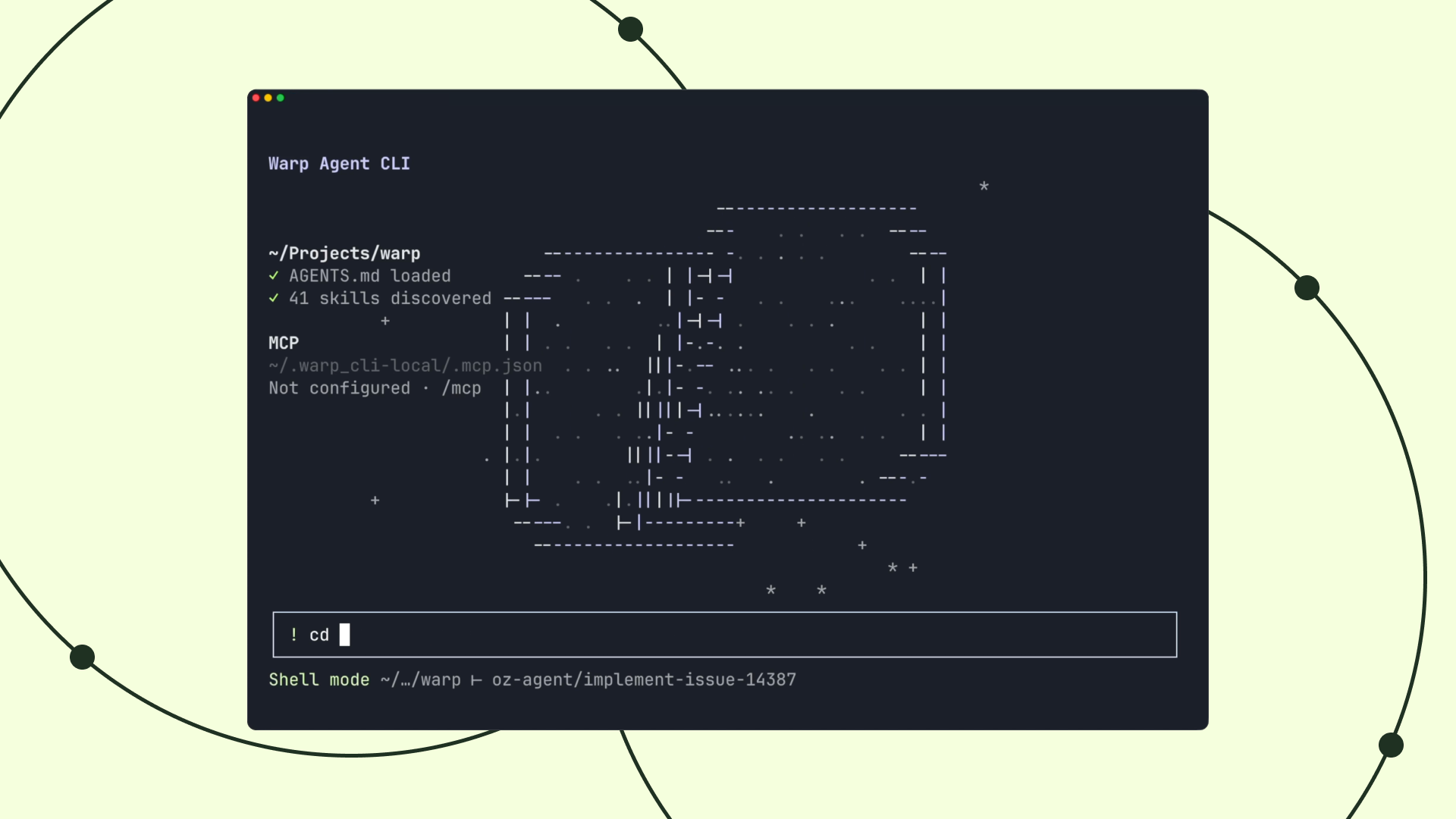
Warp Agent CLI — the Warp coding agent goes standalone in any terminal
Warp's multi-model coding agent ships as a standalone CLI you can drop into any terminal, with multiplexing, remote handoff, and BYO keys.
What is it?
Warp Agent CLI takes the coding agent previously locked inside the Warp Terminal app and packages it as a standalone binary. It works in Ghostty, iTerm 2, VS Code's integrated terminal, Windows Terminal, and Apple's default Terminal — no Warp Terminal required.
How does it work?
A native multiplexing layer keeps sessions persistent across directory switches and pipes full-screen apps like vim, gdb, and sqlite through without breaking. An auto-router picks a model per task from frontier and open-weight endpoints; subagents can be delegated or handed off to a cloud agent.
Why does it matter?
Warp Agent CLI removes the lock-in that kept teams on Warp Terminal to use its agent, giving Claude Code, Codex CLI, and Cursor a same-shape competitor that runs anywhere. The BYO-key free tier and $10 ad-hoc credit floor lower the entry cost considerably.
Who is it for?
Developers on Ghostty, iTerm 2, VS Code, or Windows who want a capable coding agent without switching terminals; teams already on Warp who want to use it in CI or SSH sessions.
|
|
|
|
MODEL
MAJOR
2026-08-04
Shieldstral 1.0 — Mistral ships a 3B open safety classifier for text and images
A 3B open-weights safety classifier that reads a plain-language policy at inference, rates text or images, and fits in a 16GB GPU.
What is it?
Shieldstral 1.0 is a compact safety classifier from Mistral for content moderation across text and images. Instead of learning one fixed rule set at training time, the model reads a plain-language policy at inference and answers yes/no about whether content violates it. Weights are open on Hugging Face under Apache 2.0.
How does it work?
The team frames moderation as binary question-answering, training on a unified 54M-sample dataset. The 3B parameter model takes a policy plus content and returns a calibrated yes/no probability in one forward pass, covering text-only, image-only, and text+image inputs across 12 languages.
Why does it matter?
Teams can rewrite a policy in a text file and re-run the classifier locally on one GPU — no retraining, no per-call API cost. Mistral reports Shieldstral matches or beats models up to 7x its size, including 97.7% F1 on VLGuard and 88.1% F1 on WildGuardTest.
Who is it for?
Trust and safety teams, LLM app builders who need flexible, self-hostable content moderation without a black-box API dependency.
|
|

|
|
TOOL
MAJOR
2026-08-04
LLM 0.32 — Simon Willison's CLI ships reasoning traces and server-side tools
The de-facto Python CLI for LLMs turns its 0.32 alpha into a stable release, with reasoning traces, provider tools, and a Git-style log store.
What is it?
LLM 0.32 is the stable release of Simon Willison's open-source Python command-line tool and library for talking to language models. It adds streamed reasoning traces, OpenAI's Responses API, server-side tools like WebSearch and CodeInterpreter, and a new content-addressed SQLite log store.
How does it work?
Reasoning-capable OpenAI models default to the /v1/responses endpoint, letting reasoning interleave with tool calls across a chain. Reasoning summaries stream to stderr so the main output stays clean for piping. The log store keys every message by hash so conversations no longer duplicate JSON.
Why does it matter?
Server-side tools mean a single llm -T websearch flag now buys a working web-search-and-answer pipeline with no local scaffolding. The pause-for-approval hook and new log schema turn LLM into a viable base for longer agent loops without a separate framework.
Who is it for?
Python developers writing CLI scripts against frontier LLMs, plugin authors, agent tinkerers who want a lightweight plumbing layer without a heavy framework.
|
|

|
|
TOOL
MAJOR
2026-08-03
Cloudflare Workers AI — FP8 doubles Kimi K2.6 context, INT4 cuts GLM 5.2 40%
FP8 KV cache and INT4 weights land on Workers AI, doubling context and shrinking checkpoints for Kimi K2.6 and GLM 5.2.
What is it?
Cloudflare quantized how Workers AI serves two of the biggest open MoE models. Kimi K2.6's KV cache now runs at FP8 instead of BF16 — that alone doubles the context window. GLM 5.2's weights compress from 8-bit to 4-bit, shrinking each checkpoint from 705 GB to 421 GB.
How does it work?
The FP8 KV cache halves per-token memory during attention, so the same GPUs hold twice as many tokens — Kimi K2.6 jumps from 686K to 1.37M context. INT4 weight compression frees GPU memory for 1.18M tokens of KV cache per card and speeds decode up to 55% at low concurrency.
Why does it matter?
Anyone calling Kimi K2.6 or GLM 5.2 on Workers AI now gets longer context, faster responses, and roughly 30% lower cost — with no code change. Cloudflare calls both changes effectively lossless on their benchmarks.
Who is it for?
Developers already using Workers AI who want more context headroom or lower latency without changing a line of code.
|
|

|
|
REPO
NOTABLE
2026-08-04
DeepSeek V4-Flash on one MI300X — 168 tok/s decode, no quantization
Docker Compose stack that runs the full 304B DeepSeek V4-Flash unquantized on a single AMD MI300X, hitting 168 tok/s decode.
What is it?
An Apache-2.0 vLLM overlay from developer ryanzhou that runs the full 304B DeepSeek V4-Flash model on one AMD MI300X GPU without weight quantization. The entire 156.67 GiB of weights fits in HBM3.
How does it work?
The stack fixes AMD's FNUZ FP8 cache-writer for the MI300X, patches MoE routing corruption that hurt tool-calling accuracy, ships 21 GEMM shapes tuned for gfx942, and pairs a 20 GB GPU KV cache with a 96 GiB CPU KV tier. DSpark speculative decoding adds probabilistic drafting.
Why does it matter?
Vanilla vLLM misbehaved on the MI300X for months. This drop-in Docker Compose setup rents for about $1.99/hr on AMD Developer Cloud, giving self-hosted teams a cheaper, unquantized alternative to NVIDIA for the flagship DeepSeek model.
Who is it for?
AMD GPU users and self-hosted inference teams who want to run the full DeepSeek V4-Flash without NVIDIA hardware or weight quantization.
|
|

|
|
REPO
NOTABLE
2026-08-03
Swiftlet — 80B Qwen runs in 4.3 GB on a Mac, 35B on an iPhone
Swift and Metal runtime that runs Qwen 35B on an iPhone and 80B on a Mac by streaming MoE experts from local storage.
What is it?
Swiftlet is an Apache-2.0 project that hosts Qwen3-Next and Qwen3.5/3.6 hybrid MoE models on Apple devices. Only a small dense core sits in RAM; the routed mixture-of-experts weights stream from local storage as tokens need them.
How does it work?
Every token routes through a small subset of experts, so Swiftlet only loads the active experts into memory. The routed weights stream from disk on demand — dropping an 80B footprint from tens of gigabytes of RAM to about 4.3 GB peak, at the cost of extra storage I/O.
Why does it matter?
MoE models of this size have needed workstations or servers until now. Swiftlet makes a 35B model feasible on an iPhone 17 at ~2.5 GB peak RAM and ~1 token/second, and 80B feasible on a consumer Mac at 4.3 GB RAM — entirely offline, no data leaves the device.
Who is it for?
iOS and macOS developers, on-device AI hobbyists who want the largest possible open-weight model running locally on Apple hardware.
|
|
|
All releases at ai-tldr.dev
Simple explanations • No jargon • Updated daily
|
|