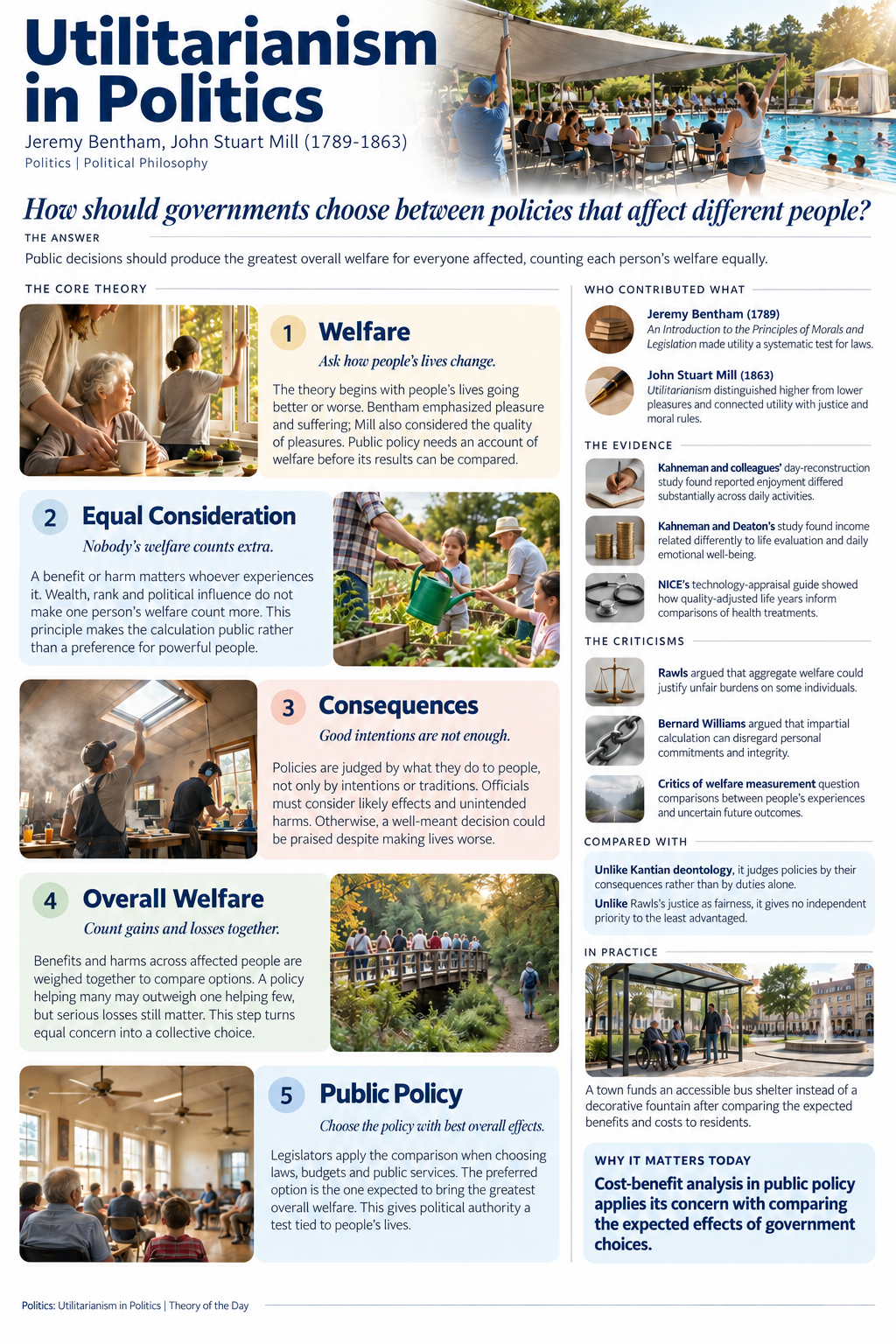
Infographic of: Utilitarianism in Politics
Politics: Political Philosophy
Utilitarianism in Politics
Jeremy Bentham, John Stuart Mill (1789-1863)
Public decisions should produce the greatest overall welfare for everyone affected, counting each person's welfare equally.
Utilitarianism developed in Britain amid debates about how laws should be justified and reformed. Jeremy Bentham's An Introduction to the Principles of Morals and Legislation, published in 1789, offered a standard for judging laws by their effects on human happiness and suffering rather than by custom or inherited authority. John Stuart Mill later defended and revised this approach in essays published in 1861 and collected as Utilitarianism in 1863. In politics, the theory asks whether institutions and public decisions improve the lives of the people they affect.
Its central claim is that a government should choose the available policy that produces the greatest overall welfare, giving each person's welfare equal consideration. The reasoning moves from individual experiences to public choices: policies alter people's lives; their likely benefits and harms can be compared; and a decision is judged by the combined result. This does not mean simply doing whatever a majority wants. A severe harm to a smaller group belongs in the comparison, as do long-term effects and consequences that officials did not intend.
Bentham made utility a systematic standard for legislation. He treated pleasure and pain as central to welfare and sought to assess laws through their consequences for everyone affected. Mill retained the concern with overall happiness but argued that pleasures differ in quality, not just quantity. He also examined how utility relates to moral rules and justice. His separate defence of liberty stressed the danger of social and political interference with individual development. Scholars disagree about whether Mill's account always fits straightforward calculations of total welfare.
No observation can establish by itself that maximizing welfare is morally right: this is a philosophical claim. Research can, however, inform the comparisons it requires. Kahneman and colleagues' 2004 day-reconstruction study found that people reported different experiences across daily activities. Kahneman and Deaton's 2010 study found that income related differently to people's evaluations of their lives and to their daily emotional well-being. In public policy, the National Institute for Health and Care Excellence's 2013 appraisal guide used quality-adjusted life years to help compare health treatments. Such measures provide information, not a complete moral verdict.
The strongest objections concern justice, rights and measurement. John Rawls argued that maximizing aggregate welfare could permit sacrifices imposed unfairly on some people. Bernard Williams questioned whether impartial calculation gives enough weight to personal commitments and integrity. It is also difficult to compare one person's welfare with another's or to predict every consequence of a law. Later utilitarians have developed accounts that give greater weight to rules whose general observance promotes welfare, though disagreements remain about whether those rules protect rights firmly enough.
Utilitarianism still matters because governments must make choices under limited budgets and uncertain conditions. Decisions about transport, healthcare or environmental protection affect different people in different ways. Welfare-based appraisal presses officials to identify those effects, include people they might overlook and explain why one use of public resources is preferable to another. It does not settle every dispute: a policy with a large overall benefit may still be challenged as unjust. Its lasting contribution is to make the human consequences of political decisions impossible to ignore.
The core theory
1. Welfare
The theory begins with people's lives going better or worse. Bentham emphasized pleasure and suffering; Mill also considered the quality of pleasures. Public policy needs an account of welfare before its results can be compared.
2. Equal Consideration
A benefit or harm matters whoever experiences it. Wealth, rank and political influence do not make one person's welfare count more. This principle makes the calculation public rather than a preference for powerful people.
3. Consequences
Policies are judged by what they do to people, not only by intentions or traditions. Officials must consider likely effects and unintended harms. Otherwise, a well-meant decision could be praised despite making lives worse.
4. Overall Welfare
Benefits and harms across affected people are weighed together to compare options. A policy helping many may outweigh one helping few, but serious losses still matter. This step turns equal concern into a collective choice.
5. Public Policy
Legislators apply the comparison when choosing laws, budgets and public services. The preferred option is the one expected to bring the greatest overall welfare. This gives political authority a test tied to people's lives.
The argument in four steps
- People experience pleasure and suffering, and public decisions change those experiences.
- Each affected person's welfare deserves equal consideration, regardless of status.
- Policies differ in the total benefits and harms they produce across those people.
- Therefore, the right policy produces the greatest overall welfare among the available options.
How it works
- Officials identify feasible options and estimate how each would affect people's lives.
- They weigh benefits against harms across those affected, including less visible groups and long-term effects.
- They choose the option with the best expected overall result, subject to what they can reliably predict.
Who contributed what
- Jeremy Bentham (1789): An Introduction to the Principles of Morals and Legislation made utility a systematic test for laws.
- John Stuart Mill (1863): Utilitarianism distinguished higher from lower pleasures and connected utility with justice and moral rules.
Compared with rival views
- Unlike Kantian deontology, it judges policies by their consequences rather than by duties alone.
- Unlike Rawls's justice as fairness, it gives no independent priority to the least advantaged.
Further reading
- Jeremy Bentham, An Introduction to the Principles of Morals and Legislation (1789)
- John Rawls, A Theory of Justice (1971)
- J. J. C. Smart and Bernard Williams, Utilitarianism: For and Against (1973)