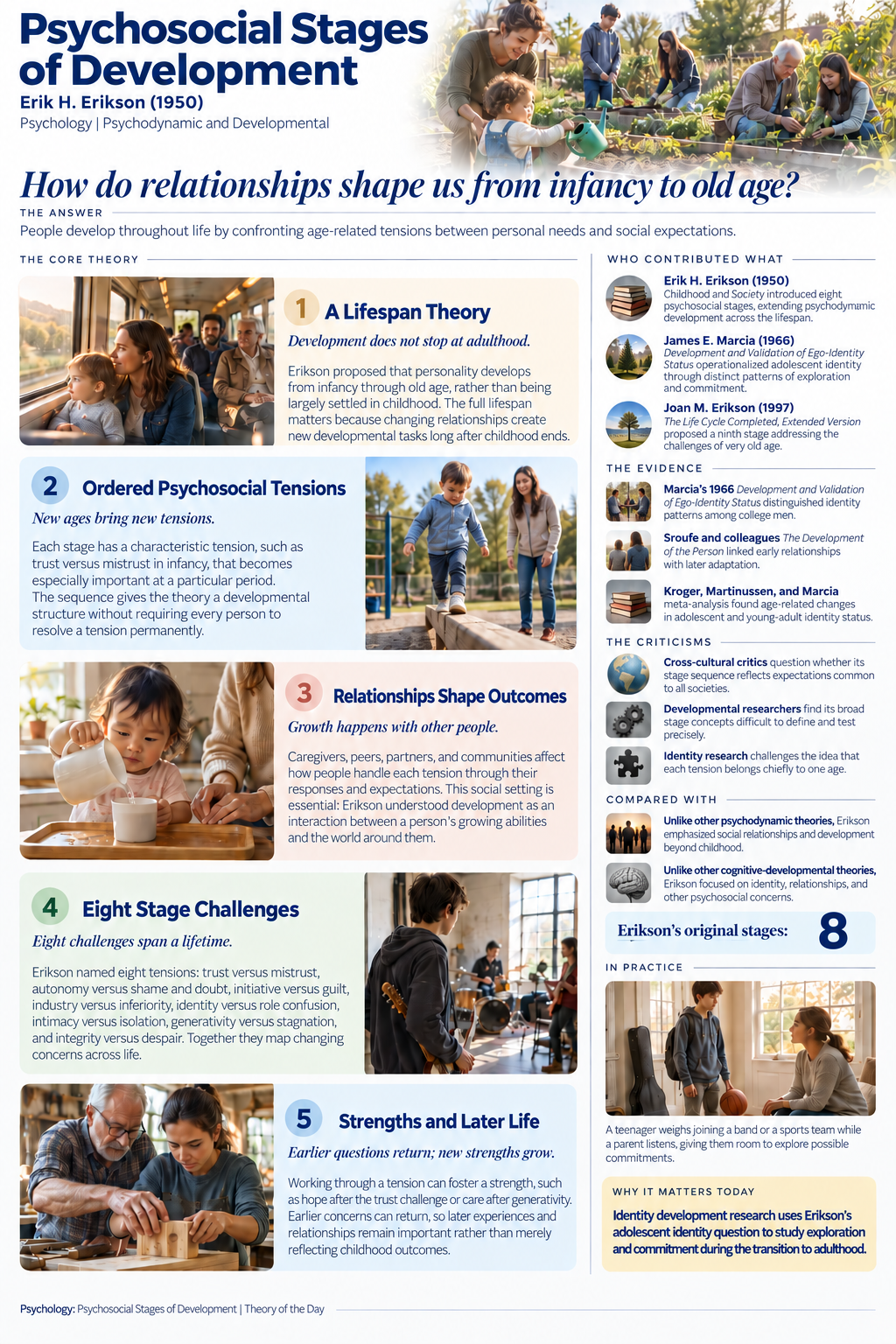
Infographic of: Psychosocial Stages of Development
Psychology: Psychodynamic and Developmental
Psychosocial Stages of Development
Erik H. Erikson (1950)
People develop throughout life by confronting age-related tensions between personal needs and social expectations.
Erik H. Erikson introduced his theory of psychosocial development in Childhood and Society (1950). Trained in the psychoanalytic tradition, he accepted that early experience matters but challenged the emphasis on childhood and sexual drives in Sigmund Freud's account. Erikson was interested in how families, institutions, and cultures shape a person's sense of self. He proposed a framework reaching from infancy into old age, with social relationships central at every point.
The theory describes eight stages, each organized around a tension that becomes especially important at a particular period. In infancy, for example, dependable care supports trust, while unreliable care contributes to mistrust. Later tensions concern autonomy versus shame and doubt; initiative versus guilt; industry versus inferiority; identity versus role confusion; intimacy versus isolation; generativity versus stagnation; and integrity versus despair. Generativity means contributing to younger people or to a wider community. These are not tests a person passes once and for all: both sides of a tension can have a place in a healthy life, and earlier concerns can return.
Erikson provided the original sequence and explored adolescent identity in particular: young people confront questions about who they are and what they will stand for. James E. Marcia later made that part of the theory easier to study. His 1966 research distinguished identity patterns by whether a person had explored alternatives and made commitments, rather than assuming everyone follows one route to adulthood. Joan M. Erikson subsequently proposed a ninth stage in the 1997 extended version of The Life Cycle Completed, drawing attention to the distinctive demands of very old age.
Evidence is stronger for some broad insights than for the exact eight-stage sequence. Marcia's 1966 interviews distinguished different approaches to identity among college men; later research has examined how those approaches change. A 2010 meta-analysis by Jane Kroger, Monica Martinussen, and Marcia found age-related changes in identity status through adolescence and young adulthood. Separately, L. Alan Sroufe and colleagues' 2005 account of the Minnesota longitudinal study connected early relationships with later adaptation. Such findings support the importance of relationships and continuing development, but they do not establish that everyone encounters eight crises in the proposed order.
The theory's stages are broad, making their boundaries and outcomes difficult to measure precisely. Critics also question whether expectations built into the sequence—particularly those concerning identity, partnership, and adulthood—apply equally across cultures and historical periods. Development is less tidy than a stage chart suggests: people revisit questions of trust, identity, and belonging, and later experiences can alter earlier patterns. Marcia's identity research and Joan Erikson's attention to very old age are developments of the framework, not demonstrations that every proposed stage is universal.
Erikson still matters because he supplied a vocabulary for asking what people need from relationships at different times of life without treating adulthood as development's endpoint. His account helps organize questions in developmental psychology, especially about adolescent identity, close relationships, and adult care for others. Its most useful role is as a guide to those questions, alongside research that tests particular ideas and allows for different life paths.
The core theory
1. A Lifespan Theory
Erikson proposed that personality develops from infancy through old age, rather than being largely settled in childhood. The full lifespan matters because changing relationships create new developmental tasks long after childhood ends.
2. Ordered Psychosocial Tensions
Each stage has a characteristic tension, such as trust versus mistrust in infancy, that becomes especially important at a particular period. The sequence gives the theory a developmental structure without requiring every person to resolve a tension permanently.
3. Relationships Shape Outcomes
Caregivers, peers, partners, and communities affect how people handle each tension through their responses and expectations. This social setting is essential: Erikson understood development as an interaction between a person's growing abilities and the world around them.
4. Eight Stage Challenges
Erikson named eight tensions: trust versus mistrust, autonomy versus shame and doubt, initiative versus guilt, industry versus inferiority, identity versus role confusion, intimacy versus isolation, generativity versus stagnation, and integrity versus despair. Together they map changing concerns across life.
5. Strengths and Later Life
Working through a tension can foster a strength, such as hope after the trust challenge or care after generativity. Earlier concerns can return, so later experiences and relationships remain important rather than merely reflecting childhood outcomes.
The argument in four steps
- Development continues beyond childhood because social demands change as people grow older.
- Each period brings a characteristic tension between a developing need and the demands of relationships.
- How people handle that tension shapes capacities they bring to later relationships and challenges.
- So successive tensions shape trust, identity, care for others, and reflection across the lifespan.
How it works
- Growing abilities bring a person into new relationships and expectations at different periods of life.
- Support, conflict, and opportunities to act influence how that person handles the period's tension.
- Their response develops a strength or leaves a difficulty that later experiences can reshape.
Who contributed what
- Erik H. Erikson (1950): Childhood and Society introduced eight psychosocial stages, extending psychodynamic development across the lifespan.
- James E. Marcia (1966): Development and Validation of Ego-Identity Status operationalized adolescent identity through distinct patterns of exploration and commitment.
- Joan M. Erikson (1997): The Life Cycle Completed, Extended Version proposed a ninth stage addressing the challenges of very old age.
Compared with rival views
- Unlike Freud's psychosexual stages, Erikson emphasized social relationships and development beyond childhood.
- Unlike Piaget's cognitive-developmental stages, Erikson focused on identity, relationships, and other psychosocial concerns.
Further reading
- Erik H. Erikson, Childhood and Society (1950)
- L. Alan Sroufe and colleagues, The Development of the Person: The Minnesota Study of Risk and Adaptation from Birth to Adulthood (2005)
- Jane Kroger, Monica Martinussen, and James E. Marcia, Identity Status Change During Adolescence and Young Adulthood: A Meta-Analysis (2010)