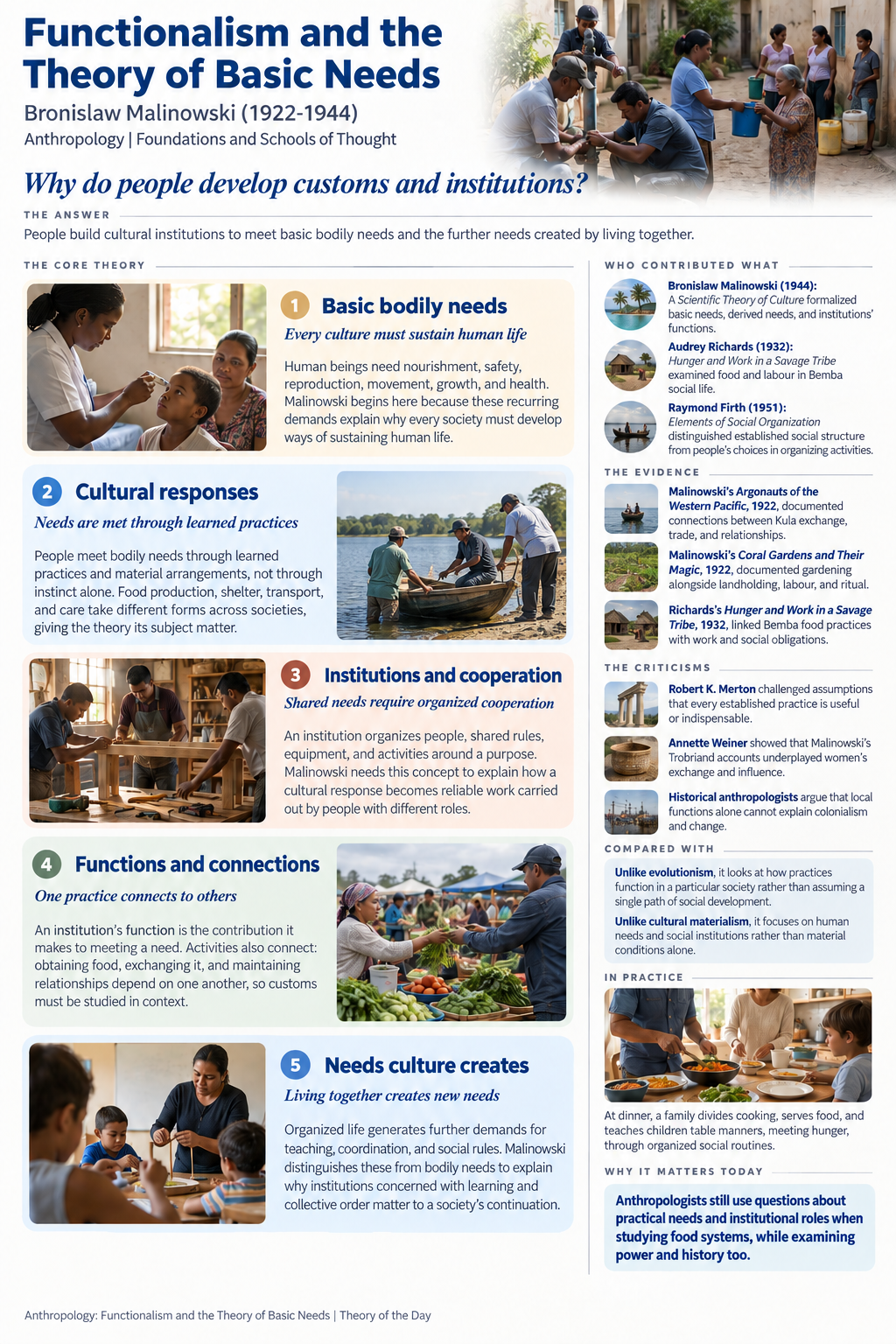
Infographic of: Functionalism and the Theory of Basic Needs
Anthropology: Foundations and Schools of Thought
Functionalism and the Theory of Basic Needs
Bronislaw Malinowski (1922-1944)
People build cultural institutions to meet basic bodily needs and the further needs created by living together.
Bronislaw Malinowski developed his version of functionalism in the early twentieth century, when many anthropologists were trying to reconstruct where customs originated or how they spread. His fieldwork in the Trobriand Islands led him to ask a different question: how do people use customs and institutions in the course of living? Argonauts of the Western Pacific, published in 1922, demonstrated his approach through detailed study of exchange and everyday activity. His posthumous book A Scientific Theory of Culture and Other Essays, published in 1944, set out the theory of basic needs more systematically.
Malinowski began with demands all human beings face, including nourishment, reproduction, safety, growth, and health. People meet these demands through culture: learned practices, tools, cooperation, and institutions. A way of producing food, for example, involves more than obtaining calories. It requires equipment, knowledge, work roles, and expectations about who does what. Organized life then creates further needs, including teaching skills and coordinating people's conduct. Malinowski called the contribution an institution makes toward meeting a need its function. He therefore studied practices in relation to the wider activities of which they formed a part.
Malinowski was the principal developer of this needs-based theory. His distinctive contribution was to connect the study of institutions to human requirements while insisting that anthropologists observe how people actually use them. Other researchers extended functionalist inquiry without simply repeating his model. In Hunger and Work in a Savage Tribe, published in 1932, Audrey Richards examined how food and labour were bound up with Bemba social relationships. Raymond Firth's Elements of Social Organization, published in 1951, gave closer attention to the choices people make as they organize activities within established social arrangements.
The classic studies offer detailed illustrations rather than a decisive test of the claim that every institution serves a need. In Argonauts of the Western Pacific, Malinowski documented how ceremonial Kula exchange connected travel, partnerships, trade, and social standing. His Coral Gardens and Their Magic, published in 1935, placed Trobriand gardening alongside landholding, labour, and ritual. Richards's study showed why a question about food could not be answered by looking at nutrition alone: work and social obligations shaped how people obtained and used it. These studies made the links among activities visible through sustained field research.
Functionalism also attracted substantial criticism. It can explain an existing custom by naming a need it supposedly meets, without independently showing that this explanation is correct. Sociologist Robert K. Merton challenged the assumption that established practices are necessarily useful or indispensable. Annette Weiner's later Trobriand research brought women's exchanges and influence into view where Malinowski's accounts had given them too little attention. Historical anthropologists have likewise argued that attention to a local institution's current role can obscure colonial pressures, conflict, and change. These objections limit claims that every custom can be explained by its beneficial function.
The theory still matters because it asks a productive question: what work does an institution do in people's lives, and how does that work connect to other activities? In studying a food system, for instance, an anthropologist can examine nourishment alongside labour, teaching, exchange, and rules of access. Today that question is most useful when joined to equally careful questions about unequal power, historical change, and whose needs an arrangement actually serves.
The core theory
1. Basic bodily needs
Human beings need nourishment, safety, reproduction, movement, growth, and health. Malinowski begins here because these recurring demands explain why every society must develop ways of sustaining human life.
2. Cultural responses
People meet bodily needs through learned practices and material arrangements, not through instinct alone. Food production, shelter, transport, and care take different forms across societies, giving the theory its subject matter.
3. Institutions and cooperation
An institution organizes people, shared rules, equipment, and activities around a purpose. Malinowski needs this concept to explain how a cultural response becomes reliable work carried out by people with different roles.
4. Functions and connections
An institution's function is the contribution it makes to meeting a need. Activities also connect: obtaining food, exchanging it, and maintaining relationships depend on one another, so customs must be studied in context.
5. Needs culture creates
Organized life generates further demands for teaching, coordination, and social rules. Malinowski distinguishes these from bodily needs to explain why institutions concerned with learning and collective order matter to a society's continuation.
The argument in four steps
- People everywhere must obtain food, reproduce, find safety, and maintain health.
- Meeting these needs requires learned practices, tools, and cooperation rather than biology alone.
- Repeated cooperation develops organized roles and rules, which create further needs for coordination and teaching.
- Therefore, cultural institutions sustain collective life by meeting basic needs and the needs their organization creates.
How it works
- A recurring practical problem leads people to use and pass on a workable practice.
- Cooperation brings specialized roles and expectations, while conflicting demands can disrupt the arrangement.
- The practice endures when an institution supports everyday life and passes its methods to others.
Who contributed what
- Bronislaw Malinowski (1944): A Scientific Theory of Culture formalized basic needs, derived needs, and institutions' functions.
- Audrey Richards (1932): Hunger and Work in a Savage Tribe examined food and labour in Bemba social life.
- Raymond Firth (1951): Elements of Social Organization distinguished established social structure from people's choices in organizing activities.
Compared with rival views
- Unlike diffusionism, it asks what practices do locally rather than chiefly where they originated.
- Unlike Radcliffe-Brown's structural functionalism, it starts with human needs rather than social structure's continuity.
Further reading
- Bronislaw Malinowski, A Scientific Theory of Culture and Other Essays (1944)
- Adam Kuper, Anthropology and Anthropologists: The Modern British School (1973)
- Annette B. Weiner, Women of Value, Men of Renown: New Perspectives in Trobriand Exchange (1976)