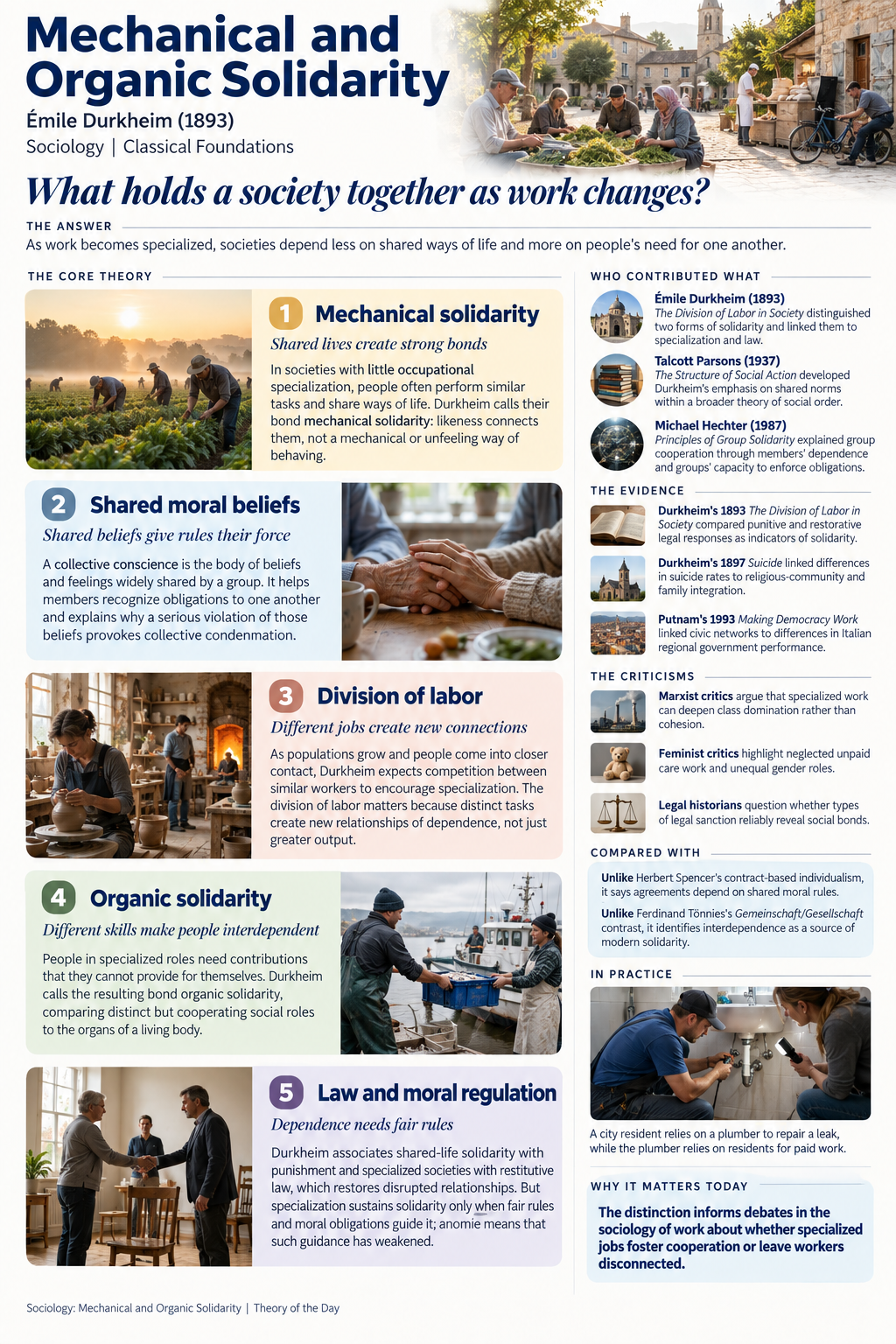
Infographic of: Mechanical and Organic Solidarity
Sociology: Classical Foundations
Mechanical and Organic Solidarity
Émile Durkheim (1893)
As work becomes specialized, societies depend less on shared ways of life and more on people's need for one another.
Émile Durkheim introduced mechanical and organic solidarity in The Division of Labor in Society, published in 1893. Writing amid industrialization and expanding cities, he asked how societies hold together when people no longer share the same occupations and daily experiences. He challenged the idea that modern order rests simply on individuals pursuing their interests and making contracts. For Durkheim, even a contract depends on moral expectations that neither party invents alone. His question was therefore not just how work becomes more efficient, but how a changing division of labor alters social bonds.
Mechanical solidarity binds people through likeness: similar work, experiences, beliefs and obligations support a strong collective conscience, or widely shared moral life. Durkheim associated this form with punitive law, which expresses collective outrage at a violation. Organic solidarity instead binds people whose specialized contributions are different but mutually necessary. He compared their relationship to the distinct organs of a body. As population grows and social contact increases, competition encourages specialization. In a well-regulated society, cooperation across specialized roles becomes a source of solidarity in its own right.
Durkheim originated the distinction and used patterns of law to investigate it. Talcott Parsons later drew on Durkheim in The Structure of Social Action (1937), stressing the shared norms that make coordinated action possible; he did not originate the two types. Michael Hechter offered a different account in Principles of Group Solidarity (1987). Rather than explaining solidarity chiefly through a historical shift in the division of labor, Hechter examined how dependence among group members and the enforcement of obligations support cooperation. These later approaches developed questions about moral order and cooperation without simply repeating Durkheim's account.
Durkheim treated legal sanctions as clues to otherwise hard-to-observe social bonds. In his 1893 book, he contrasted punishment with remedies intended to restore disrupted relationships, while acknowledging that both forms of law exist. Suicide (1897) offered related, indirect evidence: its comparisons associated suicide rates with forms of family and religious-community integration. Much later, Robert Putnam's Making Democracy Work (1993) connected civic networks with differences in the performance of Italian regional governments. That finding illustrates the importance of social ties, although it does not directly test Durkheim's proposed transition between types of solidarity.
The distinction is not a simple claim that every modern society becomes harmonious. Durkheim described abnormal forms of the division of labor, including anomie, where moral guidance is inadequate, and forced specialization, where inequality prevents people from taking roles on fair terms. Marxist critics argue that interdependence can coexist with exploitation and class conflict. Feminist critics point to unpaid care work and gendered inequalities that his account insufficiently addresses. Scholars also question whether punitive and restorative law neatly separate into two kinds of society. The categories are best treated as analytical contrasts, not a rigid historical sequence.
The theory still gives sociologists a useful way to ask what connects people who lead very different lives. A resident and a plumber need each other's contributions, but that dependence alone does not guarantee trust or fair treatment. Rules, obligations and access to roles shape whether cooperation lasts. In the sociology of work, Durkheim's distinction helps frame a continuing debate: does specialization create dependable relationships across a society, or do unequal conditions and weak protections leave people interdependent but divided?
The core theory
1. Mechanical solidarity
In societies with little occupational specialization, people often perform similar tasks and share ways of life. Durkheim calls their bond mechanical solidarity: likeness connects them, not a mechanical or unfeeling way of behaving.
2. Shared moral beliefs
A collective conscience is the body of beliefs and feelings widely shared by a group. It helps members recognize obligations to one another and explains why a serious violation of those beliefs provokes collective condemnation.
3. Division of labor
As populations grow and people come into closer contact, Durkheim expects competition between similar workers to encourage specialization. The division of labor matters because distinct tasks create new relationships of dependence, not just greater output.
4. Organic solidarity
People in specialized roles need contributions that they cannot provide for themselves. Durkheim calls the resulting bond organic solidarity, comparing distinct but cooperating social roles to the organs of a living body.
5. Law and moral regulation
Durkheim associates shared-life solidarity with punishment and specialized societies with restitutive law, which restores disrupted relationships. But specialization sustains solidarity only when fair rules and moral obligations guide it; anomie means that such guidance has weakened.
The argument in four steps
- Every society needs bonds that connect individuals to a wider social life.
- Where people lead similar lives, shared beliefs make wrongdoing feel like an offense against everyone.
- As work becomes specialized, people rely on others with different skills and roles.
- So, under fair rules, interdependence becomes the basis of solidarity.
How it works
- Growing population and more frequent contact put people doing similar work into sharper competition.
- Specialized roles develop, but trustworthy cooperation requires fair terms and obligations beyond any single exchange.
- Where those conditions fail, forced roles or weak moral guidance produce conflict or anomie instead of cohesion.
Who contributed what
- Émile Durkheim (1893): The Division of Labor in Society distinguished two forms of solidarity and linked them to specialization and law.
- Talcott Parsons (1937): The Structure of Social Action developed Durkheim's emphasis on shared norms within a broader theory of social order.
- Michael Hechter (1987): Principles of Group Solidarity explained group cooperation through members' dependence and groups' capacity to enforce obligations.
Compared with rival views
- Unlike Herbert Spencer's contract-based individualism, it says agreements depend on shared moral rules.
- Unlike Ferdinand Tönnies's Gemeinschaft/Gesellschaft contrast, it identifies interdependence as a source of modern solidarity.
Further reading
- Émile Durkheim, The Division of Labor in Society (1893)
- Steven Lukes, Émile Durkheim: His Life and Work: A Historical and Critical Study (1973)
- Anthony Giddens, Capitalism and Modern Social Theory (1971)