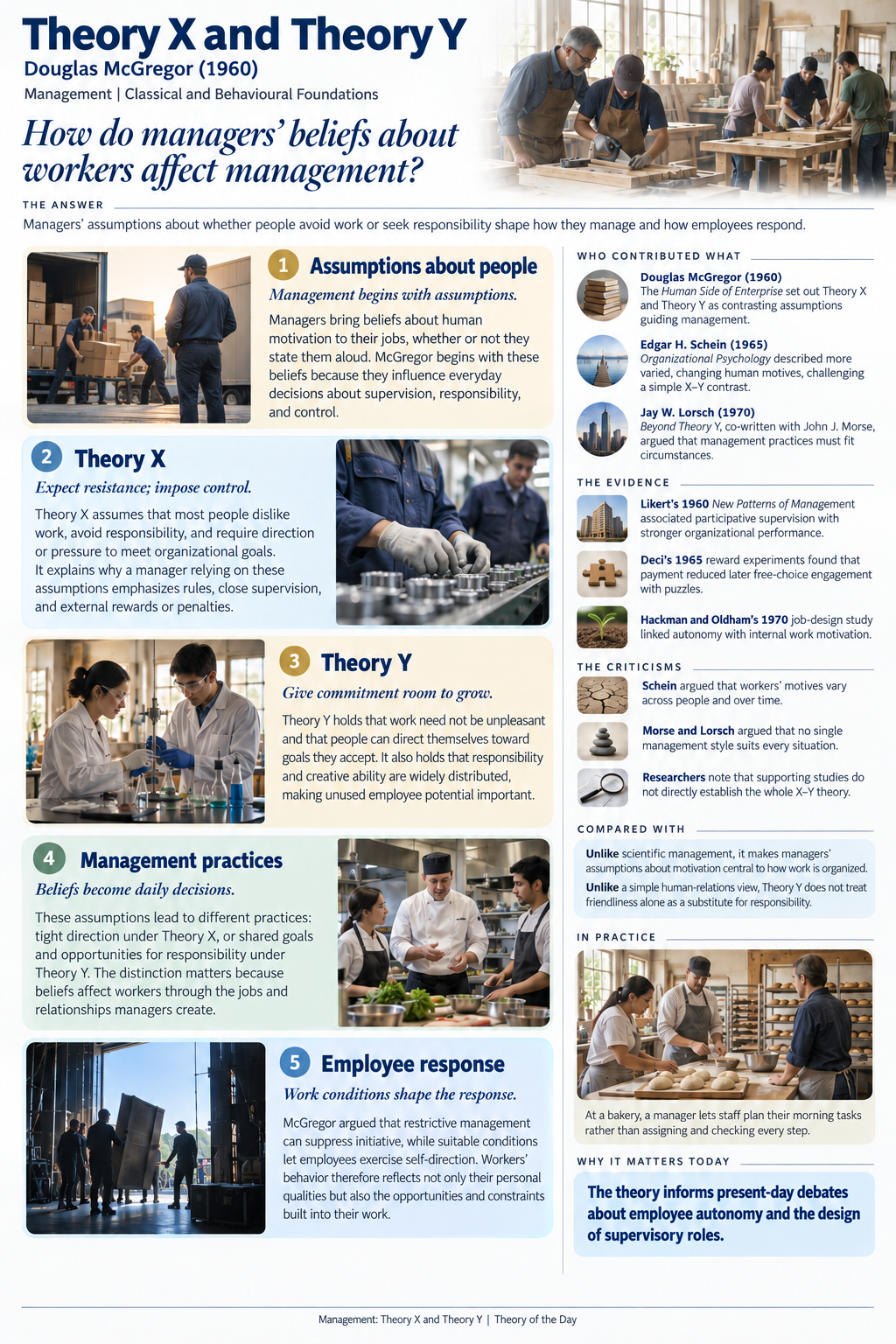
Infographic of: Theory X and Theory Y
Management: Classical and Behavioural Foundations
Theory X and Theory Y
Douglas McGregor (1960)
Managers’ assumptions about whether people avoid work or seek responsibility shape how they manage and how employees respond.
Douglas McGregor presented Theory X and Theory Y in his 1960 book The Human Side of Enterprise, during a period when management scholars were questioning whether close supervision and financial incentives adequately explained performance at work. Influenced in part by research on human needs and motivation, he asked managers to examine something less visible than an organizational chart: their assumptions about employees. His two theories describe contrasting sets of managerial beliefs, not two permanent types of worker.
Theory X assumes that people generally dislike work, avoid responsibility, and need direction, pressure, or control to serve organizational goals. Theory Y begins from different assumptions: work need not be unpleasant, people can direct themselves toward goals they accept, and responsibility and creativity are more widely distributed than many organizations recognize. For McGregor, these beliefs matter because managers act on them. A manager who expects reluctance builds tight controls; one who expects initiative tries to create conditions in which employees can commit to goals and exercise judgment. Theory Y is not a call to abandon management: goals, coordination, and suitable working conditions remain essential.
McGregor developed the X–Y contrast and argued that conventional organizations often failed to use employees’ capacities. Later scholars complicated his account rather than simply endorsing one side. Edgar H. Schein described people’s motives as varied and changeable, challenging any neat classification of what workers want. In 1970, John J. Morse and Jay W. Lorsch argued in Beyond Theory Y that the effectiveness of a management approach depends on its fit with the task and organizational circumstances. Their point was that participation is not a universal recipe.
Theory X and Theory Y were chiefly a framework for interpreting management, not a single experiment with a decisive numerical result. Related research lends support to particular mechanisms. Rensis Likert’s New Patterns of Management, published in 1961, reported associations between participative supervision and stronger organizational performance. Edward Deci’s 1971 experiments found that, under the conditions he studied, payment reduced people’s later voluntary engagement with puzzles. J. Richard Hackman and Greg R. Oldham’s 1976 research on job design linked autonomy with internal work motivation. None of these studies, by itself, proves McGregor’s complete theory.
Critics argue that the X–Y contrast can make a complicated range of managerial beliefs look like a choice between two camps. People differ in what they want from work, and the same person’s needs change with the task, their experience, and their circumstances. Morse and Lorsch’s contingency argument also warns that giving responsibility without adequate resources or coordination is not necessarily effective. Later work on motivation and job design examines these conditions more closely. It is therefore safer to treat McGregor’s theories as contrasting assumptions with practical consequences, rather than as fixed labels for employees or guaranteed predictions.
The theory still gives managers a useful question to ask: what behavior does our way of organizing work invite? Close monitoring can be appropriate for some tasks, but a workplace that permits no judgment offers little opportunity to observe employees exercising it. Conversely, inviting people to help set goals or solve problems gives them a chance to demonstrate abilities that rigid supervision might conceal. In management education and debates about employee autonomy, McGregor’s enduring contribution is to make the manager’s beliefs—and the work arrangements built from them—part of the explanation for employee behavior.
The core theory
1. Assumptions about people
Managers bring beliefs about human motivation to their jobs, whether or not they state them aloud. McGregor begins with these beliefs because they influence everyday decisions about supervision, responsibility, and control.
2. Theory X
Theory X assumes that most people dislike work, avoid responsibility, and require direction or pressure to meet organizational goals. It explains why a manager relying on these assumptions emphasizes rules, close supervision, and external rewards or penalties.
3. Theory Y
Theory Y holds that work need not be unpleasant and that people can direct themselves toward goals they accept. It also holds that responsibility and creative ability are widely distributed, making unused employee potential important.
4. Management practices
These assumptions lead to different practices: tight direction under Theory X, or shared goals and opportunities for responsibility under Theory Y. The distinction matters because beliefs affect workers through the jobs and relationships managers create.
5. Employee response
McGregor argued that restrictive management can suppress initiative, while suitable conditions let employees exercise self-direction. Workers’ behavior therefore reflects not only their personal qualities but also the opportunities and constraints built into their work.
The argument in four steps
- Managers act on assumptions about what motivates workers.
- When managers expect avoidance, they impose close supervision and external pressure.
- When managers expect initiative, they offer responsibility, participation, and room for self-direction.
- So managerial assumptions create conditions that shape employee motivation and conduct.
How it works
- A supervisor chooses how much to consult employees and how closely to check their work.
- Tight controls restrict discretion; meaningful goals, resources, and shared decisions support initiative.
- The outcome depends on whether the work arrangement gives employees genuine opportunities to take responsibility.
Who contributed what
- Douglas McGregor (1960): The Human Side of Enterprise set out Theory X and Theory Y as contrasting assumptions guiding management.
- Edgar H. Schein (1965): Organizational Psychology described more varied, changing human motives, challenging a simple X–Y contrast.
- Jay W. Lorsch (1970): Beyond Theory Y, co-written with John J. Morse, argued that management practices must fit circumstances.
Compared with rival views
- Unlike scientific management, it makes managers’ assumptions about motivation central to how work is organized.
- Unlike a simple human-relations view, Theory Y does not treat friendliness alone as a substitute for responsibility.
Further reading
- Douglas McGregor, The Human Side of Enterprise (1960)
- Edgar H. Schein, Organizational Psychology (1965)
- John J. Morse and Jay W. Lorsch, Beyond Theory Y (1970)