Infographic of: Essentialism and Perennialism
Education: Philosophies and Movements of Education
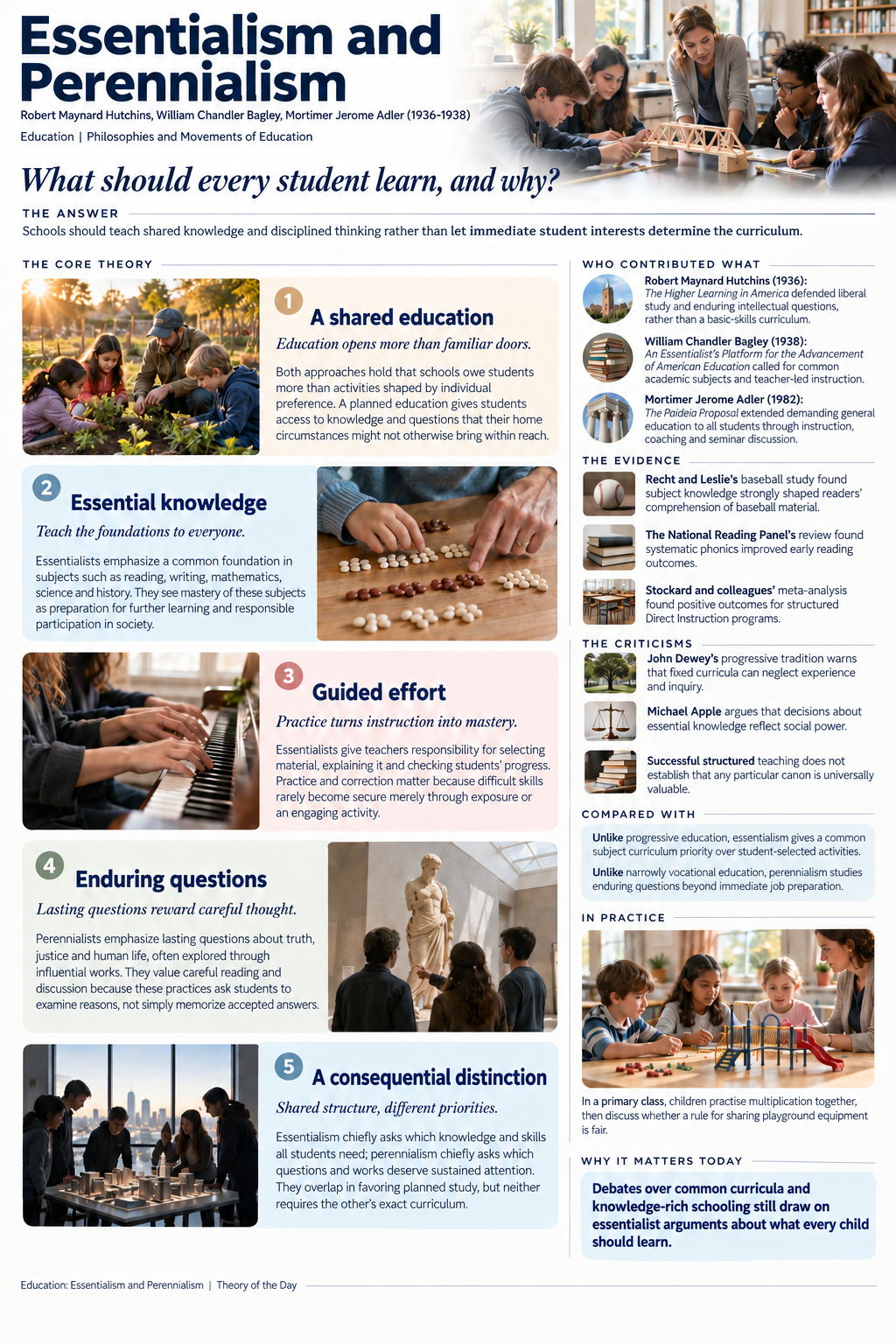
Essentialism and Perennialism
Robert Maynard Hutchins, William Chandler Bagley, Mortimer Jerome Adler (1936-1938)
Schools should teach shared knowledge and disciplined thinking rather than let immediate student interests determine the curriculum.
Essentialism and perennialism are related, but distinct, philosophies of education. Both gained prominence in the United States amid arguments about what schools should teach and whether education organized around children’s immediate interests gave enough attention to demanding academic study. Robert Maynard Hutchins made a major statement of the perennialist case in 1936; William Chandler Bagley set out an essentialist platform in 1938. Mortimer Jerome Adler later developed a more explicitly universal version of perennial education. The dates mark influential statements, not the invention of either concern: educators had long debated common knowledge and lasting intellectual questions.
Essentialists argue that schools should deliberately teach a foundation of subjects and skills, including literacy, mathematics, science and history. Teachers select and sequence content, explain difficult ideas, provide practice and assess understanding. Perennialists put greater emphasis on sustained engagement with enduring questions about truth, justice and human life, often through influential works and discussion. Their aim is not simply to pass on conclusions but to develop reasoned judgment. Both approaches reject the idea that students’ current interests alone should determine what they study, although they differ over which knowledge deserves priority.
Hutchins’s The Higher Learning in America defended liberal education against narrow specialization and linked education to intellectual inquiry. Bagley’s An Essentialist’s Platform for the Advancement of American Education instead stressed a common academic curriculum, disciplined effort and teachers’ responsibility to guide learning. Adler’s The Paideia Proposal extended the ambition of demanding general education to all children, not only those headed for university. Its proposed combination of instruction, coaching and seminar discussion also shows why perennial education should not be mistaken for memorizing a list of classics. These writers shared a concern for serious study, but did not set out one unified theory.
Evidence supports some educational practices associated with these views more directly than it supports the philosophies as wholes. Recht and Leslie’s 1988 study found that knowledge of baseball strongly affected how well students understood baseball material, illustrating the importance of subject knowledge for comprehension. The National Reading Panel’s 2000 review found benefits from systematic phonics in early reading instruction. Stockard and colleagues’ 2018 meta-analysis reported positive outcomes for structured Direct Instruction programs. None of these findings establishes which historical, literary or philosophical works every student should study, or settles how much choice students should have.
Critics raise both practical and political questions. The progressive tradition associated with John Dewey cautions that instruction can become detached from students’ experience if a prescribed curriculum leaves too little room for inquiry. Critical curriculum scholars, notably Michael Apple, ask who decides what counts as essential knowledge and whose histories are left out. Teachers also have to consider differences in students’ prior preparation and access to learning resources. Adler’s proposal for a demanding education for everyone addressed one concern about exclusion, but did not end disagreements over the content of a shared curriculum.
These philosophies still matter whenever schools decide what every student should learn. Essentialist arguments appear in debates over common curricula, foundational literacy and subject knowledge; perennialist arguments appear in discussions of liberal education and sustained dialogue about major questions. Their most useful contribution is not a ready-made reading list or a single teaching method. It is the challenge to justify a curriculum: whether its content opens important opportunities to all students, and whether its teaching helps them understand and question what they encounter.
The core theory
1. A shared education
Both approaches hold that schools owe students more than activities shaped by individual preference. A planned education gives students access to knowledge and questions that their home circumstances might not otherwise bring within reach.
2. Essential knowledge
Essentialists emphasize a common foundation in subjects such as reading, writing, mathematics, science and history. They see mastery of these subjects as preparation for further learning and responsible participation in society.
3. Guided effort
Essentialists give teachers responsibility for selecting material, explaining it and checking students’ progress. Practice and correction matter because difficult skills rarely become secure merely through exposure or an engaging activity.
4. Enduring questions
Perennialists emphasize lasting questions about truth, justice and human life, often explored through influential works. They value careful reading and discussion because these practices ask students to examine reasons, not simply memorize accepted answers.
5. A consequential distinction
Essentialism chiefly asks which knowledge and skills all students need; perennialism chiefly asks which questions and works deserve sustained attention. They overlap in favoring planned study, but neither requires the other’s exact curriculum.
The argument in four steps
- Children inherit a body of knowledge they cannot discover anew through personal experience alone.
- Shared subjects give them tools for understanding the world and participating in society.
- Guided study builds knowledge and reasoning beyond what students already know or prefer.
- Therefore, schools must teach a deliberate curriculum rather than rely chiefly on student choice.
How it works
- Educators choose a sequence of foundational subjects or enduring questions before individual interests set the agenda.
- Teachers explain, assign practice and lead discussion; gaps in prior knowledge or limited access to resources hinder progress.
- Students’ demonstrated understanding determines when instruction revisits a topic or moves toward harder material.
Who contributed what
- Robert Maynard Hutchins (1936): The Higher Learning in America defended liberal study and enduring intellectual questions, rather than a basic-skills curriculum.
- William Chandler Bagley (1938): An Essentialist’s Platform for the Advancement of American Education called for common academic subjects and teacher-led instruction.
- Mortimer Jerome Adler (1982): The Paideia Proposal extended demanding general education to all students through instruction, coaching and seminar discussion.
Compared with rival views
- Unlike progressive education, essentialism gives a common subject curriculum priority over student-selected activities.
- Unlike narrowly vocational education, perennialism studies enduring questions beyond immediate job preparation.
Further reading
- William Chandler Bagley, An Essentialist’s Platform for the Advancement of American Education (1938)
- Nel Noddings, Philosophy of Education (1995)
- Michael W. Apple, Ideology and Curriculum (1979)