Infographic of: As a Man Thinketh
Positivity: Classic Positive Thinking
As a Man Thinketh
James Allen (1903)
Repeated thoughts shape character, actions, and, Allen believed, the circumstances of a person's life.
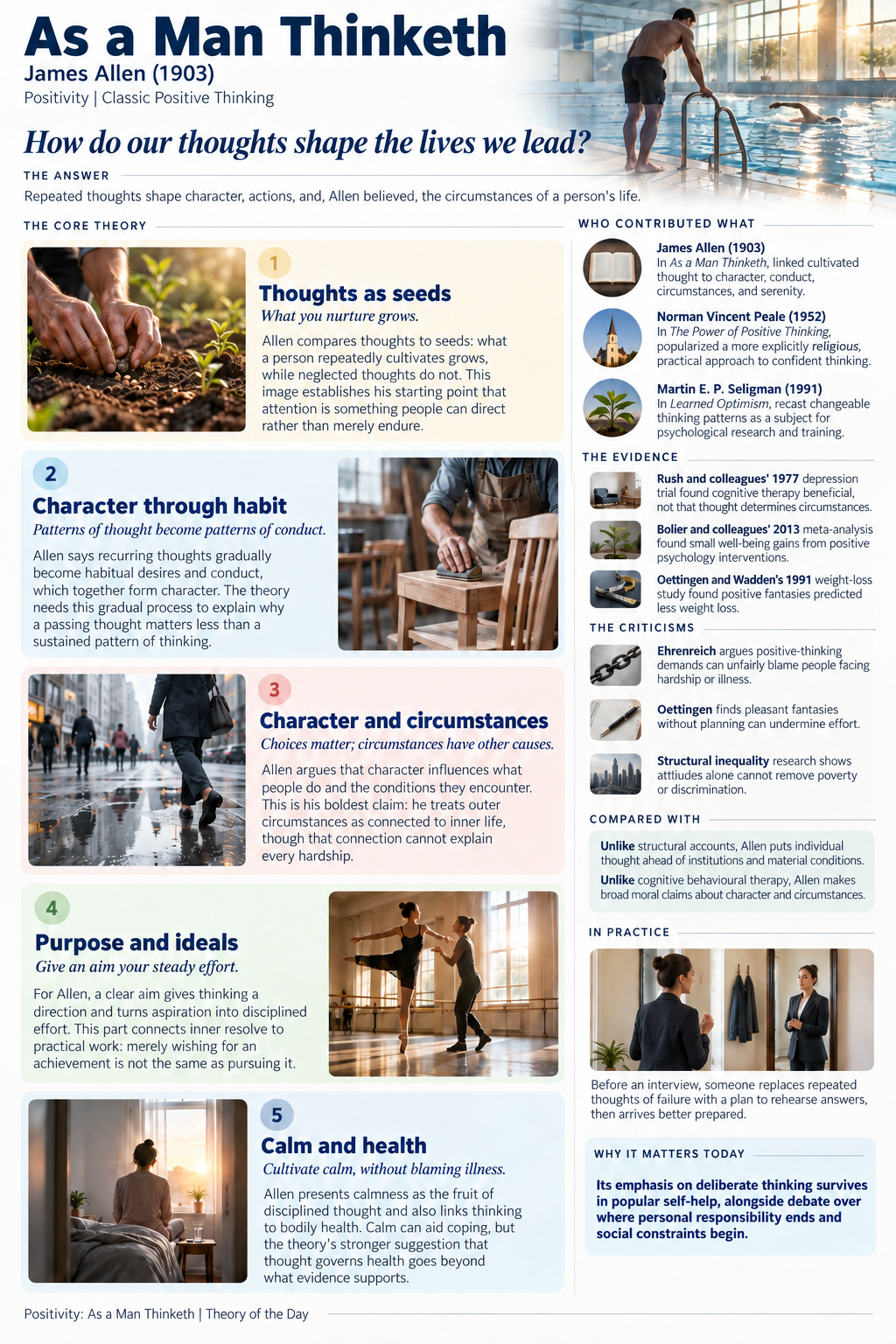
James Allen published As a Man Thinketh in 1903, when writing about character, self-improvement, and the power of the mind attracted a broad readership. It is a short work of moral philosophy and popular self-help, not an academic theory established through experiments. Allen wanted readers to examine their habitual thinking rather than regard their character as fixed. His title draws on a biblical phrase, but the essay offers a general lesson about personal responsibility rather than a formal psychological model.
Allen compares thoughts to seeds that grow when cultivated. In his account, repeatedly dwelling on certain desires and judgments forms habits; those habits shape character, which guides action and influences life's circumstances. A clear purpose directs effort, while disciplined thinking brings calm. He goes further, suggesting a close relationship between thoughts and bodily health. The useful distinction is between a fleeting thought and an enduring pattern, though Allen often describes the reach of thought more broadly than evidence warrants.
Allen alone wrote the original essay. Later authors developed related ideas, but they did not jointly originate his work. Norman Vincent Peale's The Power of Positive Thinking, published in 1952, offered a more explicitly religious and practical message about confidence. Martin E. P. Seligman's Learned Optimism, published in 1991, approached changeable thinking patterns through psychology. Seligman's research tradition is not a validation of every claim Allen made: it examines more specific questions about expectations, explanations for setbacks, and coping.
Research supports some narrower links between thinking and outcomes. In a 1977 trial, A. John Rush and colleagues found that cognitive therapy helped patients with depression; changing patterns of thought was part of a structured treatment, not a demonstration that thoughts control all events. A 2013 meta-analysis by Linda Bolier and colleagues found small improvements in well-being from positive psychology interventions. Evidence also cautions against treating optimism as sufficient: Gabriele Oettingen and Thomas Wadden reported in 1991 that positive fantasies about weight loss predicted less subsequent weight loss.
The main objection is to Allen's leap from thinking to circumstances. Poverty, discrimination, illness, and chance can shape a life regardless of anyone's outlook; character is not their sole cause. Barbara Ehrenreich has criticized the pressure to think positively for encouraging blame when people suffer. Later psychological approaches generally make more limited claims: thought patterns can affect feelings, decisions, and behaviour, while practical action and external support matter too. Nor does evidence establish that positive thoughts by themselves attract desired events.
As a Man Thinketh still matters because it states, with unusual clarity, an enduring self-help proposition: pay attention to the thoughts you repeatedly cultivate. Its emphasis on reflection, purpose, and practice can help a reader ask whether a habitual expectation is discouraging useful action. The responsible way to read it is neither as a promise that anyone can think away adversity nor as a reason to dismiss agency. It is a historical account of self-direction whose strongest claims need to be separated from testable, narrower benefits.
The core theory
1. Thoughts as seeds
Allen compares thoughts to seeds: what a person repeatedly cultivates grows, while neglected thoughts do not. This image establishes his starting point that attention is something people can direct rather than merely endure.
2. Character through habit
Allen says recurring thoughts gradually become habitual desires and conduct, which together form character. The theory needs this gradual process to explain why a passing thought matters less than a sustained pattern of thinking.
3. Character and circumstances
Allen argues that character influences what people do and the conditions they encounter. This is his boldest claim: he treats outer circumstances as connected to inner life, though that connection cannot explain every hardship.
4. Purpose and ideals
For Allen, a clear aim gives thinking a direction and turns aspiration into disciplined effort. This part connects inner resolve to practical work; merely wishing for an achievement is not the same as pursuing it.
5. Calm and health
Allen presents calmness as the fruit of disciplined thought and also links thinking to bodily health. Calm can aid coping, but the theory's stronger suggestion that thought governs health goes beyond what evidence supports.
The argument in four steps
- People repeatedly entertain certain thoughts, whether deliberately or without noticing.
- Repeated thoughts settle into habits of attention, desire, and judgment.
- Those habits shape character and guide choices, conduct, and effort.
- So deliberate, constructive thinking produces stronger character, purposeful action, and a more peaceful life.
How it works
- A person notices recurring thoughts and begins directing attention toward a chosen purpose.
- Repetition strengthens helpful or harmful habits; deliberate practice interrupts the harmful ones.
- Conduct and effort influence what follows, while external conditions also affect the outcome.
Who contributed what
- James Allen (1903): In As a Man Thinketh, linked cultivated thought to character, conduct, circumstances, and serenity.
- Norman Vincent Peale (1952): In The Power of Positive Thinking, popularized a more explicitly religious, practical approach to confident thinking.
- Martin E. P. Seligman (1991): In Learned Optimism, recast changeable thinking patterns as a subject for psychological research and training.
Compared with rival views
- Unlike structural accounts, Allen puts individual thought ahead of institutions and material conditions.
- Unlike cognitive behavioural therapy, Allen makes broad moral claims about character and circumstances.
Further reading
- James Allen, As a Man Thinketh (1903)
- Mitch Horowitz, One Simple Idea: How Positive Thinking Reshaped Modern Life (2014)
- Barbara Ehrenreich, Bright-sided: How Positive Thinking Is Undermining America (2009)