Infographic of: Think and Grow Rich
Positivity: Classic Positive Thinking
Think and Grow Rich
Napoleon Hill (1937)
A definite goal, reinforced by belief and pursued through planning and persistence, leads to financial success.
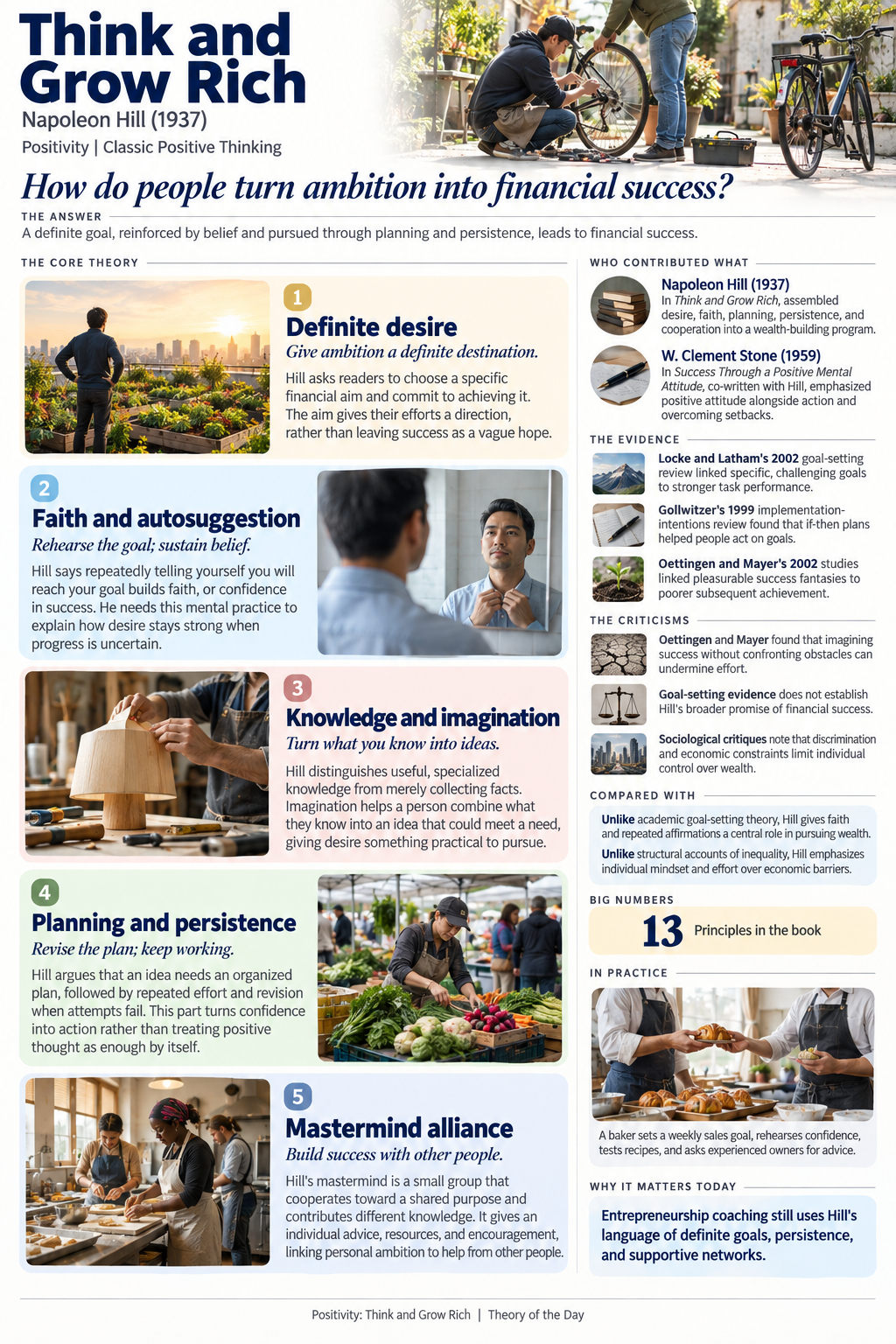
Napoleon Hill published Think and Grow Rich in 1937, during the Great Depression, as a practical guide to gaining wealth. It belongs to the American tradition of positive-thinking self-help, not to a university research program. Hill presented its lessons as drawn from studying successful people and claimed that Andrew Carnegie had encouraged his project, although many details of Hill's accounts are difficult to verify independently. The book addressed readers who wanted a way to pursue financial success despite adversity.
Hill's starting point is a strong desire for a definite goal. He argues that repeatedly affirming the goal builds faith in its attainment and keeps attention fixed on opportunities. Specialized knowledge and imagination then help turn desire into a useful idea. To carry it out, a person needs an organized plan, decisive action, persistence after setbacks, and a ‘mastermind’ group whose members share advice and resources. Hill calls these and related practices principles of success. His argument is not simply that wishing produces money: work and cooperation are essential parts of his account.
Hill developed and assembled the program in the 1937 book. He combined claims about belief and the subconscious mind with familiar business practices such as planning and seeking knowledgeable associates. In 1959, W. Clement Stone joined Hill in writing Success Through a Positive Mental Attitude, which placed additional emphasis on maintaining a constructive attitude while acting and coping with setbacks. Later psychologists did not develop Hill's system, but independently studied particular ideas that resemble parts of it, especially goal-setting, planning, and expectations. Those studies should not be mistaken for tests of the whole book.
Some narrower claims have research support. Edwin Locke and Gary Latham's 2002 review reports extensive evidence that specific, challenging goals often improve task performance when people have the ability and commitment to pursue them. Peter Gollwitzer's 1999 review describes evidence that plans linking a situation to an intended action help people follow through. But the evidence does not uniformly favor positive thinking: Gabriele Oettingen and Doris Mayer's 2002 studies associated pleasurable fantasies of success, without attention to obstacles, with poorer later achievement. These findings concern particular psychological processes, not a demonstrated route to riches.
The central limitation is that Hill's full program was not established through controlled studies, and his accounts of successful people cannot show that their beliefs caused their wealth. Results from goal-setting research do not verify claims that affirmations, faith, or subconscious influence reliably bring financial success. Positive fantasies can even interfere with effort if they substitute for planning. Critics also note that the book gives little weight to inherited resources, discrimination, economic conditions, and luck. Later work on motivation has therefore separated testable practices, such as planning, from much broader promises about prosperity.
Think and Grow Rich remains useful to study because it shows how classic positive thinking connects personal ambition to practical habits: setting an aim, learning skills, revising plans, and finding collaborators. Its continuing presence in entrepreneurship coaching also makes it an example of how self-help ideas travel far beyond the evidence for them. A careful reader can value its emphasis on purposeful action without assuming that anyone who thinks correctly will become wealthy, or that people facing poverty have failed to believe strongly enough.
The core theory
1. Definite desire
Hill asks readers to choose a specific financial aim and commit to achieving it. The aim gives their efforts a direction, rather than leaving success as a vague hope.
2. Faith and autosuggestion
Hill says repeatedly telling yourself you will reach your goal builds faith, or confidence in success. He needs this mental practice to explain how desire stays strong when progress is uncertain.
3. Knowledge and imagination
Hill distinguishes useful, specialized knowledge from merely collecting facts. Imagination helps a person combine what they know into an idea that could meet a need, giving desire something practical to pursue.
4. Planning and persistence
Hill argues that an idea needs an organized plan, followed by repeated effort and revision when attempts fail. This part turns confidence into action rather than treating positive thought as enough by itself.
5. Mastermind alliance
Hill's mastermind is a small group that cooperates toward a shared purpose and contributes different knowledge. It gives an individual advice, resources, and encouragement, linking personal ambition to help from other people.
The argument in four steps
- A strong desire gives a person a definite financial goal.
- Repeatedly affirming that goal builds faith and keeps attention on it.
- Planning, specialized knowledge, persistence, and trusted collaborators turn that attention into sustained action.
- So focused belief and organized action produce financial success.
How it works
- First, someone chooses a precise financial aim and commits to pursuing it.
- Mental rehearsal sustains confidence, while setbacks test persistence and force changes to the plan.
- The quality of practical action, useful knowledge, and cooperation shapes the result.
Who contributed what
- Napoleon Hill (1937): In Think and Grow Rich, assembled desire, faith, planning, persistence, and cooperation into a wealth-building program.
- W. Clement Stone (1959): In Success Through a Positive Mental Attitude, co-written with Hill, emphasized positive attitude alongside action and overcoming setbacks.
Compared with rival views
- Unlike academic goal-setting theory, Hill gives faith and repeated affirmations a central role in pursuing wealth.
- Unlike structural accounts of inequality, Hill emphasizes individual mindset and effort over economic barriers.
Further reading
- Napoleon Hill, Think and Grow Rich (1937)
- Edwin A. Locke and Gary P. Latham, A Theory of Goal Setting & Task Performance (1990)
- Gabriele Oettingen, Rethinking Positive Thinking: Inside the New Science of Motivation (2014)