Infographic of: The Reggio Emilia Approach
Education: Philosophies and Movements of Education
The Reggio Emilia Approach
Loris Malaguzzi (1945–1963)
Young children learn through sustained inquiry, relationships, and many forms of expression when adults take their ideas seriously.
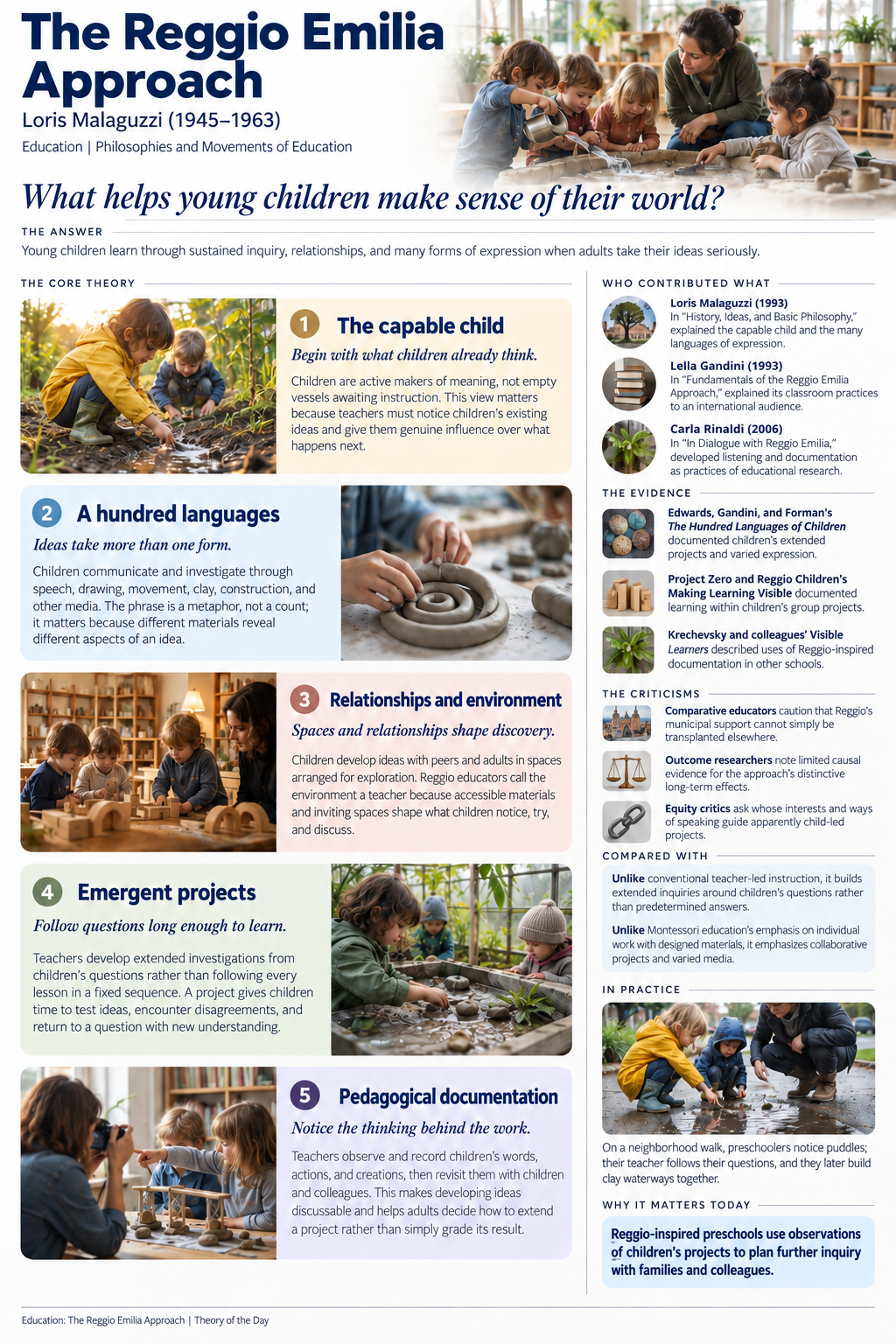
The Reggio Emilia Approach grew from community efforts to establish early-childhood education in and around the Italian city of Reggio Emilia after the Second World War. Loris Malaguzzi became its leading educational thinker as the city developed its municipal preschools; the first municipal preschool opened in 1963. Families, educators, and local government helped shape these schools. The approach was not announced in a single founding book. It developed through practice and discussion, informed by a commitment to treating young children as participants in their own education.
Its starting point is an image of the child as curious, capable, and already full of ideas. Teachers listen to children’s questions and help them investigate with other children, adults, places, and materials. Speech is only one means of thinking and communicating: drawing, clay, movement, construction, and other media offer further possibilities. Malaguzzi’s phrase “the hundred languages of children” names this diversity metaphorically. Teachers arrange inviting spaces, support extended projects, and observe how children’s ideas change. They then use what they have noticed to plan the next opportunities for inquiry.
Malaguzzi articulated the approach’s educational philosophy, including its view of children’s capabilities and forms of expression. He did not create the schools alone: their practices also depended on teachers, families, and the municipality. Later, Lella Gandini explained features of those practices to international educators, including the importance of the physical environment. Carla Rinaldi developed accounts of listening and pedagogical documentation. In this practice, educators record and revisit children’s words, actions, and work so that children and adults can discuss developing ideas and decide what to investigate next.
The literature offers rich accounts of what this work looks like, but it should not be mistaken for proof that one model produces superior outcomes. The Hundred Languages of Children, edited by Carolyn Edwards, Gandini, and George Forman in 1993, presented documented projects and accounts of the schools. Making Learning Visible, a 2001 collaboration between Project Zero and Reggio Children, examined learning in groups through documentation. Visible Learners, published by Mara Krechevsky and colleagues in 2013, described related practices in other settings. These works illuminate processes and possibilities more directly than long-term causal effects.
Critics point to limits in both the evidence and the ease of transferring the approach. Reggio Emilia’s municipal schools have a particular history of public support, professional collaboration, and family involvement; using similar-looking materials elsewhere does not reproduce those conditions. Research has not firmly isolated the long-term effects of the approach itself. Educators must also ask whose questions receive attention and whether every child’s way of communicating is heard. Later Reggio-inspired practice increasingly involves adapting its principles to local communities rather than copying a supposed set of classroom rules.
The approach matters because it offers a concrete alternative to viewing preschool as preparation for later tests or as a sequence of lessons delivered to passive children. It asks teachers to take children’s thinking seriously, make room for sustained shared investigation, and examine their own interpretations. A teacher who notices children debating where rainwater goes, provides materials to explore it, and revisits their discoveries with them is working in that spirit. The approach’s enduring contribution is a way of asking what children are trying to understand—and how an educational community can help.
The core theory
1. The capable child
Children are active makers of meaning, not empty vessels awaiting instruction. This view matters because teachers must notice children’s existing ideas and give them genuine influence over what happens next.
2. A hundred languages
Children communicate and investigate through speech, drawing, movement, clay, construction, and other media. The phrase is a metaphor, not a count; it matters because different materials reveal different aspects of an idea.
3. Relationships and environment
Children develop ideas with peers and adults in spaces arranged for exploration. Reggio educators call the environment a teacher because accessible materials and inviting spaces shape what children notice, try, and discuss.
4. Emergent projects
Teachers develop extended investigations from children’s questions rather than following every lesson in a fixed sequence. A project gives children time to test ideas, encounter disagreements, and return to a question with new understanding.
5. Pedagogical documentation
Teachers observe and record children’s words, actions, and creations, then revisit them with children and colleagues. This makes developing ideas discussable and helps adults decide how to extend a project rather than simply grade its result.
The argument in four steps
- Young children bring ideas, questions, and abilities to their encounters with the world.
- They develop those ideas by exploring materials, places, and other people’s perspectives.
- Teachers deepen inquiry by listening, arranging opportunities, and revisiting what children do and say.
- Therefore, education should sustain children’s shared investigations rather than merely deliver predetermined answers.
How it works
- Teachers listen for recurring questions and provide materials that let children investigate them.
- Children compare discoveries with peers; adults introduce new experiences when inquiry stalls or ideas conflict.
- Teachers revisit recorded observations with children, then choose opportunities that deepen the investigation.
Who contributed what
- Loris Malaguzzi (1993): In “History, Ideas, and Basic Philosophy,” explained the capable child and the many languages of expression.
- Lella Gandini (1993): In “Fundamentals of the Reggio Emilia Approach,” explained its classroom practices to an international audience.
- Carla Rinaldi (2006): In “In Dialogue with Reggio Emilia,” developed listening and documentation as practices of educational research.
Compared with rival views
- Unlike conventional teacher-led instruction, it builds extended inquiries around children’s questions rather than predetermined answers.
- Unlike Montessori education’s emphasis on individual work with designed materials, it emphasizes collaborative projects and varied media.
Further reading
- Loris Malaguzzi, History, Ideas, and Basic Philosophy: An Interview with Loris Malaguzzi (1993)
- Carolyn Edwards, Lella Gandini, and George Forman, editors, The Hundred Languages of Children: The Reggio Emilia Approach to Early Childhood Education (1993)
- Carla Rinaldi, In Dialogue with Reggio Emilia: Listening, Researching and Learning (2006)