Infographic of: The Acceptance Theory of Authority
Management: Classical and Behavioural Foundations
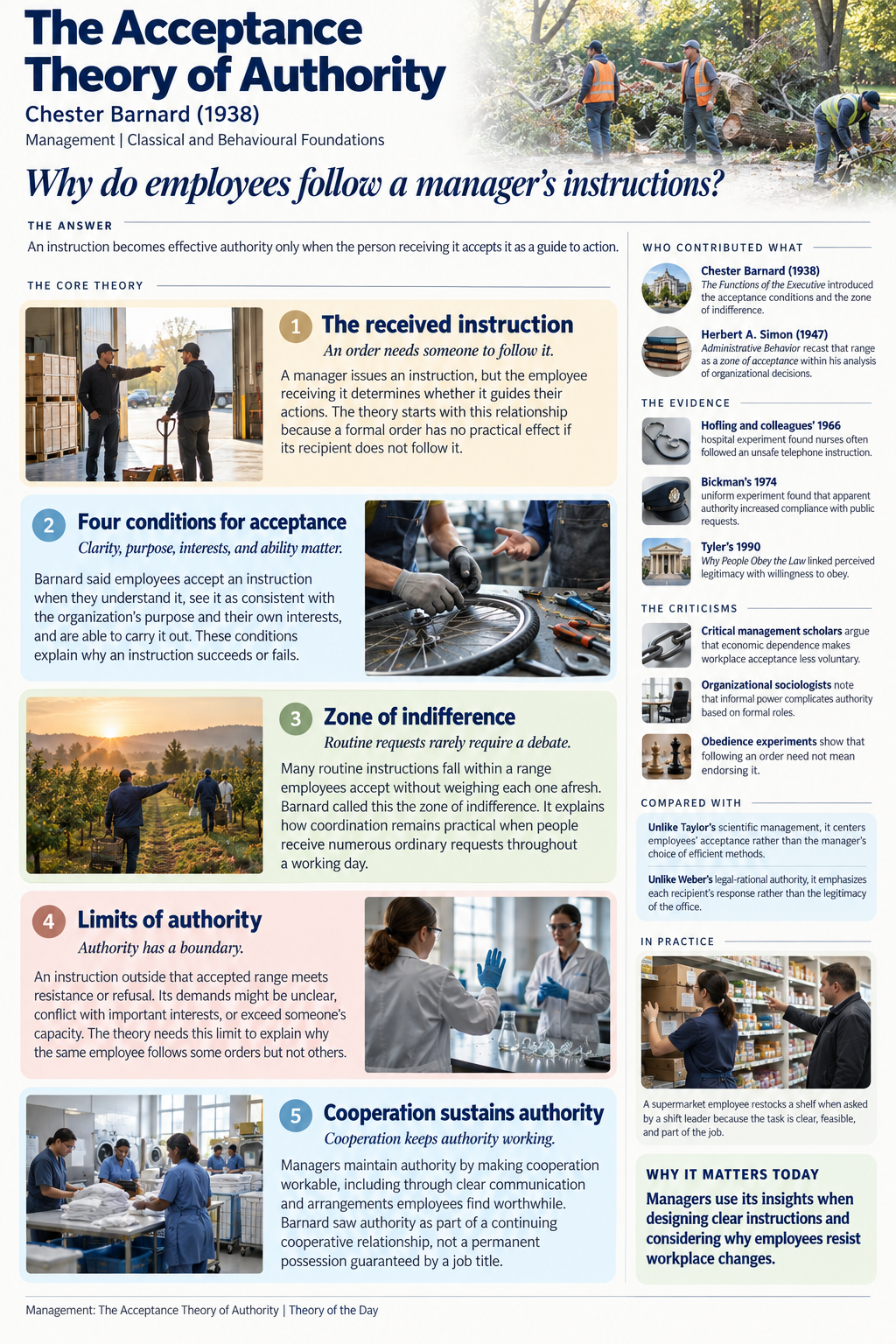
The Acceptance Theory of Authority
Chester Barnard (1938)
An instruction becomes effective authority only when the person receiving it accepts it as a guide to action.
Chester Barnard set out the acceptance theory of authority in his 1938 book The Functions of the Executive. An experienced telephone-company executive, he was interested in how organizations secure lasting cooperation among people with different aims. Earlier management writing often emphasized the manager’s right to direct work or the most efficient way to perform it. Barnard asked a different question: what makes a communicated instruction effective in the actions of the person who receives it?
His answer was that authority depends on acceptance. A manager can issue an order, but it functions as authority only if the employee treats it as a guide to action. Barnard identified four conditions for acceptance: the employee understands the instruction, regards it as consistent with the organization’s purpose, sees it as compatible with their personal interests as a whole, and is mentally and physically able to carry it out. Employees do not examine every instruction at length. Many ordinary requests fall within what Barnard called a zone of indifference and are followed as part of an established cooperative relationship.
Barnard developed these ideas within a broader account of organizations as systems of cooperation. He held that managers must communicate effectively and maintain conditions under which people are willing to contribute. Herbert A. Simon extended the account in Administrative Behavior in 1947. Simon used the term zone of acceptance to describe the range of decisions an employee allows a superior to make. His treatment placed Barnard’s insight within a wider analysis of how organizations distribute decisions among people. Barnard proposed the original theory; Simon refined one of its central ideas.
The theory is primarily a conceptual explanation, not a finding established by one decisive experiment. Later studies illuminate parts of its subject without testing all four conditions together. Charles Hofling and colleagues’ 1966 hospital experiment found that nurses often followed an unsafe instruction delivered by telephone. Leonard Bickman’s 1974 experiments found greater compliance with public requests from someone dressed in a uniform. Tom Tyler’s 1990 research on legal obedience linked perceived legitimacy to willingness to follow authorities. These studies concern different settings and forms of compliance; none proves that Barnard’s conditions always determine workplace behavior.
A central criticism is that acceptance may not be as free as the theory sounds. Employees who depend on a wage can face serious costs for refusing an instruction, even when they disagree with it. Research on obedience also warns against treating outward compliance as evidence that someone approves of a request. Informal relationships, organizational politics, and unequal resources further complicate the picture. Later organizational research has therefore examined the pressures and sources of legitimacy that shape responses to authority, rather than assuming that a formal position or an apparently willing response tells the whole story.
Barnard’s practical insight remains useful: giving an instruction is not the same as securing cooperation. A manager introducing a new procedure must make the request understandable, connect it to a credible purpose, consider its effects on employees, and provide the means to perform it. The theory does not imply that every refusal is justified or every accepted order is wise. It directs attention to the people whose actions turn managerial decisions into organizational work.
The core theory
1. The received instruction
A manager issues an instruction, but the employee receiving it determines whether it guides their actions. The theory starts with this relationship because a formal order has no practical effect if its recipient does not follow it.
2. Four conditions for acceptance
Barnard said employees accept an instruction when they understand it, see it as consistent with the organization’s purpose and their own interests, and are able to carry it out. These conditions explain why an instruction succeeds or fails.
3. Zone of indifference
Many routine instructions fall within a range employees accept without weighing each one afresh. Barnard called this the zone of indifference. It explains how coordination remains practical when people receive numerous ordinary requests throughout a working day.
4. Limits of authority
An instruction outside that accepted range meets resistance or refusal. Its demands might be unclear, conflict with important interests, or exceed someone’s capacity. The theory needs this limit to explain why the same employee follows some orders but not others.
5. Cooperation sustains authority
Managers maintain authority by making cooperation workable, including through clear communication and arrangements employees find worthwhile. Barnard saw authority as part of a continuing cooperative relationship, not a permanent possession guaranteed by a job title.
The argument in four steps
- Organizations depend on people coordinating their actions toward shared purposes.
- Managers communicate instructions, but their positions alone do not make those instructions effective.
- Employees assess whether instructions make sense, fit organizational and personal interests, and are possible to carry out.
- Therefore, authority operates through employees’ acceptance of instructions, not through managerial rank alone.
How it works
- A manager communicates a task to someone whose cooperation the organization needs.
- The recipient weighs the request against its purpose, personal interests, and practical ability; routine requests receive little scrutiny.
- The recipient’s response determines whether the instruction directs action or falls outside the accepted range.
Who contributed what
- Chester Barnard (1938): The Functions of the Executive introduced the acceptance conditions and the zone of indifference.
- Herbert A. Simon (1947): Administrative Behavior recast that range as a zone of acceptance within his analysis of organizational decisions.
Compared with rival views
- Unlike Taylor’s scientific management, it centers employees’ acceptance rather than the manager’s choice of efficient methods.
- Unlike Weber’s legal-rational authority, it emphasizes each recipient’s response rather than the legitimacy of the office.
Further reading
- Chester I. Barnard, The Functions of the Executive (1938)
- Herbert A. Simon, Administrative Behavior (1947)
- James G. March and Herbert A. Simon, Organizations (1958)