Infographic of: Universal Grammar and the Language Acquisition Device
Psychology: Psychodynamic and Developmental
Universal Grammar and the Language Acquisition Device
Noam Chomsky (1957-1965)
Based on: Noam Chomsky, Aspects of the Theory of Syntax (1965); Noam Chomsky, A Review of B. F. Skinner's Verbal Behavior, Language (1959)
Humans are born with built-in knowledge of language structure, which is why children learn grammar from limited speech.
In the 1950s American psychology was dominated by behaviourism, the view that all behaviour, speech included, is learned through habit and reward. In 1957 B. F. Skinner published Verbal Behavior, applying that view to language. The same year Noam Chomsky, then a young linguist at the Massachusetts Institute of Technology, published Syntactic Structures, which treated a language as a system of rules able to generate every sentence of it. His question was simple: how can a small child master such a system so quickly?
Chomsky's 1959 review of Skinner, printed in the journal Language, is the first step. He argues that Skinner's terms, such as stimulus and reinforcement, lose their meaning when applied to ordinary speech. People constantly say and understand sentences they have never met, and no chain of habits can explain that. Aspects of the Theory of Syntax (1965) then builds the positive case. Chapter 1, Methodological Preliminaries, separates competence (what a speaker unconsciously knows) from performance (what is actually said, slips included). It asks that a grammar be explanatory, meaning it must show how a child could reach it. Chapters 2 and 3 propose a detailed model, with a deep structure that fixes meaning and transformations that turn it into the surface sentence. Chapter 4 collects further problems.
The mechanism is the language acquisition device. Chomsky treats it as a black box that receives the speech a child hears and returns a grammar of that child's language. For this to work, the box must already hold knowledge about what human grammars can be. That built-in knowledge is what later came to be called universal grammar. Chomsky divides it into formal universals, which limit the kinds of rules a grammar may contain, and substantive universals, such as the categories noun and verb. He ties the idea to the rationalist tradition of Descartes, in which some knowledge is inborn.
Others extended the theory. Eric Lenneberg's Biological Foundations of Language (1967) argued that language is a species-specific capacity that develops within a critical period, roughly the years before puberty. Chomsky himself revised the model. In 1981 he proposed principles shared by all languages and parameters, like switches, set by a child's experience. Later he preferred the term language faculty to language acquisition device, and he abandoned deep structure in the Minimalist Program of the 1990s.
Several findings fit the theory. Brown and Hanlon (1970) found that parents respond to whether a child's statement is true, not whether it is grammatical, so children get little correction. Senghas and colleagues (2004) found that successive groups of children in Nicaragua added grammatical structure to a new sign language. Crain and Nakayama (1987) found that young children form questions by following sentence structure, not word order. Critics reply that the child's input is richer than Chomsky assumed, as Pullum and Scholz argued. Michael Tomasello holds that general learning skills and heard usage are enough. Evans and Levinson note that languages differ widely, which weakens claims about universals.
The theory still matters because it set the agenda for the study of language acquisition. Researchers who disagree with it still have to explain how children learn grammar from limited input. The debate is now urgent for artificial intelligence, since large language models learn from vast text, far more than any child hears, and people argue over what that shows about human minds.
The work, part by part
1. Why habit and reward cannot explain language
Review of Skinner's Verbal Behavior (1959)
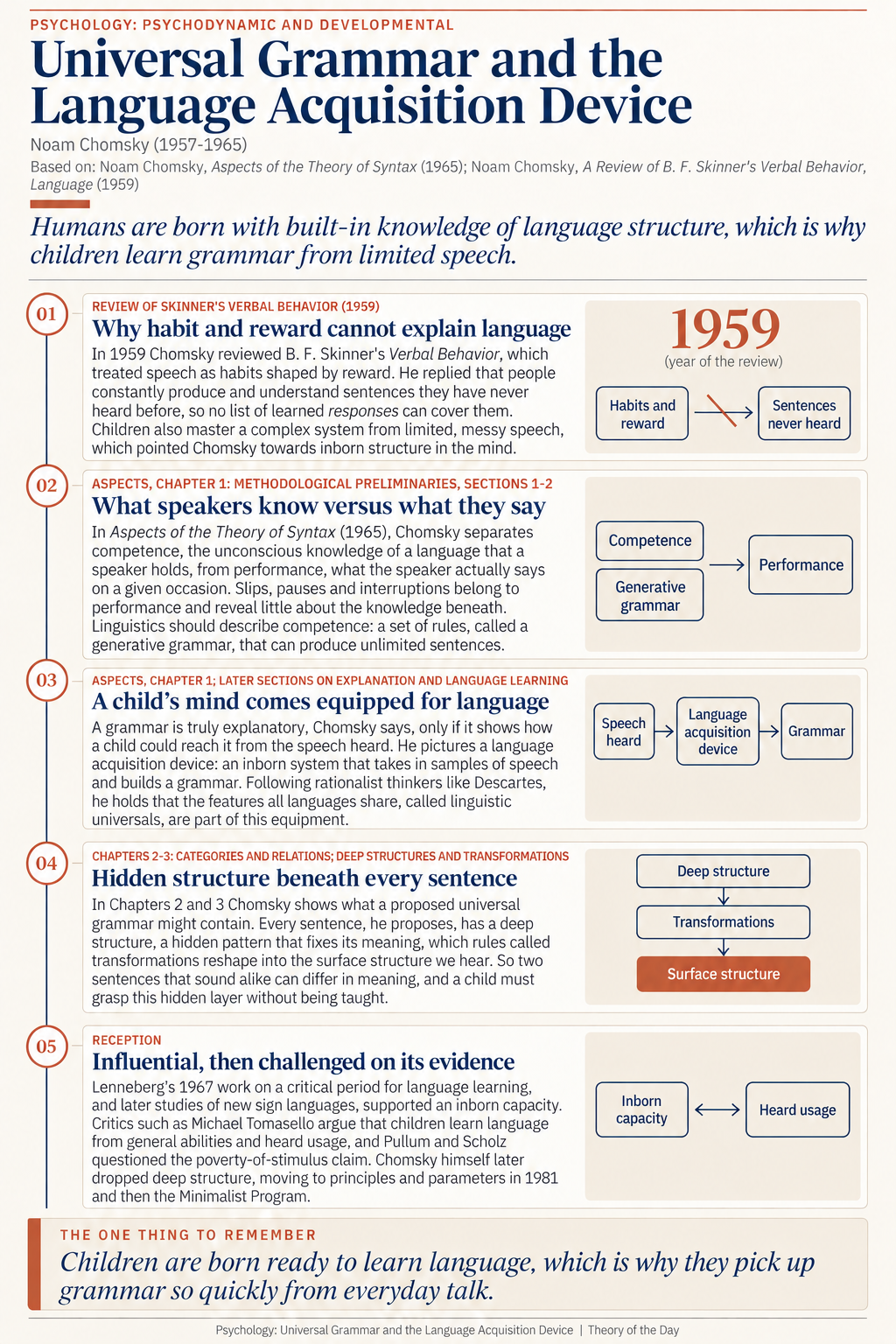
In 1959 Chomsky reviewed B. F. Skinner's Verbal Behavior, which treated speech as habits shaped by reward. He replied that people constantly produce and understand sentences they have never heard before, so no list of learned responses can cover them. Children also master a complex system from limited, messy speech, which pointed Chomsky towards inborn structure in the mind.
2. What speakers know versus what they say
Aspects, Chapter 1: Methodological Preliminaries, sections 1-2
In Aspects of the Theory of Syntax (1965), Chomsky separates competence, the unconscious knowledge of a language that a speaker holds, from performance, what the speaker actually says on a given occasion. Slips, pauses and interruptions belong to performance and reveal little about the knowledge beneath. Linguistics should describe competence: a set of rules, called a generative grammar, that can produce unlimited sentences.
3. A child's mind comes equipped for language
Aspects, Chapter 1, later sections on explanation and language learning
A grammar is truly explanatory, Chomsky says, only if it shows how a child could reach it from the speech heard. He pictures a language acquisition device: an inborn system that takes in samples of speech and builds a grammar. Following rationalist thinkers like Descartes, he holds that the features all languages share, called linguistic universals, are part of this equipment.
4. Hidden structure beneath every sentence
Chapters 2-3: Categories and Relations; Deep Structures and Transformations
In Chapters 2 and 3 Chomsky shows what a proposed universal grammar might contain. Every sentence, he proposes, has a deep structure, a hidden pattern that fixes its meaning, which rules called transformations reshape into the surface structure we hear. So two sentences that sound alike can differ in meaning, and a child must grasp this hidden layer without being taught.
5. Influential, then challenged on its evidence
Reception
Lenneberg's 1967 work on a critical period for language learning, and later studies of new sign languages, supported an inborn capacity. Critics such as Michael Tomasello argue that children learn language from general abilities and heard usage, and Pullum and Scholz questioned the poverty-of-stimulus claim. Chomsky himself later dropped deep structure, moving to principles and parameters in 1981 and then the Minimalist Program.
The argument in four steps
- Speakers produce and understand endless new sentences, so language cannot be a stock of learned habits.
- Speakers' knowledge is a system of rules, far richer than the muddled speech children hear.
- Children therefore need an inborn language acquisition device that already knows what all human languages share.
- So the core of grammar is innate and universal, and learning only fills in the details of one language.
Who contributed what
- Noam Chomsky (1965): Aspects of the Theory of Syntax set out competence, universals and the language acquisition device.
- Eric Lenneberg (1967): Biological Foundations of Language argued language is species-specific and develops within a critical period.
- Noam Chomsky (1981): Lectures on Government and Binding proposed principles shared by all languages, with parameters set by experience.
The evidence
- Brown and Hanlon's 1970 study found parents reacted to whether children's statements were true, not grammatical.
- Senghas and colleagues' 2004 Nicaraguan Sign Language study showed new child cohorts adding grammatical structure.
- Crain and Nakayama's 1987 experiments showed young children respect sentence structure, not word order, when forming questions.
The criticisms
- Tomasello argues children learn from general thinking skills and heard usage, without innate grammar.
- Pullum and Scholz argued children's input holds more evidence than the poverty-of-stimulus claim assumes.
- Evans and Levinson say languages differ too much for shared universals.
Compared with rival views
- Unlike Skinner's behaviourism, it explains language by inborn mental rules, not by habits built through reward.
- Unlike Bloomfield's structuralism, it studies speakers' knowledge of rules, not catalogues of recorded speech.
Why it matters today
Debates over whether large language models, trained on huge text, show that grammar can be learned without innate knowledge.
Further reading
- Steven Pinker, The Language Instinct (1994)
- Randy Allen Harris, The Linguistics Wars (1993)
- Michael Tomasello, Constructing a Language: A Usage-Based Theory of Language Acquisition (2003)