Infographic of: Republican Liberty as Non-Domination
Politics: Political Philosophy
Republican Liberty as Non-Domination
Philip Pettit, Quentin Skinner (1997)
Based on: Philip Pettit, Republicanism: A Theory of Freedom and Government (1997); Quentin Skinner, Liberty before Liberalism (1998)
You are unfree whenever someone else can interfere with your choices at will, even if they never actually do.
In the 1990s, political philosophy still lived in the shadow of Isaiah Berlin's 1958 essay on two kinds of liberty. Negative liberty means being left alone by others. Positive liberty means governing yourself, often through political participation. Philip Pettit, an Irish-born philosopher, wrote Republicanism: A Theory of Freedom and Government (1997) to ask whether freedom is only being left alone, and whether an older republican tradition could offer something better, both as an idea of freedom and as a guide to building a state.
Pettit builds his case in stages. He first recovers the republican tradition, which runs from Rome through Renaissance Italy and seventeenth-century England to the eighteenth century. He then sets out its idea of liberty and defends it against the two modern rivals. The final chapters ask what institutions a state needs if it is to protect this kind of freedom. The book moves from history, to a concept, to a programme for government.
The central idea is domination: living under another person's power to interfere with you at will. Pettit calls such power arbitrary when it does not have to follow the interests and ideas of the people it affects. A slave with a kind master is unfree, because the master could interfere whenever he liked. By contrast, a law that follows citizens' interests and that they can challenge does not dominate them, even though it limits what they may do. Pettit separates private domination, which he calls dominium, from public domination, imperium, and says a free state must prevent the first without becoming the second. Its tools are the rule of law, divided and balanced powers, and contestatory democracy, where citizens can challenge decisions.
Quentin Skinner supplied the historical foundation. In Liberty before Liberalism (1998), a short book that grew out of his Cambridge lecture, he traced a neo-Roman theory of liberty through Roman law, Machiavelli and English writers such as Harrington and Milton. On this view, to be free is not to depend on anyone else's will. Skinner showed that Hobbes rejected this idea and defined liberty as the absence of physical obstruction, a move that shaped later liberal thought. Pettit's contribution was the philosophical analysis and the institutional programme, while Skinner's was the historical argument.
The theory rests mainly on textual and conceptual evidence. Skinner's readings of Roman legal definitions of slavery and of Machiavelli's Discourses show that earlier writers judged freedom by independence, not by actual interference. Pettit and Braithwaite's Not Just Deserts (1990) had already applied the idea to criminal justice. The main criticism is that non-domination may not be a distinct idea. Ian Carter and Matthew Kramer argued that domination is a different harm from unfreedom, or that non-interference already explains it. Charles Larmore called republican liberty a form of negative liberty. Others find the word arbitrary too vague. Pettit and Skinner replied that security from mere possible interference is part of what freedom means.
The theory still matters because it gives a way to criticise power that is never exercised harshly. It has shaped debates about employers' control over workers and about unaccountable officials. In 2008, Pettit published an assessment of the Spanish government under Zapatero, which had declared itself republican in spirit. It remains a leading alternative to purely liberal accounts of freedom.
The work, part by part
1. A third idea of liberty
Background
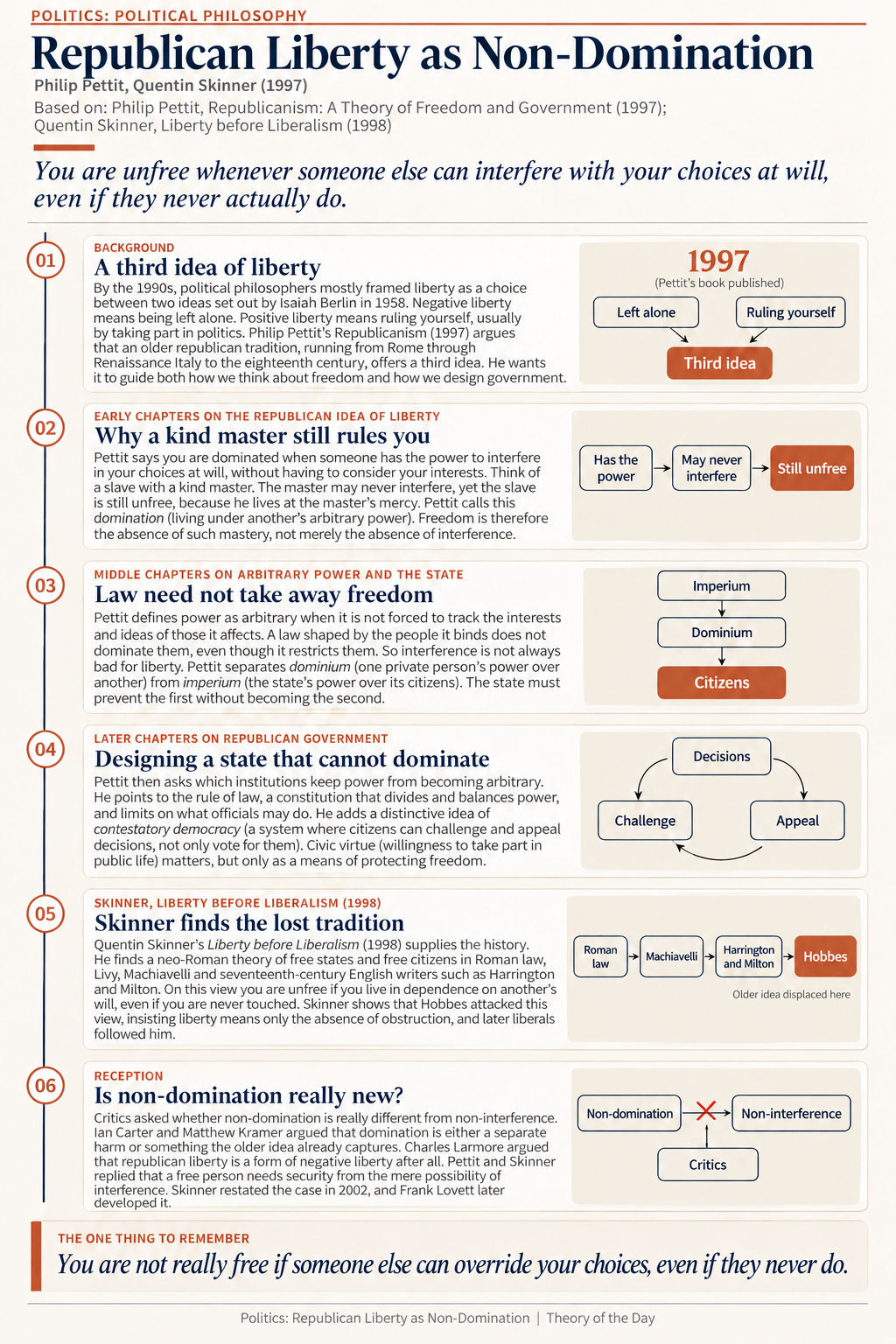
By the 1990s, political philosophers mostly framed liberty as a choice between two ideas set out by Isaiah Berlin in 1958. Negative liberty means being left alone. Positive liberty means ruling yourself, usually by taking part in politics. Philip Pettit's Republicanism (1997) argues that an older republican tradition, running from Rome through Renaissance Italy to the eighteenth century, offers a third idea. He wants it to guide both how we think about freedom and how we design government.
2. Why a kind master still rules you
Early chapters on the republican idea of liberty
Pettit says you are dominated when someone has the power to interfere in your choices at will, without having to consider your interests. Think of a slave with a kind master. The master may never interfere, yet the slave is still unfree, because he lives at the master's mercy. Pettit calls this domination (living under another's arbitrary power). Freedom is therefore the absence of such mastery, not merely the absence of interference.
3. Law need not take away freedom
Middle chapters on arbitrary power and the state
Pettit defines power as arbitrary when it is not forced to track the interests and ideas of those it affects. A law shaped by the people it binds does not dominate them, even though it restricts them. So interference is not always bad for liberty. Pettit separates dominium (one private person's power over another) from imperium (the state's power over its citizens). The state must prevent the first without becoming the second.
4. Designing a state that cannot dominate
Later chapters on republican government
Pettit then asks which institutions keep power from becoming arbitrary. He points to the rule of law, a constitution that divides and balances power, and limits on what officials may do. He adds a distinctive idea of contestatory democracy (a system where citizens can challenge and appeal decisions, not only vote for them). Civic virtue (willingness to take part in public life) matters, but only as a means of protecting freedom.
5. Skinner finds the lost tradition
Skinner, Liberty before Liberalism (1998)
Quentin Skinner's Liberty before Liberalism (1998) supplies the history. He finds a neo-Roman theory of free states and free citizens in Roman law, Livy, Machiavelli and seventeenth-century English writers such as Harrington and Milton. On this view you are unfree if you live in dependence on another's will, even if you are never touched. Skinner shows that Hobbes attacked this view, insisting liberty means only the absence of obstruction, and later liberals followed him.
6. Is non-domination really new?
Reception
Critics asked whether non-domination is really different from non-interference. Ian Carter and Matthew Kramer argued that domination is either a separate harm or something the older idea already captures. Charles Larmore argued that republican liberty is a form of negative liberty after all. Pettit and Skinner replied that a free person needs security from the mere possibility of interference. Skinner restated the case in 2002, and Frank Lovett later developed it.
The argument in four steps
- A person is unfree if another can interfere at will, even if the other never does.
- Power dominates when it is arbitrary, meaning it need not follow the interests of those it rules.
- Law that tracks citizens' interests and that they can challenge limits power without dominating them.
- So a free society is one with institutions that guard every citizen against arbitrary power, public or private.
Who contributed what
- Philip Pettit (1997): In Republicanism, defined freedom as non-domination and built a theory of institutions, including contestatory democracy.
- Quentin Skinner (1998): In Liberty before Liberalism, showed historically that a neo-Roman idea of liberty as independence preceded and rivalled liberalism.
The evidence
- Skinner's 1998 reading of Roman law shows slavery defined as living in another's power.
- Skinner's reading of Machiavelli's Discourses (c. 1517) ties liberty to freedom from any ruler's will.
- Pettit and Braithwaite's Not Just Deserts (1990) applied the idea to criminal justice, judging punishment by its effect on domination.
The criticisms
- Carter and Kramer: non-interference already explains why the dominated are worse off.
- Larmore: republican liberty is really a form of negative liberty, not a third kind.
- Critics say 'arbitrary' is vague and its test is open to dispute.
Compared with rival views
- Unlike Berlin's negative liberty, it counts living at someone's mercy as unfree even without interference.
- Unlike positive liberty or Aristotelian civic life, political participation is a means to freedom, not freedom itself.
Why it matters today
Applied in Spain, where Pettit assessed Zapatero's government in 2008, and in debates about employers' power over workers.
Further reading
- Iseult Honohan, Civic Republicanism (2002)
- Cécile Laborde and John Maynor (eds.), Republicanism and Political Theory (2008)
- Frank Lovett, A General Theory of Domination and Justice (2010)