Infographic of: Psycho-Cybernetics and the Self-Image
Positivity: Classic Positive Thinking
Psycho-Cybernetics and the Self-Image
Maxwell Maltz (1960)
Based on: Maxwell Maltz, Psycho-Cybernetics: A New Way to Get More Living Out of Life (1960)
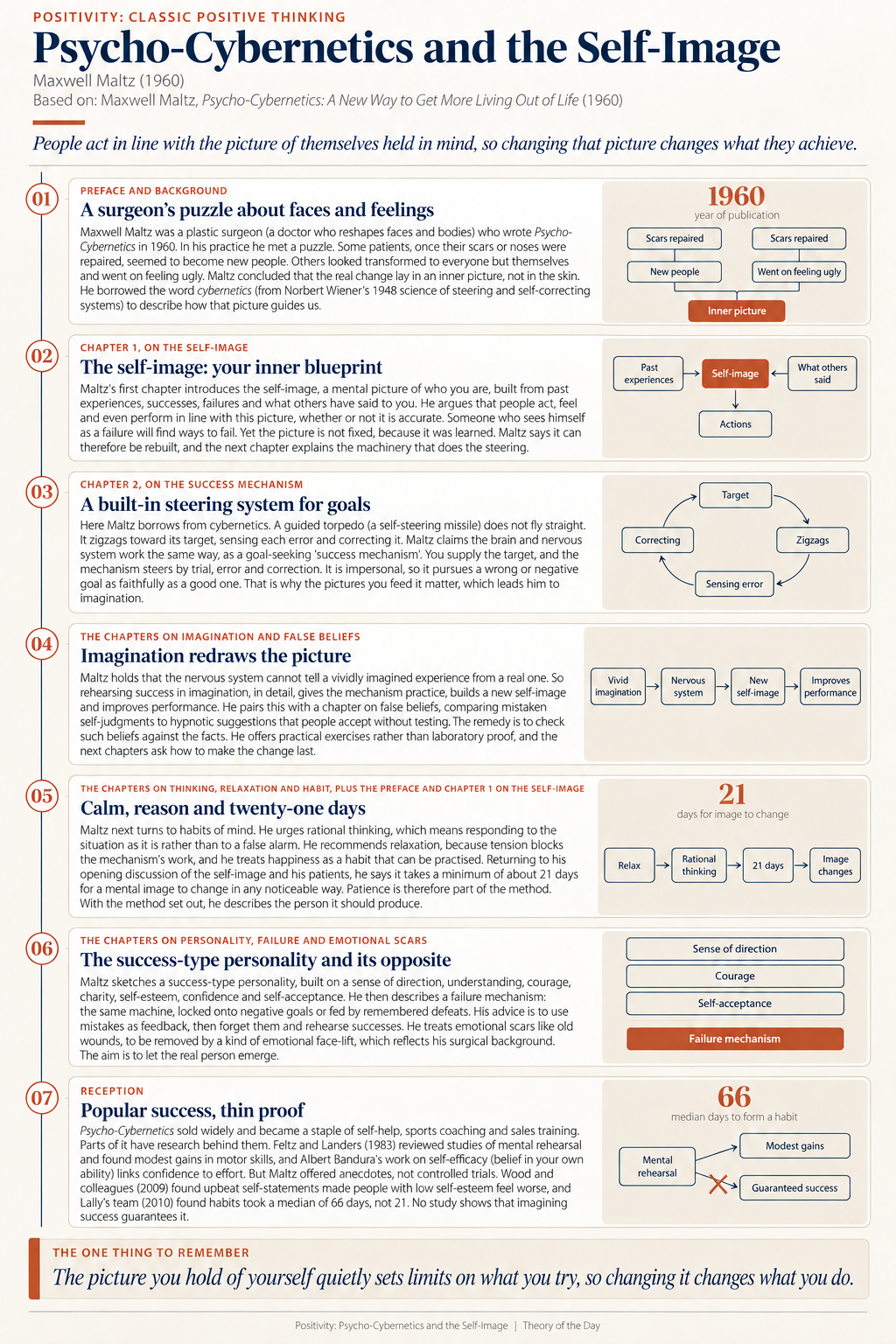
People act in line with the picture of themselves held in mind, so changing that picture changes what they achieve.
Psycho-Cybernetics: A New Way to Get More Living Out of Life appeared in 1960. Its author, Maxwell Maltz, was a plastic surgeon, a doctor who repairs and reshapes faces. He noticed that fixing a patient's face did not always fix the patient. Some people were transformed by surgery, while others still felt ugly and stayed shy or unhappy. The book sets out to answer a simple question: why do some people stay stuck even when their circumstances change?
Maltz builds his answer step by step. The opening chapters introduce the self-image, a mental picture of who you are, formed from past experiences, successes, failures and what others have said to you. He argues that people behave in line with this picture. The next chapter, on the success mechanism, explains how. The following chapters treat imagination and false beliefs. Later chapters cover rational thinking, relaxation, the habit of happiness, the success-type personality, the failure mechanism and emotional scars. Most chapters end with practical exercises.
The mechanism rests on cybernetics, the science of self-steering systems, which Norbert Wiener had named in 1948. Maltz compares the brain to a guided torpedo that zigzags toward a target, senses each error and corrects it. You supply the goal and the machine steers, and it works equally well for negative goals. Because it steers by pictures, and Maltz says the nervous system cannot tell vivid imagination from real experience, rehearsing success in the mind trains it. He says a mental image takes at least 21 days to change.
Maltz was the only author of the theory, but related ideas were developed later by researchers. Albert Bandura's 1977 paper on self-efficacy showed that belief in one's own ability shapes effort and performance. Charles Carver and Michael Scheier modelled self-regulation as feedback loops in 1982. Neither set out to test Maltz, but each gave a rigorous version of part of his picture.
Some research supports parts of the book. A 1983 review by Feltz and Landers found that mental rehearsal modestly improves motor skills. Studies of cosmetic surgery patients show that a new look does not reliably change how people feel about themselves. But the book relies on anecdotes, not controlled trials. Wood and colleagues found in 2009 that repeating positive statements made people with low self-esteem feel worse. Lally's team found in 2010 that habits took a median of 66 days to form, not 21. The cybernetic language is a metaphor, not a tested mechanism.
The book still matters because its central practice, imagined rehearsal, lives on in sports psychology and performance coaching. It also shows the difference between popular positive thinking that rests on a testable idea and the kind that promises results without effort. Maltz asks people to practise, correct errors and be patient. That advice survives scrutiny better than the claim that a good self-picture guarantees success.
The work, part by part
1. A surgeon's puzzle about faces and feelings
Preface and background
Maxwell Maltz was a plastic surgeon (a doctor who reshapes faces and bodies) who wrote Psycho-Cybernetics in 1960. In his practice he met a puzzle. Some patients, once their scars or noses were repaired, seemed to become new people. Others looked transformed to everyone but themselves and went on feeling ugly. Maltz concluded that the real change lay in an inner picture, not in the skin. He borrowed the word cybernetics (from Norbert Wiener's 1948 science of steering and self-correcting systems) to describe how that picture guides us.
2. The self-image: your inner blueprint
Chapter 1, on the self-image
Maltz's first chapter introduces the self-image, a mental picture of who you are, built from past experiences, successes, failures and what others have said to you. He argues that people act, feel and even perform in line with this picture, whether or not it is accurate. Someone who sees himself as a failure will find ways to fail. Yet the picture is not fixed, because it was learned. Maltz says it can therefore be rebuilt, and the next chapter explains the machinery that does the steering.
3. A built-in steering system for goals
Chapter 2, on the success mechanism
Here Maltz borrows from cybernetics. A guided torpedo (a self-steering missile) does not fly straight. It zigzags toward its target, sensing each error and correcting it. Maltz claims the brain and nervous system work the same way, as a goal-seeking 'success mechanism'. You supply the target, and the mechanism steers by trial, error and correction. It is impersonal, so it pursues a wrong or negative goal as faithfully as a good one. That is why the pictures you feed it matter, which leads him to imagination.
4. Imagination redraws the picture
The chapters on imagination and false beliefs
Maltz holds that the nervous system cannot tell a vividly imagined experience from a real one. So rehearsing success in imagination, in detail, gives the mechanism practice, builds a new self-image and improves performance. He pairs this with a chapter on false beliefs, comparing mistaken self-judgments to hypnotic suggestions that people accept without testing. The remedy is to check such beliefs against the facts. He offers practical exercises rather than laboratory proof, and the next chapters ask how to make the change last.
5. Calm, reason and twenty-one days
The chapters on thinking, relaxation and habit, plus the preface and Chapter 1 on the self-image
Maltz next turns to habits of mind. He urges rational thinking, which means responding to the situation as it is rather than to a false alarm. He recommends relaxation, because tension blocks the mechanism's work, and he treats happiness as a habit that can be practised. Returning to his opening discussion of the self-image and his patients, he says it takes a minimum of about 21 days for a mental image to change in any noticeable way. Patience is therefore part of the method. With the method set out, he describes the person it should produce.
6. The success-type personality and its opposite
The chapters on personality, failure and emotional scars
Maltz sketches a success-type personality, built on a sense of direction, understanding, courage, charity, self-esteem, confidence and self-acceptance. He then describes a failure mechanism: the same machine, locked onto negative goals or fed by remembered defeats. His advice is to use mistakes as feedback, then forget them and rehearse successes. He treats emotional scars like old wounds, to be removed by a kind of emotional face-lift, which reflects his surgical background. The aim is to let the real person emerge.
7. Popular success, thin proof
Reception
Psycho-Cybernetics sold widely and became a staple of self-help, sports coaching and sales training. Parts of it have research behind them. Feltz and Landers (1983) reviewed studies of mental rehearsal and found modest gains in motor skills, and Albert Bandura's work on self-efficacy (belief in your own ability) links confidence to effort. But Maltz offered anecdotes, not controlled trials. Wood and colleagues (2009) found upbeat self-statements made people with low self-esteem feel worse, and Lally's team (2010) found habits took a median of 66 days, not 21. No study shows that imagining success guarantees it.
The argument in four steps
- Every person carries a mental picture of who they are, and behaves to match it.
- The brain works like a self-steering device that aims at goals and corrects its own errors.
- The brain steers by mental pictures and cannot tell vivid imagination from real experience, Maltz says.
- So a changed self-image changes what a person does, and daily mental practice changes the self-image.
Who contributed what
- Maxwell Maltz (1960): Psycho-Cybernetics: framed the self-image as a goal-steering 'success mechanism' retrained by imagery and practice.
- Albert Bandura (1977): Self-efficacy paper in Psychological Review: tested how belief in one's ability shapes effort and performance.
- Charles S. Carver (1982): With Michael Scheier, modelled self-regulation as feedback loops in Psychological Bulletin, a tested cousin of Maltz's metaphor.
The evidence
- Feltz and Landers's 1983 meta-analysis found mental practice modestly improves motor performance versus no practice.
- Bandura's 1977 self-efficacy paper showed belief in one's ability predicts effort and persistence.
- Honigman, Phillips and Castle's 2004 review: some cosmetic-surgery patients, especially with body dysmorphic disorder, stay dissatisfied.
The criticisms
- Wood, Perunovic and Lee (2009): positive self-statements backfired for people with low self-esteem.
- Lally and colleagues (2010) found habits took a median 66 days, not Maltz's 21.
- Evidence is anecdotal; the cybernetic language is metaphor, never tested as a mechanism.
Compared with rival views
- Unlike Peale's faith-based positive thinking, it offers a feedback-machine model and imagery practice.
- Unlike the Law of Attraction, it claims no cosmic pull; change works through behaviour.
Why it matters today
Mental rehearsal of skills in sports psychology and performance coaching echoes Maltz's idea that vivid imagined practice trains the mind.
Further reading
- Mitch Horowitz, One Simple Idea: How Positive Thinking Reshaped Modern Life (2014)
- Barbara Ehrenreich, Bright-Sided: How Positive Thinking Is Undermining America (2009)
- Gabriele Oettingen, Rethinking Positive Thinking: Inside the New Science of Motivation (2014)