Infographic of: Dual Coding Theory
Education: Memory, Study and How Learning Sticks
Dual Coding Theory
Allan Paivio (1971)
Based on: Allan Paivio, Imagery and Verbal Processes (1971); Allan Paivio, Mental Representations: A Dual Coding Approach (1986)
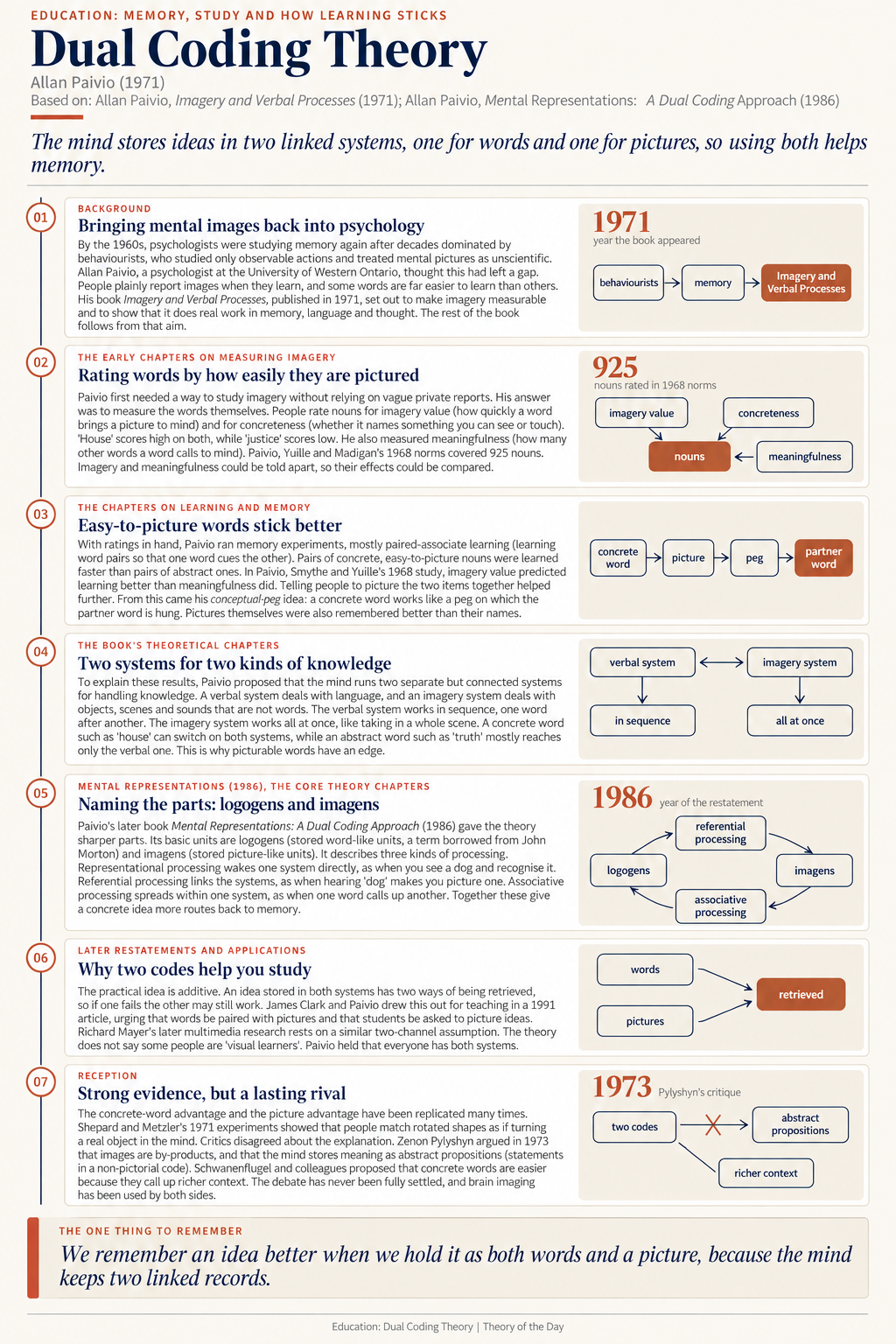
The mind stores ideas in two linked systems, one for words and one for pictures, so using both helps memory.
Allan Paivio, a Canadian psychologist at the University of Western Ontario, published Imagery and Verbal Processes in 1971. For decades psychology had been dominated by behaviourism, which studied only observable actions and distrusted talk of mental pictures. Memory research of the 1950s and 60s mostly used lists of words and treated one word much like another. Paivio saw that this missed something obvious: some words, such as 'house', are far easier to learn than others, such as 'truth'. His book asked why pictures and concrete words are easier to remember, and what that reveals about how the mind stores knowledge.
The book builds its case in steps. Its early chapters argue that imagery can be studied scientifically by measuring the words people are given, rather than relying on private reports. People rate nouns for imagery value (how readily a word brings a picture to mind), for concreteness and for meaningfulness. Paivio, Yuille and Madigan's 1968 norms covered 925 nouns. The chapters on learning and memory then use these ratings in experiments, chiefly paired-associate learning, where people memorise word pairs. The later chapters carry the idea into language and thought.
The mechanism is two linked memory systems. The verbal system handles language and works in sequence. The imagery system handles objects, scenes and non-verbal sounds, and works all at once. Concrete words reach both systems, while abstract words mainly reach the verbal one. In his 1986 book Mental Representations, Paivio named the units: logogens are word-like units and imagens are picture-like units. He described three kinds of processing: representational (one system responds directly), referential (one system calls up the other) and associative (activity spreads within one system). An idea stored in both systems has two ways back, so it is remembered better.
Others helped shape the theory. John Morton's 1969 logogen model supplied the term Paivio borrowed. Shepard and Metzler's 1971 rotation experiments and Stephen Kosslyn's work on imagery gave independent evidence that images behave like pictures, though Kosslyn built his own account. James Clark and Paivio carried the theory into education in 1991. Richard Mayer's multimedia learning research from 2001 rests on a similar two-channel assumption, and Mark Sadoski and Paivio applied the theory to reading and writing.
The core findings are well supported. Paivio, Smythe and Yuille found in 1968 that imagery value predicted word-pair learning better than meaningfulness, and Paivio and Csapo found in 1973 that pictures were recalled better than their names. The explanation has been disputed. Zenon Pylyshyn argued in 1973 that images are by-products of abstract, proposition-like descriptions. Schwanenflugel and colleagues argued that concrete words are easier because they call up richer context. Other critics say the theory is hard to falsify, since two codes can fit most results.
The theory still matters because it gives a simple reason why pictures and words together help learning. It underlies guidelines for designing slides, textbooks and teaching videos, and it informs research on reading. It is also often misread. It does not claim that some people are visual learners and others verbal learners. Paivio held that everyone has both systems, and that learning is strongest when both are used.
The work, part by part
1. Bringing mental images back into psychology
Background
By the 1960s, psychologists were studying memory again after decades dominated by behaviourists, who studied only observable actions and treated mental pictures as unscientific. Allan Paivio, a psychologist at the University of Western Ontario, thought this had left a gap. People plainly report images when they learn, and some words are far easier to learn than others. His book Imagery and Verbal Processes, published in 1971, set out to make imagery measurable and to show that it does real work in memory, language and thought. The rest of the book follows from that aim.
2. Rating words by how easily they are pictured
The early chapters on measuring imagery
Paivio first needed a way to study imagery without relying on vague private reports. His answer was to measure the words themselves. People rate nouns for imagery value (how quickly a word brings a picture to mind) and for concreteness (whether it names something you can see or touch). 'House' scores high on both, while 'justice' scores low. He also measured meaningfulness (how many other words a word calls to mind). Paivio, Yuille and Madigan's 1968 norms covered 925 nouns. Imagery and meaningfulness could be told apart, so their effects could be compared.
3. Easy-to-picture words stick better
The chapters on learning and memory
With ratings in hand, Paivio ran memory experiments, mostly paired-associate learning (learning word pairs so that one word cues the other). Pairs of concrete, easy-to-picture nouns were learned faster than pairs of abstract ones. In Paivio, Smythe and Yuille's 1968 study, imagery value predicted learning better than meaningfulness did. Telling people to picture the two items together helped further. From this came his conceptual-peg idea: a concrete word works like a peg on which the partner word is hung. Pictures themselves were also remembered better than their names.
4. Two systems for two kinds of knowledge
The book's theoretical chapters
To explain these results, Paivio proposed that the mind runs two separate but connected systems for handling knowledge. A verbal system deals with language, and an imagery system deals with objects, scenes and sounds that are not words. The verbal system works in sequence, one word after another. The imagery system works all at once, like taking in a whole scene. A concrete word such as 'house' can switch on both systems, while an abstract word such as 'truth' mostly reaches only the verbal one. This is why picturable words have an edge.
5. Naming the parts: logogens and imagens
Mental Representations (1986), the core theory chapters
Paivio's later book Mental Representations: A Dual Coding Approach (1986) gave the theory sharper parts. Its basic units are logogens (stored word-like units, a term borrowed from John Morton) and imagens (stored picture-like units). It describes three kinds of processing. Representational processing wakes one system directly, as when you see a dog and recognise it. Referential processing links the systems, as when hearing 'dog' makes you picture one. Associative processing spreads within one system, as when one word calls up another. Together these give a concrete idea more routes back to memory.
6. Why two codes help you study
Later restatements and applications
The practical idea is additive. An idea stored in both systems has two ways of being retrieved, so if one fails the other may still work. James Clark and Paivio drew this out for teaching in a 1991 article, urging that words be paired with pictures and that students be asked to picture ideas. Richard Mayer's later multimedia research rests on a similar two-channel assumption. The theory does not say some people are 'visual learners'. Paivio held that everyone has both systems.
7. Strong evidence, but a lasting rival
Reception
The concrete-word advantage and the picture advantage have been replicated many times. Shepard and Metzler's 1971 experiments showed that people match rotated shapes as if turning a real object in the mind. Critics disagreed about the explanation. Zenon Pylyshyn argued in 1973 that images are by-products, and that the mind stores meaning as abstract propositions (statements in a non-pictorial code). Schwanenflugel and colleagues proposed that concrete words are easier because they call up richer context. The debate has never been fully settled, and brain imaging has been used by both sides.
The argument in four steps
- Behaviourism ignored mental images, yet people clearly report them and use them when they learn.
- Words that are easy to picture, like 'house', are learned faster than abstract words, like 'truth'.
- The mind holds one system for language, handled in sequence, and another for images, handled all at once.
- So an idea stored as both word and picture has two routes back, and is remembered better.
Who contributed what
- Allan Paivio (1971): Imagery and Verbal Processes: argued words and images use separate, linked systems; 1986 book added logogens and imagens.
- James M. Clark (1991): With Paivio, 'Dual Coding Theory and Education': applied the theory to teaching, urging words paired with pictures.
- Richard E. Mayer (2001): Multimedia Learning: built on a two-channel assumption to test when words plus pictures improve learning.
The evidence
- Paivio, Smythe and Yuille (1968) found imagery value predicted word-pair learning better than meaningfulness.
- Paivio and Csapo (1973) found pictures were recalled better than their names, fitting two memory codes.
- Shepard and Metzler (1971): matching time rose with rotation angle, as if turning a real object.
The criticisms
- Pylyshyn (1973) argued images are by-products of abstract, proposition-like mental descriptions.
- Schwanenflugel and colleagues: concrete words win through richer context, not images.
- Critics say it is hard to falsify, since two codes fit most results.
Compared with rival views
- Unlike behaviourism, it treats mental images as real, measurable causes of learning.
- Unlike propositional theories (Pylyshyn), it holds that images keep a picture-like form.
Why it matters today
Multimedia teaching design: Mayer's guidelines to pair diagrams with spoken or written words draw on dual coding.
Further reading
- James M. Clark and Allan Paivio, Dual Coding Theory and Education (1991)
- Mark Sadoski and Allan Paivio, Imagery and Text: A Dual Coding Theory of Reading and Writing (2001)
- Stephen M. Kosslyn, Image and Brain: The Resolution of the Imagery Debate (1994)