Infographic of: Socio-Technical Systems
Management: Organization Theory
Socio-Technical Systems
Eric Trist, Ken Bamforth, Fred Emery (1951)
Based on: Eric Trist and Ken Bamforth, Some Social and Psychological Consequences of the Longwall Method of Coal-Getting, Human Relations (1951); Eric Trist, G. W. Higgin, H. Murray and A. B. Pollock, Organizational Choice: Capabilities of Groups at the Coal Face under Changing Technologies (1963)
Output and morale depend on designing machines and work groups together, because technology leaves real choice about how people organise.
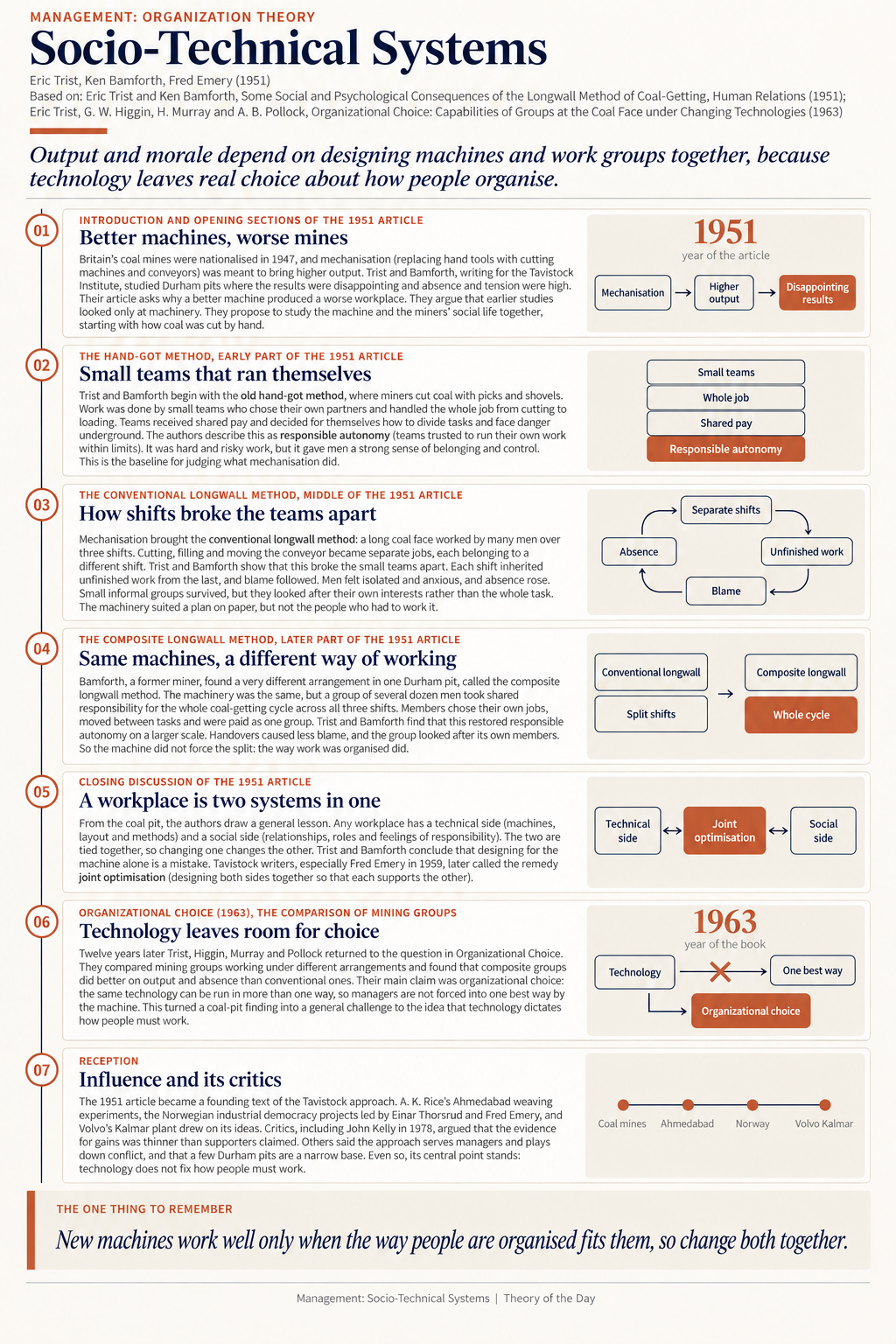
In the late 1940s Britain's coal mines had just been nationalised, and the new managers expected mechanisation to raise output. Eric Trist and Ken Bamforth, working with the Tavistock Institute of Human Relations in London, studied pits in County Durham where this was not happening. Their 1951 article in the journal Human Relations, "Some Social and Psychological Consequences of the Longwall Method of Coal-Getting", asked a simple question: why did better machines produce unhappier and less productive work groups?
The article, about thirty-five pages long, begins with the older hand-got method, in which miners cut coal with hand tools in small teams. These teams chose their own partners, did the whole job and shared their pay. The authors describe the result as responsible autonomy, meaning teams trusted to run their own work within limits. They then turn to the conventional longwall method, which used cutting machines and conveyors along a long coal face. Work was divided into separate jobs for three shifts. Teams broke apart, each shift blamed the one before for unfinished work, and tension and absence rose. Finally they describe the composite longwall method, found by Bamforth in one Durham pit, where a large group shared the whole cycle across all shifts and did better.
The mechanism is a fit between two sides of any workplace. The technical side is the machines, the layout and the method. The social side is the relationships, roles and sense of responsibility among the people. A technology does not fix a single way of working. It makes some arrangements easier and others harder. If managers copy the pattern the machine seems to demand, such as narrow jobs and strict shifts, they can destroy the bonds that help people cope with danger and uncertainty. If groups are left room to manage themselves, the same machine can work well. The 1963 book Organizational Choice gave this freedom its name.
Several people shaped the theory. Bamforth supplied the key observation of the composite method, and Trist led the analysis and the wider Tavistock programme. Fred Emery set out design principles in 1959, notably joint optimisation, meaning that the social and technical sides should be designed together. Trist, G. W. Higgin, H. Murray and A. B. Pollock wrote Organizational Choice in 1963, comparing mining groups under different technologies. A. K. Rice carried the ideas to weaving sheds in Ahmedabad, India, and Emery worked with Einar Thorsrud on projects in Norway.
The main evidence is the Durham comparison itself. Organizational Choice reported that composite groups did better than conventional ones on output and absence. Rice's Ahmedabad work reported gains in weaving efficiency after workers were regrouped. Critics have pushed back. John Kelly argued in 1978 that the evidence was weaker than supporters claimed. Labour-process writers say the approach serves management and plays down conflict and power. Others note that the findings rest on a few pits in a single industry.
The idea still matters because the same mistake keeps recurring. Organisations buy new technology and then wonder why it fails, when the real problem is that work routines, skills and teams were never redesigned around it. Designers of hospital information systems, safety-critical software and team-based factories use the socio-technical approach to avoid that error. It also frames current debates about automation at work: machines do not decide how people will work, because people choose that.
The work, part by part
1. Better machines, worse mines
Introduction and opening sections of the 1951 article
Britain's coal mines were nationalised in 1947, and mechanisation (replacing hand tools with cutting machines and conveyors) was meant to bring higher output. Trist and Bamforth, writing for the Tavistock Institute, studied Durham pits where the results were disappointing and absence and tension were high. Their article asks why a better machine produced a worse workplace. They argue that earlier studies looked only at machinery. They propose to study the machine and the miners' social life together, starting with how coal was cut by hand.
2. Small teams that ran themselves
The hand-got method, early part of the 1951 article
Trist and Bamforth begin with the old hand-got method, where miners cut coal with picks and shovels. Work was done by small teams who chose their own partners and handled the whole job from cutting to loading. Teams received shared pay and decided for themselves how to divide tasks and face danger underground. The authors describe this as responsible autonomy (teams trusted to run their own work within limits). It was hard and risky work, but it gave men a strong sense of belonging and control. This is the baseline for judging what mechanisation did.
3. How shifts broke the teams apart
The conventional longwall method, middle of the 1951 article
Mechanisation brought the conventional longwall method: a long coal face worked by many men over three shifts. Cutting, filling and moving the conveyor became separate jobs, each belonging to a different shift. Trist and Bamforth show that this broke the small teams apart. Each shift inherited unfinished work from the last, and blame followed. Men felt isolated and anxious, and absence rose. Small informal groups survived, but they looked after their own interests rather than the whole task. The machinery suited a plan on paper, but not the people who had to work it.
4. Same machines, a different way of working
The composite longwall method, later part of the 1951 article
Bamforth, a former miner, found a very different arrangement in one Durham pit, called the composite longwall method. The machinery was the same, but a group of several dozen men took shared responsibility for the whole coal-getting cycle across all three shifts. Members chose their own jobs, moved between tasks and were paid as one group. Trist and Bamforth find that this restored responsible autonomy on a larger scale. Handovers caused less blame, and the group looked after its own members. So the machine did not force the split: the way work was organised did.
5. A workplace is two systems in one
Closing discussion of the 1951 article
From the coal pit, the authors draw a general lesson. Any workplace has a technical side (machines, layout and methods) and a social side (relationships, roles and feelings of responsibility). The two are tied together, so changing one changes the other. Trist and Bamforth conclude that designing for the machine alone is a mistake. Tavistock writers, especially Fred Emery in 1959, later called the remedy joint optimisation (designing both sides together so that each supports the other).
6. Technology leaves room for choice
Organizational Choice (1963), the comparison of mining groups
Twelve years later Trist, Higgin, Murray and Pollock returned to the question in Organizational Choice. They compared mining groups working under different arrangements and found that composite groups did better on output and absence than conventional ones. Their main claim was organizational choice: the same technology can be run in more than one way, so managers are not forced into one best way by the machine. This turned a coal-pit finding into a general challenge to the idea that technology dictates how people must work.
7. Influence and its critics
Reception
The 1951 article became a founding text of the Tavistock approach. A. K. Rice's Ahmedabad weaving experiments, the Norwegian industrial democracy projects led by Einar Thorsrud and Fred Emery, and Volvo's Kalmar plant drew on its ideas. Critics, including John Kelly in 1978, argued that the evidence for gains was thinner than supporters claimed. Others said the approach serves managers and plays down conflict, and that a few Durham pits are a narrow base. Even so, its central point stands: technology does not fix how people must work.
The argument in four steps
- Mining teams are shaped both by their machines and by the human bonds between workers.
- Hand-got mining gave small self-chosen teams the whole job and real control.
- Conventional longwall split them across shifts, yet composite longwall kept the machines and restored whole-job groups.
- So technology leaves room for choice, and the best results come from designing people and machines together.
Who contributed what
- Eric Trist (1951): Led the Tavistock coal studies; framed the mine as linked social and technical systems, extended in Organizational Choice (1963).
- Ken Bamforth (1951): Ex-miner who found the composite longwall method in a Durham pit, supplying the contrasting case.
- Fred Emery (1959): In 'Characteristics of Socio-Technical Systems', set out design principles such as joint optimisation, tying the idea to open systems.
The evidence
- Trist and Bamforth's 1951 Durham study linked split shifts to blame, tension and absence.
- Trist, Higgin, Murray and Pollock's 1963 comparison found composite groups beat conventional ones on output and absence.
- Rice's 1958 Ahmedabad study reported better weaving efficiency and less damage after regrouping workers into small teams.
The criticisms
- John Kelly (1978) argued the evidence for socio-technical gains was weaker than claimed.
- Labour-process critics say it serves management goals and underplays conflict and power.
- Findings rest on few pits in one industry, so generalising is uncertain.
Compared with rival views
- Unlike Taylor's scientific management, it denies that technology fixes one best way and narrow jobs.
- Unlike the Hawthorne human relations school, it treats machines and work methods as shaping social life.
Why it matters today
Designers of hospital information systems and safety-critical software use it to redesign staff routines alongside the technology, since new systems often fail when work practices are ignored.
Further reading
- Eric Trist and Hugh Murray (eds.), The Social Engagement of Social Science, Volume II: The Socio-Technical Perspective (1993)
- William A. Pasmore, Designing Effective Organizations: The Sociotechnical Systems Perspective (1988)
- John E. Kelly, A Reappraisal of Sociotechnical Systems Theory (1978)