Infographic of: Bureaucracy as an Ideal Type
Sociology: Classical Foundations
Bureaucracy as an Ideal Type
Max Weber (1922)
Based on: Max Weber, Economy and Society (1922)
The most efficient way to run a large organisation is through fixed rules, a chain of command and trained, salaried officials.
Max Weber, the German sociologist and economic historian, died in 1920 before finishing the huge work later published as Economy and Society (1922). His widow, Marianne Weber, edited the manuscripts, and the pages on bureaucracy were drafted before the First World War. Weber lived in a country with a famously orderly civil service and a fast-growing industrial economy. He wanted to know why modern life everywhere was organised through offices run by trained officials, how such administration works, and what it does to the people living under it. His tool was the ideal type, a deliberately simplified model that picks out the main features of a thing so that messy real cases can be compared with it.
The argument begins in Part Two, where Weber asks why people obey. He separates three kinds of legitimate authority, meaning power the ruled accept as rightful: traditional (resting on custom), charismatic (resting on a leader's extraordinary gifts) and legal-rational (resting on enacted rules). Bureaucracy is the purest administrative form of the third. In Chapter XI, 'Bureaucracy', he lists its features: fixed areas of duty set by rules, a hierarchy of offices with appeal upward, written files, trained specialists and full-time work. He then describes the official, who is appointed, paid a fixed salary and pension, follows a career, and does not own the office or its tools.
The mechanism combines legitimacy and efficiency. People accept orders that come from rules and offices they regard as lawful, so administrators need no personal loyalty from the ruled. Because duties, procedures and records are fixed, results become predictable and cases are handled without anger or favour. Weber claims this gives bureaucracy a technical superiority over part-time notables or a ruler's personal servants: more precision, speed, continuity and lower costs, much as a machine outperforms hand work. A money economy, growing tasks and capitalist business spread it. Once established, expert knowledge and official secrecy give it a power that is very hard to break.
Weber was the only originator, but later scholars shaped how the theory is used. Robert Merton's 1940 essay 'Bureaucratic Structure and Personality' argued that rules meant as means can become ends in themselves. Alvin Gouldner's Patterns of Industrial Bureaucracy (1954) showed rules are negotiated and enforced in different patterns, and Peter Blau (1955) described informal ties inside government agencies. English readers first met Weber through Hans Gerth and C. Wright Mills's 1946 selections, and the fuller 1968 edition by Guenther Roth and Claus Wittich made the whole chapter available. Friedrich Tenbruck and others have questioned whether Weber ever meant Economy and Society as a single book.
The evidence is mixed. The Aston studies in Britain, led by Derek Pugh and David Hickson from 1968, found that features Weber bundled together, such as specialisation and rule-following, vary separately across organisations. Gouldner and Blau found real offices run on bargaining and friendship as well as written rules. Merton's point about ritualism remains the best-known criticism, and Michel Crozier's The Bureaucratic Phenomenon (1964) described French agencies trapped by rigid rules. Feminist critics such as Kathy Ferguson (1984) argue that neutral-looking rules hide power. Defenders reply that Weber offered a model for comparison, not a description or an endorsement.
The idea still matters because almost everyone deals with bureaucracies: tax offices, hospitals, universities and large firms. Debates about public-sector reform, including Paul du Gay's defence of bureaucracy as an ethic of fair, impartial service, still use Weber's model as the benchmark. It also gives ordinary people a way to name the mix of fairness and coldness they feel when they are treated as a case number.
The work, part by part
1. Why Weber studied the office
Background
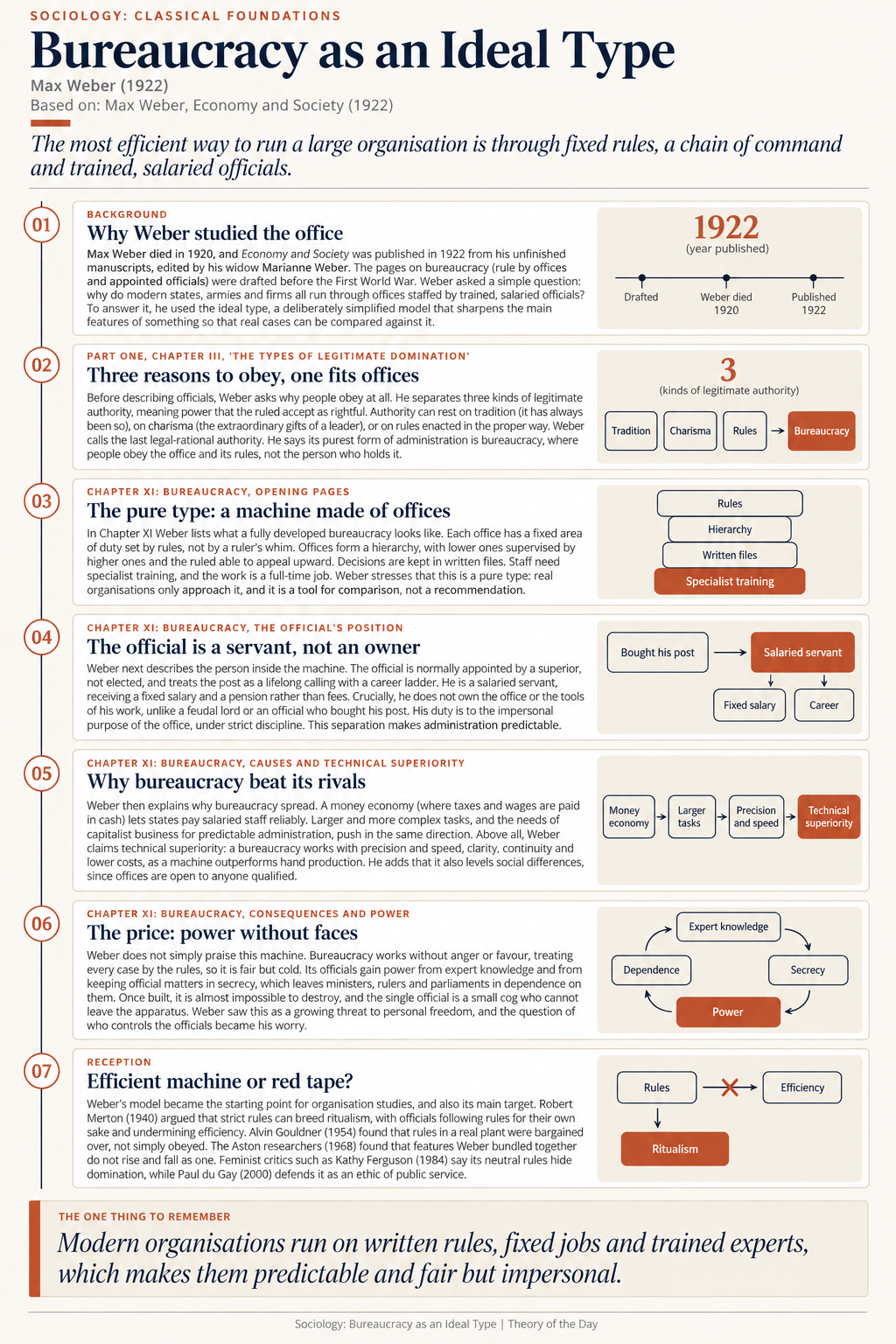
Max Weber died in 1920, and Economy and Society was published in 1922 from his unfinished manuscripts, edited by his widow Marianne Weber. The pages on bureaucracy (rule by offices and appointed officials) were drafted before the First World War. Weber asked a simple question: why do modern states, armies and firms all run through offices staffed by trained, salaried officials? To answer it, he used the ideal type, a deliberately simplified model that sharpens the main features of something so that real cases can be compared against it.
2. Three reasons to obey, one fits offices
Part One, Chapter III, 'The Types of Legitimate Domination'
Before describing officials, Weber asks why people obey at all. He separates three kinds of legitimate authority, meaning power that the ruled accept as rightful. Authority can rest on tradition (it has always been so), on charisma (the extraordinary gifts of a leader), or on rules enacted in the proper way. Weber calls the last legal-rational authority. He says its purest form of administration is bureaucracy, where people obey the office and its rules, not the person who holds it.
3. The pure type: a machine made of offices
Chapter XI: Bureaucracy, opening pages
In Chapter XI Weber lists what a fully developed bureaucracy looks like. Each office has a fixed area of duty set by rules, not by a ruler's whim. Offices form a hierarchy, with lower ones supervised by higher ones and the ruled able to appeal upward. Decisions are kept in written files. Staff need specialist training, and the work is a full-time job. Weber stresses that this is a pure type: real organisations only approach it, and it is a tool for comparison, not a recommendation.
4. The official is a servant, not an owner
Chapter XI: Bureaucracy, the official's position
Weber next describes the person inside the machine. The official is normally appointed by a superior, not elected, and treats the post as a lifelong calling with a career ladder. He is a salaried servant, receiving a fixed salary and a pension rather than fees. Crucially, he does not own the office or the tools of his work, unlike a feudal lord or an official who bought his post. His duty is to the impersonal purpose of the office, under strict discipline. This separation makes administration predictable.
5. Why bureaucracy beat its rivals
Chapter XI: Bureaucracy, causes and technical superiority
Weber then explains why bureaucracy spread. A money economy (where taxes and wages are paid in cash) lets states pay salaried staff reliably. Larger and more complex tasks, and the needs of capitalist business for predictable administration, push in the same direction. Above all, Weber claims technical superiority: a bureaucracy works with precision and speed, clarity, continuity and lower costs, as a machine outperforms hand production. He adds that it also levels social differences, since offices are open to anyone qualified.
6. The price: power without faces
Chapter XI: Bureaucracy, consequences and power
Weber does not simply praise this machine. Bureaucracy works without anger or favour, treating every case by the rules, so it is fair but cold. Its officials gain power from expert knowledge and from keeping official matters in secrecy, which leaves ministers, rulers and parliaments in dependence on them. Once built, it is almost impossible to destroy, and the single official is a small cog who cannot leave the apparatus. Weber saw this as a growing threat to personal freedom, and the question of who controls the officials became his worry.
7. Efficient machine or red tape?
Reception
Weber's model became the starting point for organisation studies, and also its main target. Robert Merton (1940) argued that strict rules can breed ritualism, with officials following rules for their own sake and undermining efficiency. Alvin Gouldner (1954) found that rules in a real plant were bargained over, not simply obeyed. The Aston researchers (1968) found that features Weber bundled together do not rise and fall as one. Feminist critics such as Kathy Ferguson (1984) say its neutral rules hide domination, while Paul du Gay (2000) defends it as an ethic of public service.
The argument in four steps
- Orders are obeyed when people believe the authority is rightful, and modern states ground that belief in law.
- Rule by law needs staff who follow fixed rules, obey a hierarchy, keep files and hold expert training.
- Such staff work more precisely, quickly and cheaply than amateurs, so growing states and firms adopt them.
- Therefore bureaucracy spreads through modern society and, once built, is almost impossible to dismantle.
Who contributed what
- Max Weber (1922): Economy and Society: built the ideal type of bureaucracy and argued it is technically superior and hard to resist.
- Robert K. Merton (1940): 'Bureaucratic Structure and Personality': showed rules meant as means can become ends, producing ritualism and trained incapacity.
- Alvin W. Gouldner (1954): Patterns of Industrial Bureaucracy: showed rules are negotiated, with mock, representative and punishment-centred patterns.
The evidence
- Pugh, Hickson and colleagues' 1968 Aston study of 46 organisations found structure varies on separate dimensions.
- Gouldner's 1954 gypsum-plant study found rules were bargained over and enforced in three different patterns.
- Blau's 1955 study of two US agencies found informal ties and flexible practice beside formal rules.
The criticisms
- Merton (1940): strict rules breed ritualism and 'trained incapacity', undermining efficiency.
- Gouldner and Blau: real organisations run on informal bargaining and flexible rules.
- Feminist critics such as Kathy Ferguson (1984) say its 'neutral' rules hide domination.
Compared with rival views
- Unlike traditional or charismatic rule, authority rests on impersonal rules, not on custom or a leader's gifts.
- Unlike Fayol's management principles, it is an analytical model for comparison, not advice for managers.
Why it matters today
Public-administration scholars still use Weber's model as the benchmark in debates over 'New Public Management' reforms, which du Gay answers with a defence of bureaucracy.
Further reading
- Martin Albrow, Bureaucracy (1970)
- Reinhard Bendix, Max Weber: An Intellectual Portrait (1960)
- Paul du Gay, In Praise of Bureaucracy: Weber, Organization, Ethics (2000)