Infographic of: Cultural Ecology
Anthropology: Foundations and Schools of Thought
Cultural Ecology
Julian Steward (1938-1955)
Based on: Julian Steward, Theory of Culture Change: The Methodology of Multilinear Evolution (1955); Julian Steward, Basin-Plateau Aboriginal Sociopolitical Groups (1938)
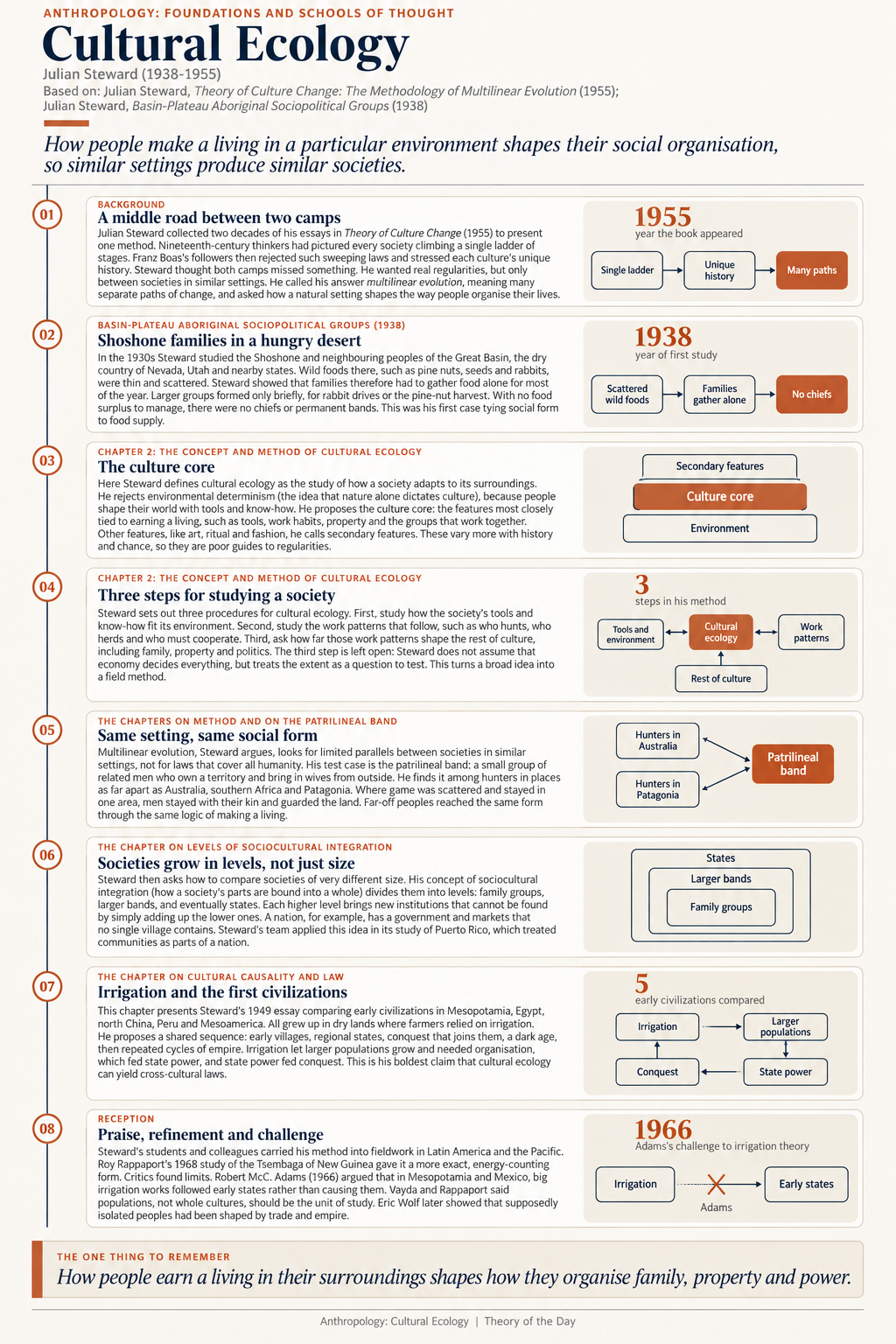
How people make a living in a particular environment shapes their social organisation, so similar settings produce similar societies.
Julian Steward (1902-1972) was an American anthropologist trained at Berkeley, who spent years among the Native peoples of the western United States. In 1955 he gathered his essays in Theory of Culture Change: The Methodology of Multilinear Evolution. He wrote into a stand-off. Nineteenth-century evolutionists had claimed that all societies climb one ladder of stages. Franz Boas's followers rejected such grand schemes and stressed each culture's unique history. Steward asked a narrower question: how does a society's natural setting shape the way its people live?
The book builds its case through method and examples. The opening pages present multilinear evolution, meaning many separate paths of change, with regularities expected only among societies in similar settings. Steward's earlier 1938 study, Basin-Plateau Aboriginal Sociopolitical Groups, supplies the model case: Shoshone families in the dry Great Basin lived off scattered pine nuts, seeds and rabbits, so they foraged alone and had no chiefs. Chapter 2, The Concept and Method of Cultural Ecology, sets out the framework. Later chapters apply it to patrilineal bands of hunters, to levels of sociocultural integration (how the parts of a society are bound into a whole), and to the first civilizations.
The mechanism has three steps. First, examine how a society's tools and know-how fit its environment. Second, examine the work patterns this requires, such as who hunts, who farms and who must cooperate. Third, ask how far those patterns shape the rest of culture. Steward called the features closest to earning a living the culture core, and treated art, ritual and fashion as secondary features that vary more with history. He rejected environmental determinism, the idea that nature alone dictates culture, because technology and know-how mediate between people and land. So similar environments with similar technology tend to produce similar social forms.
Others carried the idea forward. Steward's students at Columbia, among them Eric Wolf, Sidney Mintz and Marvin Harris, shaped later anthropology in different directions. Roy Rappaport's 1968 Pigs for the Ancestors measured energy flows among the Tsembaga of New Guinea and showed how ritual regulated pig herds and fighting. Rappaport and Andrew Vayda argued that populations, not whole cultures, should be the unit of study. Harris widened the approach into cultural materialism in 1979.
The evidence includes Steward's own Great Basin work, Rappaport's New Guinea study, and Robert Netting's 1981 account of Swiss villagers managing shared pastures. The criticisms are serious. Robert McC. Adams argued in 1966 that irrigation did not cause the earliest states in Mesopotamia and Mexico but followed them. Critics said Steward treated whole cultures as units of adaptation and played down politics, history and outside contact. Eric Wolf showed in 1982 that societies once seen as isolated had long been shaped by trade and empire.
The approach still matters because it asks a practical question: how do people fit their way of life to the land they have? Ecological anthropologists, development planners and researchers on climate resilience use it to study how herders, farmers and fishers manage shared resources. Steward's lasting lesson is that how people earn a living leaves a pattern on family, property and power, though not a fixed one.
The work, part by part
1. A middle road between two camps
Background
Julian Steward collected two decades of his essays in Theory of Culture Change (1955) to present one method. Nineteenth-century thinkers had pictured every society climbing a single ladder of stages. Franz Boas's followers then rejected such sweeping laws and stressed each culture's unique history. Steward thought both camps missed something. He wanted real regularities, but only between societies in similar settings. He called his answer multilinear evolution, meaning many separate paths of change, and asked how a natural setting shapes the way people organise their lives.
2. Shoshone families in a hungry desert
Basin-Plateau Aboriginal Sociopolitical Groups (1938)
In the 1930s Steward studied the Shoshone and neighbouring peoples of the Great Basin, the dry country of Nevada, Utah and nearby states. Wild foods there, such as pine nuts, seeds and rabbits, were thin and scattered. Steward showed that families therefore had to gather food alone for most of the year. Larger groups formed only briefly, for rabbit drives or the pine-nut harvest. With no food surplus to manage, there were no chiefs or permanent bands. This was his first case tying social form to food supply.
3. The culture core
Chapter 2: The Concept and Method of Cultural Ecology
Here Steward defines cultural ecology as the study of how a society adapts to its surroundings. He rejects environmental determinism (the idea that nature alone dictates culture), because people shape their world with tools and know-how. He proposes the culture core: the features most closely tied to earning a living, such as tools, work habits, property and the groups that work together. Other features, like art, ritual and fashion, he calls secondary features. These vary more with history and chance, so they are poor guides to regularities.
4. Three steps for studying a society
Chapter 2: The Concept and Method of Cultural Ecology
Steward sets out three procedures for cultural ecology. First, study how the society's tools and know-how fit its environment. Second, study the work patterns that follow, such as who hunts, who herds and who must cooperate. Third, ask how far those work patterns shape the rest of culture, including family, property and politics. The third step is left open: Steward does not assume that economy decides everything, but treats the extent as a question to test. This turns a broad idea into a field method.
5. Same setting, same social form
The chapters on method and on the patrilineal band
Multilinear evolution, Steward argues, looks for limited parallels between societies in similar settings, not for laws that cover all humanity. His test case is the patrilineal band: a small group of related men who own a territory and bring in wives from outside. He finds it among hunters in places as far apart as Australia, southern Africa and Patagonia. Where game was scattered and stayed in one area, men stayed with their kin and guarded the land. Far-off peoples reached the same form through the same logic of making a living.
6. Societies grow in levels, not just size
The chapter on levels of sociocultural integration
Steward then asks how to compare societies of very different size. His concept of sociocultural integration (how a society's parts are bound into a whole) divides them into levels: family groups, larger bands, and eventually states. Each higher level brings new institutions that cannot be found by simply adding up the lower ones. A nation, for example, has a government and markets that no single village contains. Steward's team applied this idea in its study of Puerto Rico, which treated communities as parts of a nation.
7. Irrigation and the first civilizations
The chapter on cultural causality and law
This chapter presents Steward's 1949 essay comparing early civilizations in Mesopotamia, Egypt, north China, Peru and Mesoamerica. All grew up in dry lands where farmers relied on irrigation. He proposes a shared sequence: early villages, regional states, conquest that joins them, a dark age, then repeated cycles of empire. Irrigation let larger populations grow and needed organisation, which fed state power, and state power fed conquest. This is his boldest claim that cultural ecology can yield cross-cultural laws.
8. Praise, refinement and challenge
Reception
Steward's students and colleagues carried his method into fieldwork in Latin America and the Pacific. Roy Rappaport's 1968 study of the Tsembaga of New Guinea gave it a more exact, energy-counting form. Critics found limits. Robert McC. Adams (1966) argued that in Mesopotamia and Mexico, big irrigation works followed early states rather than causing them. Vayda and Rappaport said populations, not whole cultures, should be the unit of study. Eric Wolf later showed that supposedly isolated peoples had been shaped by trade and empire.
The argument in four steps
- People meet their needs with tools and know-how fitted to the land they live on.
- Making a living sets who works with whom, and what property and groups they need.
- These core arrangements shape wider social life, while art and ritual vary more with history.
- So societies in similar settings with similar technology develop similar forms, along many separate paths.
Who contributed what
- Julian Steward (1955): Theory of Culture Change: defined cultural ecology, the culture core, three-step method and multilinear evolution.
- Roy A. Rappaport (1968): Pigs for the Ancestors: measured energy and ritual among the Tsembaga, treating the population as the unit.
- Marvin Harris (1979): Cultural Materialism: widened the approach into a programme explaining culture by technology, economy and environment.
The evidence
- Steward's 1938 Great Basin survey showed Shoshone family groups matching scarce, scattered wild foods.
- Rappaport's 1968 Pigs for the Ancestors showed Tsembaga ritual cycles regulating pig herds and fighting.
- Netting's 1981 Balancing on an Alp showed Swiss villagers managing common pastures to fit scarce land.
The criticisms
- Adams (1966) found irrigation followed early states in Mesopotamia and Mexico, not the reverse.
- Vayda and Rappaport said populations, not whole cultures, are the right unit of adaptation.
- Wolf (1982) showed 'isolated' peoples were shaped by trade and empire, which Steward neglected.
Compared with rival views
- Unlike unilineal evolution, it finds parallels only among societies in similar environments, not one ladder.
- Unlike Boasian historical particularism, it seeks cross-cultural regularities and explains culture by adaptation, not unique histories.
Why it matters today
Ecological anthropologists and development planners use it to study how herders, farmers and fishers manage common resources like pastures and fisheries.
Further reading
- Virginia Kerns, Scenes from the High Desert: Julian Steward's Life and Theory (2003)
- Robert McC. Netting, Cultural Ecology (1977)
- Mark Q. Sutton and E. N. Anderson, Introduction to Cultural Ecology (2004)