Infographic of: Theory of Mind
Psychology: Psychodynamic and Developmental
Theory of Mind
David Premack, Heinz Wimmer and others (1978-1985)
Based on: David Premack and Guy Woodruff, Does the Chimpanzee Have a Theory of Mind?, Behavioral and Brain Sciences (1978); Heinz Wimmer and Josef Perner, Beliefs about Beliefs: Representation and Constraining Function of Wrong Beliefs in Young Children's Understanding of Deception, Cognition (1983); Simon Baron-Cohen, Alan M. Leslie and Uta Frith, Does the Autistic Child Have a 'Theory of Mind'?, Cognition (1985)
People explain behaviour by guessing at hidden beliefs and wants, and children learn around age four that beliefs can be wrong.
In the 1970s the psychologist David Premack and his colleague Guy Woodruff asked a deceptively simple question: can a chimpanzee tell what another creature is thinking? Their 1978 article in Behavioral and Brain Sciences gave the field its name. They defined a 'theory of mind' as attributing mental states, such as wanting, knowing or believing, to oneself and to others. It is called a theory because minds cannot be seen, so we must infer them and use those inferences to predict behaviour.
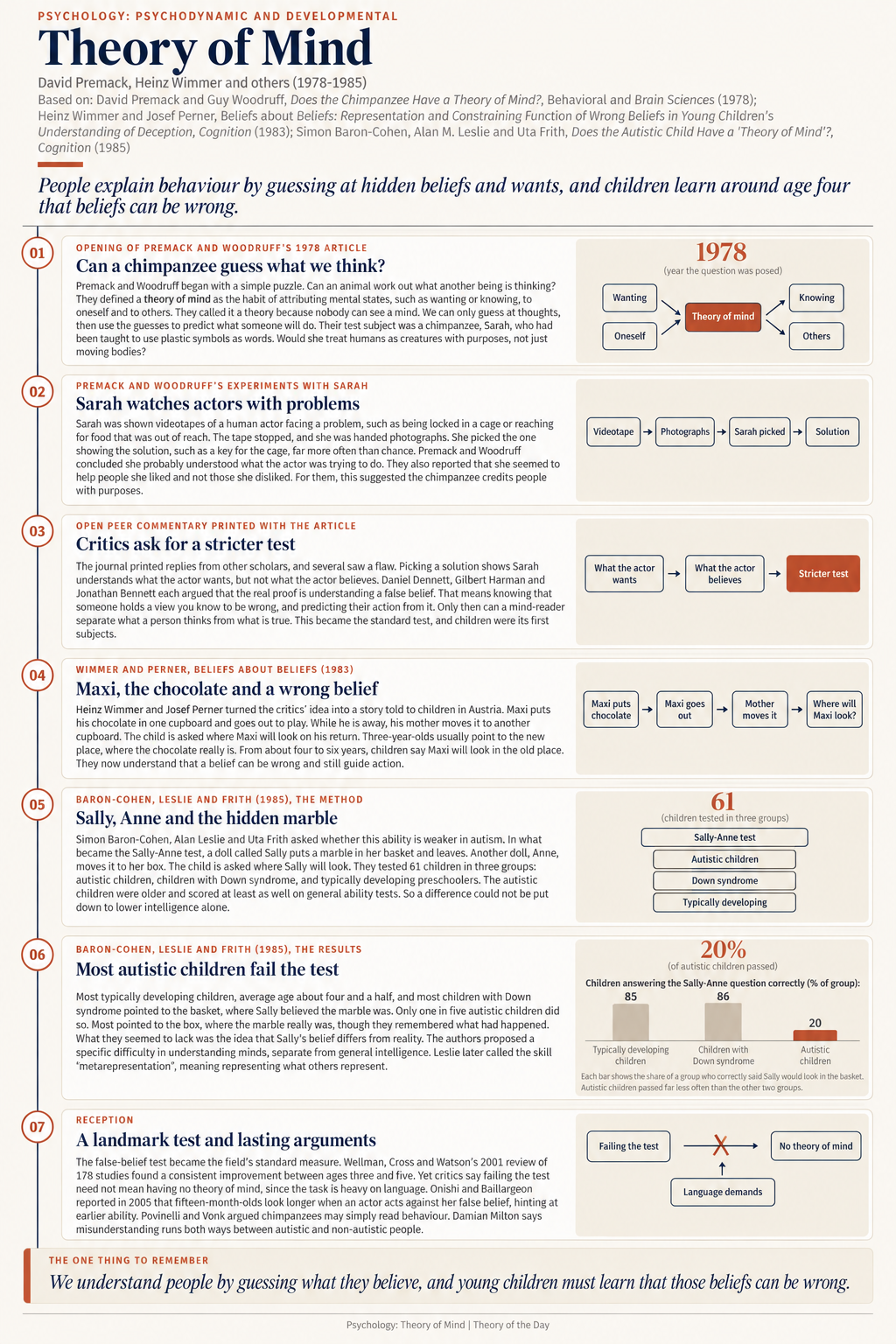
The article's core is a set of experiments with a chimpanzee named Sarah, who had been taught to use plastic symbols as words. She watched videotapes of a human actor facing a problem, such as being locked in a cage or unable to reach food. She was then given photographs and picked the one showing the solution. Premack and Woodruff concluded she probably understood the actor's purpose. The journal also printed replies from other scholars. Daniel Dennett, Gilbert Harman and Jonathan Bennett pointed out that this shows an understanding of wants, not beliefs. They proposed a stricter test: grasping a belief that is false. Heinz Wimmer and Josef Perner turned that into the 1983 Maxi task, in which a boy's chocolate is moved while he is out and children say where he will look. In 1985 Simon Baron-Cohen, Alan Leslie and Uta Frith used a similar doll story, the Sally-Anne test, with autistic children.
The mechanism these works propose is that people predict others by attributing to them inner states that represent the world. Crucially, such a representation can differ from reality. Someone who did not see the chocolate moved still believes it is in the old place, and will act on that belief. To grasp this, a child must hold two things in mind at once: what is true, and what another person thinks is true. Wimmer and Perner found that three-year-olds usually fail and that most children succeed from about four to six. Leslie later called the skill 'metarepresentation', meaning representing a representation.
Several people shaped the theory. Premack and Woodruff supplied the concept and the comparative question. Dennett, Harman and Bennett supplied the false-belief criterion. Wimmer and Perner supplied an early children's task and the age at which it is passed. Baron-Cohen, with Leslie and Frith, linked the idea to autism, and later set out his view in the 1995 book Mindblindness. Perner's 1991 book, Understanding the Representational Mind, argued that children come to see beliefs as mental pictures of the world that may be wrong.
In the 1985 study, about 85 per cent of typically developing children and 86 per cent of children with Down syndrome passed Sally-Anne, against only 20 per cent of autistic children. A 2001 review by Henry Wellman, David Cross and Julanne Watson of 178 studies found steady improvement between ages three and five. Onishi and Baillargeon reported in 2005 that fifteen-month-olds look longer when an actor acts against her false belief, which suggests earlier understanding. Critics reply that the task demands language and attention, as Paul Bloom and Tim German argued. Daniel Povinelli and Timothy Vonk argued that chimpanzees may only be reading behaviour. Damian Milton's 'double empathy' view says misunderstanding runs both ways between autistic and non-autistic people.
The idea still matters because false-belief tasks remain a standard way to study how children come to understand others. It also shapes clinical work. Mentalization-based therapy, developed by Anthony Bateman and Peter Fonagy, helps patients notice what lies behind their own and other people's behaviour, and the debate over what autistic children can and cannot do with other minds continues.
The work, part by part
1. Can a chimpanzee guess what we think?
Opening of Premack and Woodruff's 1978 article
Premack and Woodruff began with a simple puzzle. Can an animal work out what another being is thinking? They defined a theory of mind as the habit of attributing mental states, such as wanting or knowing, to oneself and to others. They called it a theory because nobody can see a mind. We can only guess at thoughts, then use the guesses to predict what someone will do. Their test subject was a chimpanzee, Sarah, who had been taught to use plastic symbols as words. Would she treat humans as creatures with purposes, not just moving bodies?
2. Sarah watches actors with problems
Premack and Woodruff's experiments with Sarah
Sarah was shown videotapes of a human actor facing a problem, such as being locked in a cage or reaching for food that was out of reach. The tape stopped, and she was handed photographs. She picked the one showing the solution, such as a key for the cage, far more often than chance. Premack and Woodruff concluded she probably understood what the actor was trying to do. They also reported that she seemed to help people she liked and not those she disliked. For them, this suggested the chimpanzee credits people with purposes.
3. Critics ask for a stricter test
Open peer commentary printed with the article
The journal printed replies from other scholars, and several saw a flaw. Picking a solution shows Sarah understands what the actor wants, but not what the actor believes. Daniel Dennett, Gilbert Harman and Jonathan Bennett each argued that the real proof is understanding a false belief. That means knowing that someone holds a view you know to be wrong, and predicting their action from it. Only then can a mind-reader separate what a person thinks from what is true. This became the standard test, and children were its first subjects.
4. Maxi, the chocolate and a wrong belief
Wimmer and Perner, Beliefs about Beliefs (1983)
Heinz Wimmer and Josef Perner turned the critics' idea into a story told to children in Austria. Maxi puts his chocolate in one cupboard and goes out to play. While he is away, his mother moves it to another cupboard. The child is asked where Maxi will look on his return. Three-year-olds usually point to the new place, where the chocolate really is. From about four to six years, children say Maxi will look in the old place. They now understand that a belief can be wrong and still guide action.
5. Sally, Anne and the hidden marble
Baron-Cohen, Leslie and Frith (1985), the method
Simon Baron-Cohen, Alan Leslie and Uta Frith asked whether this ability is weaker in autism. In what became the Sally-Anne test, a doll called Sally puts a marble in her basket and leaves. Another doll, Anne, moves it to her box. The child is asked where Sally will look. They tested 61 children in three groups: autistic children, children with Down syndrome, and typically developing preschoolers. The autistic children were older and scored at least as well on general ability tests. So a difference could not be put down to lower intelligence alone.
6. Most autistic children fail the test
Baron-Cohen, Leslie and Frith (1985), the results
Most typically developing children, average age about four and a half, and most children with Down syndrome pointed to the basket, where Sally believed the marble was. Only one in five autistic children did so. Most pointed to the box, where the marble really was, though they remembered what had happened. What they seemed to lack was the idea that Sally's belief differs from reality. The authors proposed a specific difficulty in understanding minds, separate from general intelligence. Leslie later called the skill 'metarepresentation', meaning representing what others represent.
7. A landmark test and lasting arguments
Reception
The false-belief test became the field's standard measure. Wellman, Cross and Watson's 2001 review of 178 studies found a consistent improvement between ages three and five. Yet critics say failing the test need not mean having no theory of mind, since the task is heavy on language. Onishi and Baillargeon reported in 2005 that fifteen-month-olds look longer when an actor acts against her false belief, hinting at earlier ability. Povinelli and Vonk argued chimpanzees may simply read behaviour. Damian Milton says misunderstanding runs both ways between autistic and non-autistic people.
The argument in four steps
- We cannot see minds, so we guess at others' wants and beliefs to predict what they do.
- Showing a chimpanzee human problems tests whether she understands what others want.
- Understanding wants is not enough; the real test is predicting action from a belief that is false.
- So children come to understand false beliefs around age four, and autistic children usually find this much harder.
Who contributed what
- David Premack (1978): With Woodruff, coined 'theory of mind' and tested chimpanzee Sarah with videotaped problems and photographs.
- Heinz Wimmer (1983): With Perner, designed the Maxi chocolate task, an early children's false-belief test; most pass from about four to six.
- Simon Baron-Cohen (1985): With Leslie and Frith, used the Sally-Anne test to show most autistic children fail false-belief questions.
- Josef Perner (1991): In Understanding the Representational Mind, argued children grasp beliefs as mental pictures of the world around age four.
The evidence
- Baron-Cohen, Leslie and Frith 1985: 20% of autistic children passed Sally-Anne, versus about 85% of others.
- Wellman, Cross and Watson's 2001 meta-analysis of 178 studies found improvement between ages three and five.
- Onishi and Baillargeon 2005: fifteen-month-olds looked longer when an actor acted against a false belief.
The criticisms
- Bloom and German (2000): false-belief tasks demand language and attention, not only mind-reading.
- Povinelli and Vonk (2003): chimpanzee success may come from reading behaviour, not minds.
- Milton's 2012 'double empathy' idea: misunderstanding runs both ways, not only from autistic people.
Compared with rival views
- Unlike behaviourism, it treats unseen beliefs and wants as real causes of what people do.
- Unlike Piaget's egocentrism, it tests beliefs directly and places the shift near age four.
Why it matters today
Mentalization-based therapy, developed by Bateman and Fonagy for borderline personality disorder, trains patients to read their own and others' mental states.
Further reading
- Henry M. Wellman, The Child's Theory of Mind (1990)
- Simon Baron-Cohen, Mindblindness: An Essay on Autism and Theory of Mind (1995)
- Josep Call and Michael Tomasello, Does the Chimpanzee Have a Theory of Mind? 30 Years Later (2008)