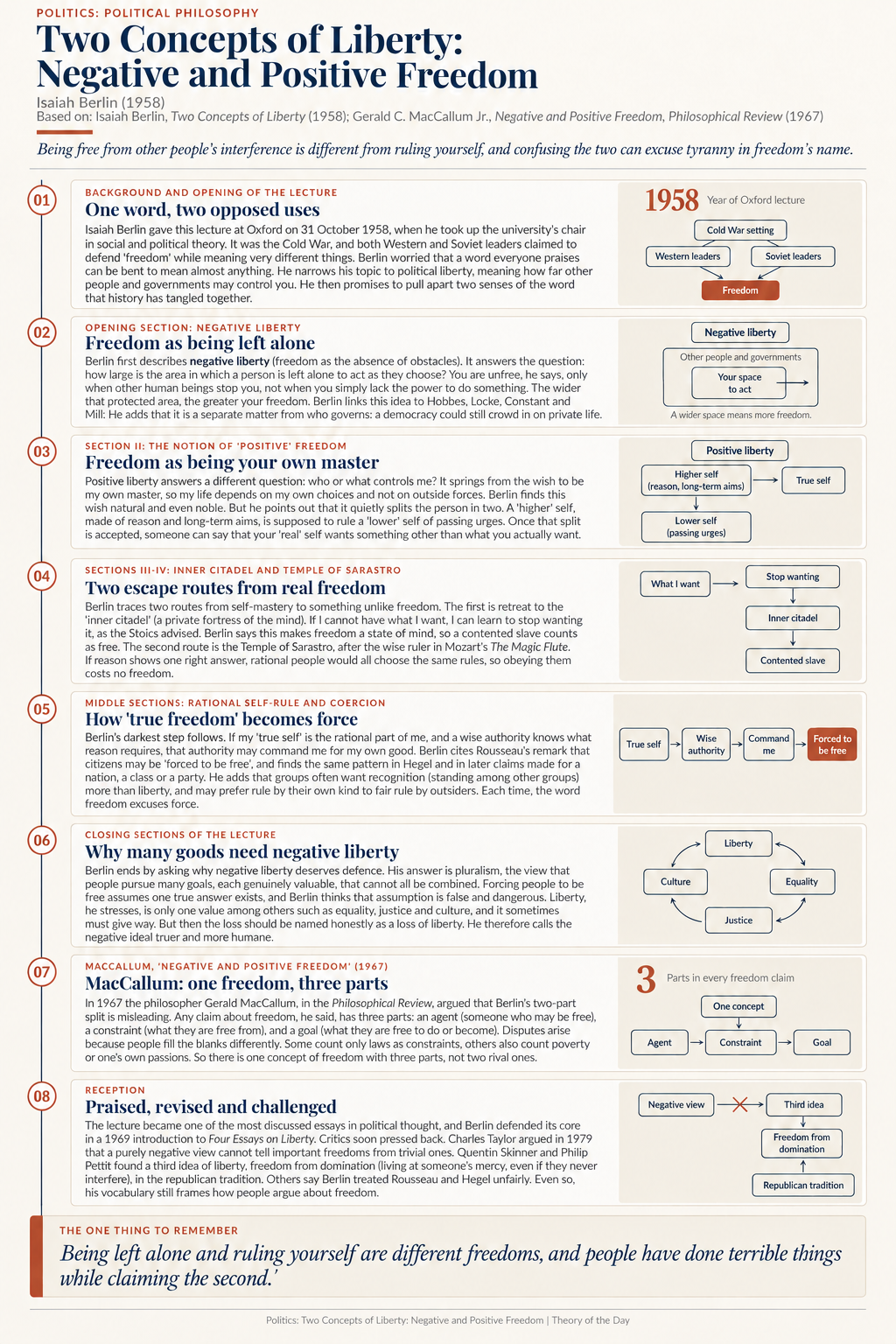
Infographic of: Two Concepts of Liberty: Negative and Positive Freedom
Politics: Political Philosophy
Two Concepts of Liberty: Negative and Positive Freedom
Isaiah Berlin (1958)
Based on: Isaiah Berlin, Two Concepts of Liberty (1958); Gerald C. MacCallum Jr., Negative and Positive Freedom, Philosophical Review (1967)
Being free from other people's interference is different from ruling yourself, and confusing the two can excuse tyranny in freedom's name.
Isaiah Berlin, a philosopher and historian of ideas born in Riga in 1909, delivered Two Concepts of Liberty at Oxford on 31 October 1958, as his inaugural lecture as professor of social and political theory. It was printed the same year and reprinted in 1969 in Four Essays on Liberty. The Cold War gave it urgency, because governments of every stripe claimed to defend freedom while meaning very different things. Berlin feared that a word everyone praises can be stretched to excuse almost anything, even tyranny. His question was plain: what do people mean when they say they want to be free?
The lecture is built as a series of numbered sections. It opens with negative liberty, the area in which other people leave you alone, an idea Berlin links to Hobbes, Locke, Constant and Mill. Section II turns to positive liberty, the wish to be your own master and not be steered by outside forces. Sections III and IV follow two ways this wish goes wrong: the retreat to the inner citadel, where you escape frustration by ceasing to want things, and the Temple of Sarastro, where reason is taken to know the single right answer. The middle sections show rulers using that idea to force people to be 'free', and the closing sections defend pluralism, the belief that human goals are many and often clash.
The mechanism Berlin describes is a slide in small steps. I want to be my own master. That means one part of me, my reason, should rule my urges. So my 'true self' wants whatever reason requires. If reason has one right answer, someone wiser may know what my true self wants better than I do. That person may then compel me and call it liberation. Negative liberty blocks the slide by asking only how much is left to the individual, never who is really in charge. Berlin admits that it has its own record of abuse, since economics of no state interference has defended hardship, and that liberty sometimes must yield to equality or justice.
Berlin was not alone. Benjamin Constant had contrasted ancient and modern liberty in 1819. Gerald MacCallum argued in 1967 that every freedom claim has three parts, an agent, a constraint and a goal, so there is really one concept. Charles Taylor answered in 1979 that a purely negative view cannot rank important freedoms above trivial ones. Quentin Skinner and Philip Pettit later proposed a third idea, freedom as not being dominated, drawn from the republican tradition.
Evidence for Berlin's warning comes from the texts he cites. Rousseau's Social Contract of 1762 said dissenters would be 'forced to be free', and J. L. Talmon's 1952 Origins of Totalitarian Democracy linked such thinking to Jacobin dictatorship. Critics find the scheme too neat. MacCallum says the two ideas collapse into one. Taylor says negative liberty cannot ignore which goals matter. Others think Berlin treated Rousseau and Hegel unfairly, and that deciding what counts as interference already needs judgments about value.
The lecture still matters because its vocabulary shapes everyday arguments. When people ask whether poverty limits freedom, or only deliberate action by others does, they use Berlin's distinction. The same goes for debates over public-health rules, state surveillance and paternalism, the idea that governments may override choices for people's own good. Its lasting lesson is a question worth asking whenever someone promises liberation: freedom from what, to do what, and who decides?
The work, part by part
1. One word, two opposed uses
Background and opening of the lecture
Isaiah Berlin gave this lecture at Oxford on 31 October 1958, when he took up the university's chair in social and political theory. It was the Cold War, and both Western and Soviet leaders claimed to defend 'freedom' while meaning very different things. Berlin worried that a word everyone praises can be bent to mean almost anything. He narrows his topic to political liberty, meaning how far other people and governments may control you. He then promises to pull apart two senses of the word that history has tangled together.
2. Freedom as being left alone
Opening section: negative liberty
Berlin first describes negative liberty (freedom as the absence of obstacles). It answers the question: how large is the area in which a person is left alone to act as they choose? You are unfree, he says, only when other human beings stop you, not when you simply lack the power to do something. The wider that protected area, the greater your freedom. Berlin links this idea to Hobbes, Locke, Constant and Mill. He adds that it is a separate matter from who governs: a democracy could still crowd in on private life.
3. Freedom as being your own master
Section II: The Notion of 'Positive' Freedom
Positive liberty answers a different question: who or what controls me? It springs from the wish to be my own master, so my life depends on my own choices and not on outside forces. Berlin finds this wish natural and even noble. But he points out that it quietly splits the person in two. A 'higher' self, made of reason and long-term aims, is supposed to rule a 'lower' self of passing urges. Once that split is accepted, someone can say that your 'real' self wants something other than what you actually want.
4. Two escape routes from real freedom
Sections III-IV: inner citadel and Temple of Sarastro
Berlin traces two routes from self-mastery to something unlike freedom. The first is retreat to the 'inner citadel' (a private fortress of the mind). If I cannot have what I want, I can learn to stop wanting it, as the Stoics advised. Berlin says this makes freedom a state of mind, so a contented slave counts as free. The second route is the Temple of Sarastro, after the wise ruler in Mozart's The Magic Flute. If reason shows one right answer, rational people would all choose the same rules, so obeying them costs no freedom.
5. How 'true freedom' becomes force
Middle sections: rational self-rule and coercion
Berlin's darkest step follows. If my 'true self' is the rational part of me, and a wise authority knows what reason requires, that authority may command me for my own good. Berlin cites Rousseau's remark that citizens may be 'forced to be free', and finds the same pattern in Hegel and in later claims made for a nation, a class or a party. He adds that groups often want recognition (standing among other groups) more than liberty, and may prefer rule by their own kind to fair rule by outsiders. Each time, the word freedom excuses force.
6. Why many goods need negative liberty
Closing sections of the lecture
Berlin ends by asking why negative liberty deserves defence. His answer is pluralism, the view that people pursue many goals, each genuinely valuable, that cannot all be combined. Forcing people to be free assumes one true answer exists, and Berlin thinks that assumption is false and dangerous. Liberty, he stresses, is only one value among others such as equality, justice and culture, and it sometimes must give way. But then the loss should be named honestly as a loss of liberty. He therefore calls the negative ideal truer and more humane.
7. MacCallum: one freedom, three parts
MacCallum, 'Negative and Positive Freedom' (1967)
In 1967 the philosopher Gerald MacCallum, in the Philosophical Review, argued that Berlin's two-part split is misleading. Any claim about freedom, he said, has three parts: an agent (someone who may be free), a constraint (what they are free from), and a goal (what they are free to do or become). Disputes arise because people fill the blanks differently. Some count only laws as constraints, others also count poverty or one's own passions. So there is one concept of freedom with three parts, not two rival ones.
8. Praised, revised and challenged
Reception
The lecture became one of the most discussed essays in political thought, and Berlin defended its core in a 1969 introduction to Four Essays on Liberty. Critics soon pressed back. Charles Taylor argued in 1979 that a purely negative view cannot tell important freedoms from trivial ones. Quentin Skinner and Philip Pettit found a third idea of liberty, freedom from domination (living at someone's mercy, even if they never interfere), in the republican tradition. Others say Berlin treated Rousseau and Hegel unfairly. Even so, his vocabulary still frames how people argue about freedom.
The argument in four steps
- One meaning of freedom is the size of the area in which others leave you alone.
- A second meaning is self-rule: being master of your own life, guided by your true or rational self.
- Once self-rule means obeying a 'true self', rulers claim to know its wishes and force obedience.
- So negative freedom is the safer ideal, because it respects people's many conflicting goals instead of imposing one.
Who contributed what
- Isaiah Berlin (1958): In Two Concepts of Liberty, split freedom into non-interference and self-mastery, warning the second invites tyranny.
- Gerald C. MacCallum Jr. (1967): In 'Negative and Positive Freedom', recast both as one three-part relation: agent, constraint, goal.
- Charles Taylor (1979): In 'What's Wrong with Negative Liberty', argued some freedoms matter more, so a purely negative view fails.
The evidence
- Constant's 1819 lecture separated political participation from private independence, anticipating Berlin's split.
- Rousseau's 1762 Social Contract said dissenting citizens would be 'forced to be free', showing coercive risk.
- Talmon's 1952 Origins of Totalitarian Democracy linked Rousseau's ideal of true freedom to Jacobin dictatorship.
The criticisms
- MacCallum (1967): freedom is one three-part relation, so the two-concept split misleads.
- Taylor (1979): a purely negative view cannot rank important freedoms above trivial ones.
- Skinner and Pettit: Berlin missed a third idea, freedom as non-domination.
Compared with rival views
- Unlike Constant's 1819 contrast of ancient and modern liberty, it separates two ideas within modern thought.
- Unlike the republican view, it counts only actual interference as loss of freedom, not domination.
Why it matters today
Debates over whether poverty limits freedom, or only deliberate action by others does, still run on Berlin's two concepts.
Further reading
- Ian Carter, A Measure of Freedom (1999)
- George Crowder, Isaiah Berlin: Liberty and Pluralism (2004)
- Quentin Skinner, A Third Concept of Liberty (2002)