Infographic of: Affirmations and Mirror Work
Positivity: Classic Positive Thinking
Affirmations and Mirror Work
Louise Hay (1984)
Based on: Louise L. Hay, You Can Heal Your Life (1984); Louise L. Hay, Mirror Work: 21 Days to Heal Your Life (2016)
Repeating loving statements to yourself in a mirror can replace harsh inner beliefs and so change your life and health.
Louise Hay was an American writer and a minister of Religious Science, part of the New Thought movement, which holds that the mind shapes reality. In 1976 she published a small booklet, Heal Your Body, listing mental patterns she linked to physical problems. In 1984 she expanded it into You Can Heal Your Life. The book asks a simple question: can changing what we tell ourselves change our lives? Hay wrote from her own account of a painful childhood and a recovery from cancer, which she credited to forgiveness and new thinking. That account rests on her word alone.
The book moves from belief to practice. Its early chapters, including "What I Believe", state her principles: every thought and word shapes our future, we are each responsible for our experiences, and the point of power is the present moment. Later chapters argue that many beliefs are harsh messages absorbed in childhood, and that we resist letting them go. The exercise chapters then offer tools: affirmations, which are short positive statements repeated to yourself, and mirror work, where you say them while looking into your own eyes. A central part is a list pairing bodily problems with a probable mental cause and a new thought pattern.
Hay's mechanism is replacement. A belief is, in her view, a thought repeated until it feels true. Because beliefs shape experience, swapping a harsh belief for a loving one should change what happens to us. Affirmations should be positive and in the present tense, such as "I love and approve of myself." The mirror makes the practice harder to avoid, because doubt shows up as soon as you speak, and Hay tells readers to notice that doubt and answer it kindly. In 2016, Mirror Work: 21 Days to Heal Your Life turned the practice into a daily programme.
Hay drew on the New Thought tradition, and similar ideas appear in Émile Coué's autosuggestion. The scholarly study of affirmation developed separately. Claude Steele's self-affirmation theory (1988) proposed that people protect their sense of worth by reflecting on values that matter to them. Joanne Wood and colleagues (2009) tested positive self-statements directly and found that the effect depends on who is speaking. Hay supplied the popular package: the slogans, the mirror and the illness list.
Research gives partial support. Geoffrey Cohen's 2006 Science study found that a short exercise of writing about personal values raised the grades of Black seventh-graders, although later results have varied. A small 2006 study by Delinsky and Wilson found that mirror exposure reduced body dissatisfaction. But Wood's experiments found that repeating "I am a lovable person" left people with low self-esteem feeling worse. The strongest objection concerns health: there is no evidence that thoughts cause cancer or other disease, or that affirmations cure them. Susan Sontag's Illness as Metaphor (1978) attacked psychological theories of cancer, and Barbara Ehrenreich's Bright-Sided (2009) argued that such ideas blame the sick.
Affirmations and mirror work remain staples of self-help books, journaling apps and wellness coaching, so it matters to know what holds up. Kind, realistic self-talk can ease harsh self-criticism, and values-based affirmation is studied in schools. Mirror exposure also has a place in body-image therapy. But the claim that thinking alone creates health or wealth is unsupported, and it can add guilt to illness. Used as a gentle habit, not a cure, Hay's method may help some people, though not everyone.
The work, part by part
1. From a hard life to a self-help classic
Background
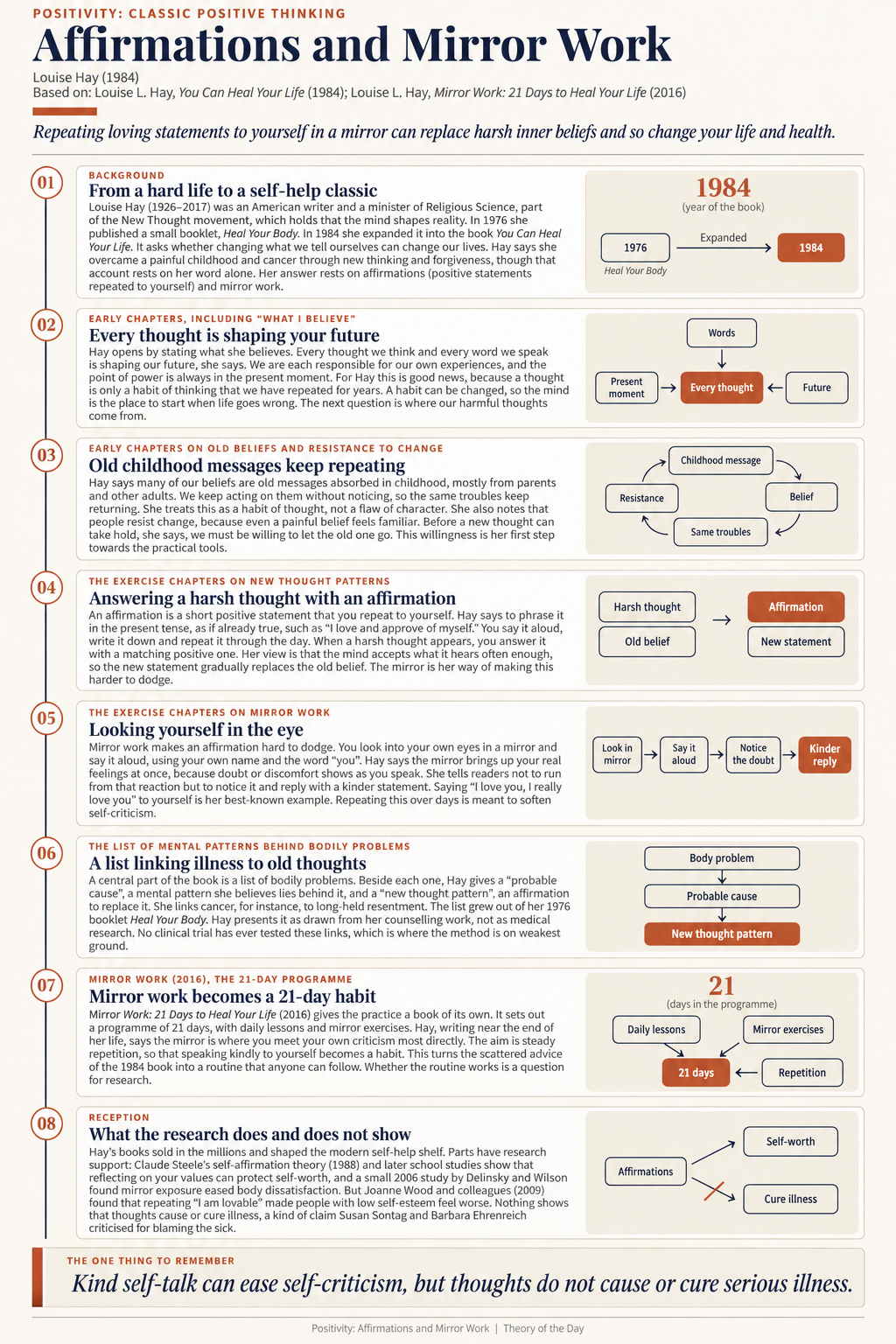
Louise Hay (1926–2017) was an American writer and a minister of Religious Science, part of the New Thought movement, which holds that the mind shapes reality. In 1976 she published a small booklet, Heal Your Body. In 1984 she expanded it into the book You Can Heal Your Life. It asks whether changing what we tell ourselves can change our lives. Hay says she overcame a painful childhood and cancer through new thinking and forgiveness, though that account rests on her word alone. Her answer rests on affirmations (positive statements repeated to yourself) and mirror work.
2. Every thought is shaping your future
Early chapters, including "What I Believe"
Hay opens by stating what she believes. Every thought we think and every word we speak is shaping our future, she says. We are each responsible for our own experiences, and the point of power is always in the present moment. For Hay this is good news, because a thought is only a habit of thinking that we have repeated for years. A habit can be changed, so the mind is the place to start when life goes wrong. The next question is where our harmful thoughts come from.
3. Old childhood messages keep repeating
Early chapters on old beliefs and resistance to change
Hay says many of our beliefs are old messages absorbed in childhood, mostly from parents and other adults. We keep acting on them without noticing, so the same troubles keep returning. She treats this as a habit of thought, not a flaw of character. She also notes that people resist change, because even a painful belief feels familiar. Before a new thought can take hold, she says, we must be willing to let the old one go. This willingness is her first step towards the practical tools.
4. Answering a harsh thought with an affirmation
The exercise chapters on new thought patterns
An affirmation is a short positive statement that you repeat to yourself. Hay says to phrase it in the present tense, as if already true, such as "I love and approve of myself." You say it aloud, write it down and repeat it through the day. When a harsh thought appears, you answer it with a matching positive one. Her view is that the mind accepts what it hears often enough, so the new statement gradually replaces the old belief. The mirror is her way of making this harder to dodge.
5. Looking yourself in the eye
The exercise chapters on mirror work
Mirror work makes an affirmation hard to dodge. You look into your own eyes in a mirror and say it aloud, using your own name and the word "you". Hay says the mirror brings up your real feelings at once, because doubt or discomfort shows as you speak. She tells readers not to run from that reaction but to notice it and reply with a kinder statement. Saying "I love you, I really love you" to yourself is her best-known example. Repeating this over days is meant to soften self-criticism.
6. A list linking illness to old thoughts
The list of mental patterns behind bodily problems
A central part of the book is a list of bodily problems. Beside each one, Hay gives a "probable cause", a mental pattern she believes lies behind it, and a "new thought pattern", an affirmation to replace it. She links cancer, for instance, to long-held resentment. The list grew out of her 1976 booklet Heal Your Body. Hay presents it as drawn from her counselling work, not as medical research. No clinical trial has ever tested these links, which is where the method is on weakest ground.
7. Mirror work becomes a 21-day habit
Mirror Work (2016), the 21-day programme
Mirror Work: 21 Days to Heal Your Life (2016) gives the practice a book of its own. It sets out a programme of 21 days, with daily lessons and mirror exercises. Hay, writing near the end of her life, says the mirror is where you meet your own criticism most directly. The aim is steady repetition, so that speaking kindly to yourself becomes a habit. This turns the scattered advice of the 1984 book into a routine that anyone can follow. Whether the routine works is a question for research.
8. What the research does and does not show
Reception
Hay's books sold in the millions and shaped the modern self-help shelf. Parts have research support: Claude Steele's self-affirmation theory (1988) and later school studies show that reflecting on your values can protect self-worth, and a small 2006 study by Delinsky and Wilson found mirror exposure eased body dissatisfaction. But Joanne Wood and colleagues (2009) found that repeating "I am lovable" made people with low self-esteem feel worse. Nothing shows that thoughts cause or cure illness, a kind of claim Susan Sontag and Barbara Ehrenreich criticised for blaming the sick.
The argument in four steps
- Every thought and spoken word shapes the experiences we later have.
- Harsh beliefs about ourselves, absorbed in childhood, keep returning as adult problems and illness.
- Stating loving, present-tense affirmations aloud, especially to your own eyes in a mirror, overwrites those beliefs.
- So self-love, practised daily, is the route to a healthier body and a better life.
Who contributed what
- Louise Hay (1984): You Can Heal Your Life: joined affirmations, mirror work and forgiveness to a list of illness causes.
- Claude Steele (1988): Self-affirmation theory: reflecting on core values protects self-worth, tested in controlled experiments.
- Joanne V. Wood (2009): Experiments showing positive self-statements help high-self-esteem people but can backfire for low-self-esteem people.
The evidence
- Steele's 1988 self-affirmation theory: reflecting on core values reduces defensiveness after a threat to self-image.
- Cohen and colleagues' 2006 Science study found a brief values-writing task raised Black students' grades.
- Wood, Perunovic and Lee's 2009 experiments found "I am lovable" left low-self-esteem people feeling worse.
The criticisms
- Wood and colleagues: positive statements can backfire for people with low self-esteem.
- No evidence that thoughts cause cancer or other illness; Sontag opposed such claims.
- Ehrenreich argues it blames sick people for their illness and ignores circumstance.
Compared with rival views
- Unlike Coué's autosuggestion, it adds eye contact in a mirror and ties illness to mental patterns.
- Unlike cognitive therapy, it replaces thoughts by repeated decree rather than testing them against evidence.
Why it matters today
Values-affirmation exercises, a studied cousin of her method, are used in schools to narrow achievement gaps, while mirror exposure helps in body-image therapy.
Further reading
- Barbara Ehrenreich, Bright-Sided: How Positive Thinking Is Undermining America (2009)
- Susan Sontag, Illness as Metaphor (1978)
- Geoffrey L. Cohen and David K. Sherman, The Psychology of Change: Self-Affirmation and Social Psychological Intervention (2014)