Infographic of: Learning Styles and the Meshing Hypothesis
Education: Memory, Study and How Learning Sticks
Learning Styles and the Meshing Hypothesis
Neil Fleming, Harold Pashler, Doug Rohrer (1992-2008)
Based on: Neil Fleming and Colleen Mills, Not Another Inventory, Rather a Catalyst for Reflection, To Improve the Academy (1992); Harold Pashler, Mark McDaniel, Doug Rohrer and Robert Bjork, Learning Styles: Concepts and Evidence, Psychological Science in the Public Interest (2008)
Students prefer different ways of learning, but teaching to those preferences has not been shown to help them learn more.
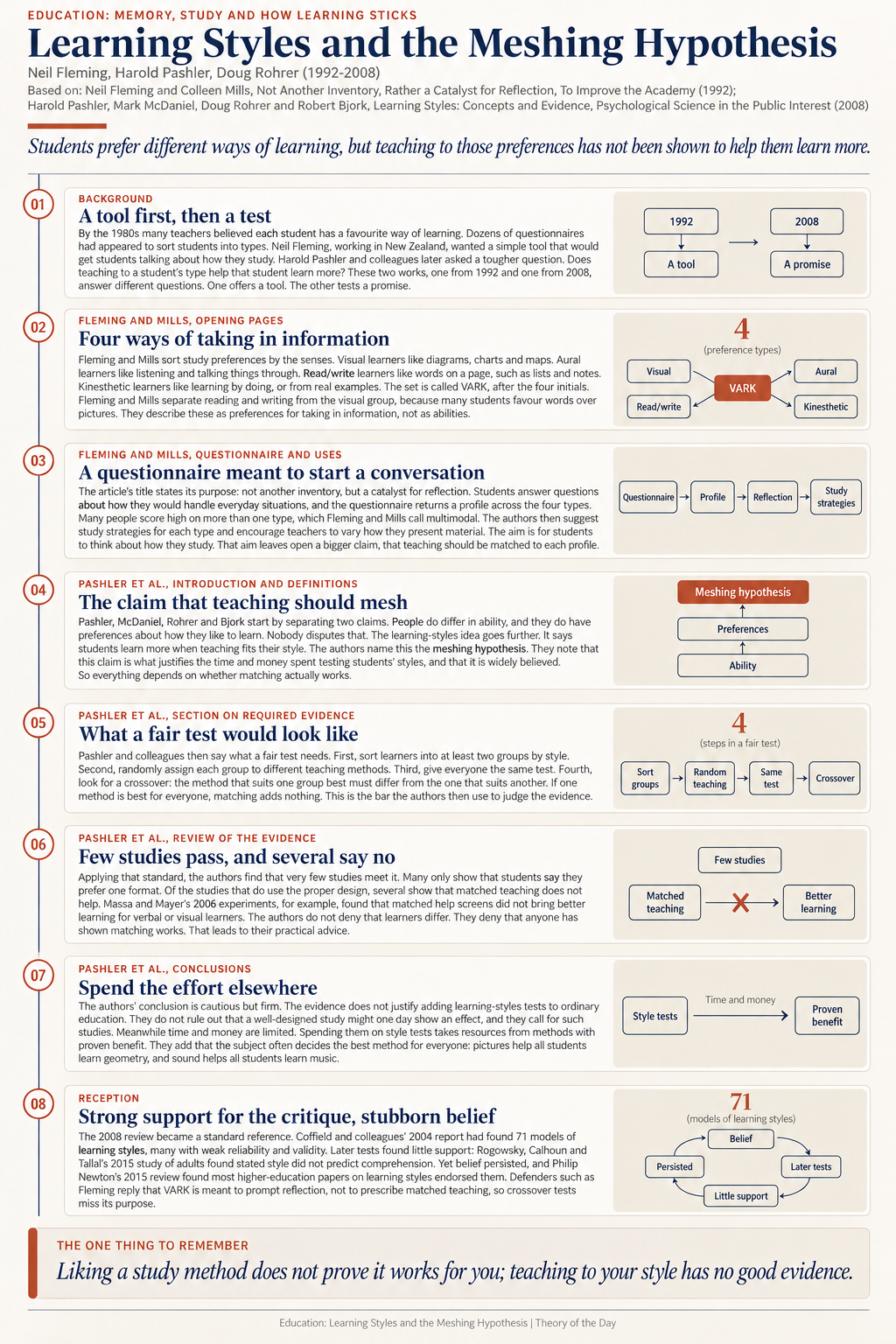
Many teachers believe every student has a favourite way of learning and that lessons should be built to fit it. This idea, usually called learning styles, spread through schools, universities and training courses in the late twentieth century. Two articles show how it was packaged and then tested. In 1992 Neil Fleming and Colleen Mills published 'Not Another Inventory, Rather a Catalyst for Reflection' in To Improve the Academy. In 2008 Harold Pashler, Mark McDaniel, Doug Rohrer and Robert Bjork published 'Learning Styles: Concepts and Evidence' in Psychological Science in the Public Interest. The first describes a tool. The second asks whether students learn more when taught in their preferred style.
Fleming and Mills sort study preferences by the senses. Visual learners favour diagrams, aural learners favour listening and talking, read/write learners favour words on a page, and kinesthetic learners favour learning by doing. The set is called VARK, after the initials. Students answer questions about everyday situations and receive a profile. Many score on more than one type, which the authors call multimodal. Their title signals the aim: a prompt for reflection, not a verdict on what a person is. Pashler and colleagues then define learning styles, set out four requirements for a fair test, review the studies and end with conclusions about practice.
The mechanism both works assume is simple. A student has a preferred style. Teaching that presents material in that style, the meshing hypothesis, should produce better learning than teaching that does not. Pashler's team stress that this is a claim about results, not just about preferences. To prove it, researchers must sort learners into groups by style, randomly give each group different teaching methods, test everyone on the same material and find a crossover. The best method for one group must differ from the best for another. If one method wins for everyone, matching adds nothing.
Several people shaped the debate. Fleming and Mills supplied the questionnaire and its four types. Pashler, McDaniel, Rohrer and Bjork supplied the name, the standard and the review. Rohrer and Pashler restated the case in 2012 in 'Learning Styles: Where's the Evidence?' in Medical Education. The logic of seeking a crossover comes from earlier work on how teaching methods suit different learners, set out in Cronbach and Snow's 1977 book Aptitudes and Instructional Methods. In 2004 Frank Coffield and colleagues counted 71 models of learning styles and found many of them weak.
The 2008 review found very few studies that met the standard, and several of those contradicted matching. Massa and Mayer's 2006 experiments found no gain from matching help to verbal or visual learners. Rogowsky, Calhoun and Tallal's 2015 study found adults' stated style did not predict comprehension. Critics of the style industry include Coffield, who found weak reliability and validity, and Willingham, Hughes and Dobolyi, who found poor definitions. Defenders such as Fleming reply that VARK is meant to prompt reflection, not to prescribe matched teaching. Pashler's team also concede that better studies might one day show an effect.
The debate still matters because the belief persists. Philip Newton's 2015 review found most higher-education papers on learning styles endorsed them. Teachers spend time and money on style tests, and students may wrongly narrow their study to the method they think suits them. The episode is a lesson in what counts as proof: liking a method is not evidence that it works.
The work, part by part
1. A tool first, then a test
Background
By the 1980s many teachers believed each student has a favourite way of learning. Dozens of questionnaires had appeared to sort students into types. Neil Fleming, working in New Zealand, wanted a simple tool that would get students talking about how they study. Harold Pashler and colleagues later asked a tougher question. Does teaching to a student's type help that student learn more? These two works, one from 1992 and one from 2008, answer different questions. One offers a tool. The other tests a promise.
2. Four ways of taking in information
Fleming and Mills, opening pages
Fleming and Mills sort study preferences by the senses. Visual learners like diagrams, charts and maps. Aural learners like listening and talking things through. Read/write learners like words on a page, such as lists and notes. Kinesthetic learners like learning by doing, or from real examples. The set is called VARK, after the four initials. Fleming and Mills separate reading and writing from the visual group, because many students favour words over pictures. They describe these as preferences for taking in information, not as abilities.
3. A questionnaire meant to start a conversation
Fleming and Mills, questionnaire and uses
The article's title states its purpose: not another inventory, but a catalyst for reflection. Students answer questions about how they would handle everyday situations, and the questionnaire returns a profile across the four types. Many people score high on more than one type, which Fleming and Mills call multimodal. The authors then suggest study strategies for each type and encourage teachers to vary how they present material. The aim is for students to think about how they study. That aim leaves open a bigger claim, that teaching should be matched to each profile.
4. The claim that teaching should mesh
Pashler et al., introduction and definitions
Pashler, McDaniel, Rohrer and Bjork start by separating two claims. People do differ in ability, and they do have preferences about how they like to learn. Nobody disputes that. The learning-styles idea goes further. It says students learn more when teaching fits their style. The authors name this the meshing hypothesis. They note that this claim is what justifies the time and money spent testing students' styles, and that it is widely believed. So everything depends on whether matching actually works.
5. What a fair test would look like
Pashler et al., section on required evidence
Pashler and colleagues then say what a fair test needs. First, sort learners into at least two groups by style. Second, randomly assign each group to different teaching methods. Third, give everyone the same test. Fourth, look for a crossover: the method that suits one group best must differ from the one that suits another. If one method is best for everyone, matching adds nothing. This is the bar the authors then use to judge the evidence.
6. Few studies pass, and several say no
Pashler et al., review of the evidence
Applying that standard, the authors find that very few studies meet it. Many only show that students say they prefer one format. Of the studies that do use the proper design, several show that matched teaching does not help. Massa and Mayer's 2006 experiments, for example, found that matched help screens did not bring better learning for verbal or visual learners. The authors do not deny that learners differ. They deny that anyone has shown matching works. That leads to their practical advice.
7. Spend the effort elsewhere
Pashler et al., conclusions
The authors' conclusion is cautious but firm. The evidence does not justify adding learning-styles tests to ordinary education. They do not rule out that a well-designed study might one day show an effect, and they call for such studies. Meanwhile time and money are limited. Spending them on style tests takes resources from methods with proven benefit. They add that the subject often decides the best method for everyone: pictures help all students learn geometry, and sound helps all students learn music.
8. Strong support for the critique, stubborn belief
Reception
The 2008 review became a standard reference. Coffield and colleagues' 2004 report had found 71 models of learning styles, many with weak reliability and validity. Later tests found little support: Rogowsky, Calhoun and Tallal's 2015 study of adults found stated style did not predict comprehension. Yet belief persisted, and Philip Newton's 2015 review found most higher-education papers on learning styles endorsed them. Defenders such as Fleming reply that VARK is meant to prompt reflection, not to prescribe matched teaching, so crossover tests miss its purpose.
The argument in four steps
- Students do prefer different formats, and the VARK questionnaire sorts those preferences into four sensory types.
- A preference is not proof of benefit; the real claim is that matched teaching improves learning.
- A fair test needs style groups, random teaching methods, one common test and a crossover; few studies pass.
- So there is no good evidence that matching teaching to learning styles makes students learn more.
Who contributed what
- Neil Fleming (1992): With Mills, 'Not Another Inventory' presented the VARK questionnaire, sorting learners' preferences into four sensory types.
- Harold Pashler (2008): With McDaniel, Rohrer and Bjork, named the meshing hypothesis and set a four-part standard for testing it.
- Doug Rohrer (2012): With Pashler, 'Learning Styles: Where's the Evidence?' restated the case against matching for medical educators.
The evidence
- Pashler and colleagues' 2008 review found very few fair tests, and several contradicted matching.
- Massa and Mayer's 2006 experiments found matching help to verbal or visual style gave no learning gain.
- Rogowsky, Calhoun and Tallal's 2015 study found adults' stated style did not predict comprehension.
The criticisms
- Coffield's 2004 review found weak reliability and validity in many style inventories.
- Willingham, Hughes and Dobolyi in 2015 found style theories lack support and clear definition.
- Defenders such as Fleming say VARK prompts reflection, so matching tests miss its purpose.
Compared with rival views
- Unlike Gardner's multiple intelligences, VARK describes preferred formats for information, not separate abilities.
- Unlike the evidence-first view of Pashler's team, the meshing hypothesis assumes matching teaching to learners improves results.
Why it matters today
Teacher educators now use the 2008 critique to challenge style-matching in schools, while VARK questionnaires persist in university study-skills sessions.
Further reading
- Frank Coffield, David Moseley, Elaine Hall and Kathryn Ecclestone, Learning Styles and Pedagogy in Post-16 Learning: A Systematic and Critical Review (2004)
- Daniel T. Willingham, Elizabeth M. Hughes and David G. Dobolyi, The Scientific Status of Learning Styles Theories (2015)
- Philip M. Newton, The Learning Styles Myth Is Thriving in Higher Education (2015)