Infographic of: Mechanistic and Organic Organizations
Management: Organization Theory
Mechanistic and Organic Organizations
Tom Burns, G. M. Stalker (1961)
Based on: Tom Burns and G. M. Stalker, The Management of Innovation (1961)
The right way to organise a firm depends on its surroundings: rigid hierarchy suits stable conditions, flexible teamwork suits rapid change.
The Management of Innovation was published in 1961 by Tavistock Publications. Its authors were Tom Burns, a sociologist at the University of Edinburgh, and G. M. Stalker. It grew out of research on Scottish manufacturers trying to move into electronics after the Second World War, a field that rewarded fast invention. The question was practical: why did some firms cope with rapid technological change while others floundered? Burns and Stalker looked for the answer in how people inside each firm were organised, rather than in money or machinery.
The opening chapters describe the Scottish firms. These were established companies with clear departments, set duties and a firm chain of command, which had served them well with familiar products. Electronics demanded quick development of new goods and close contact between laboratory, factory and customer. The authors record disputes over who should decide, and read them as strain in the structure. They then compared the Scottish firms with English ones, twenty firms in all. The central chapter, Chapter 5, sets out two types of organisation, and later chapters examine why firms struggle to change.
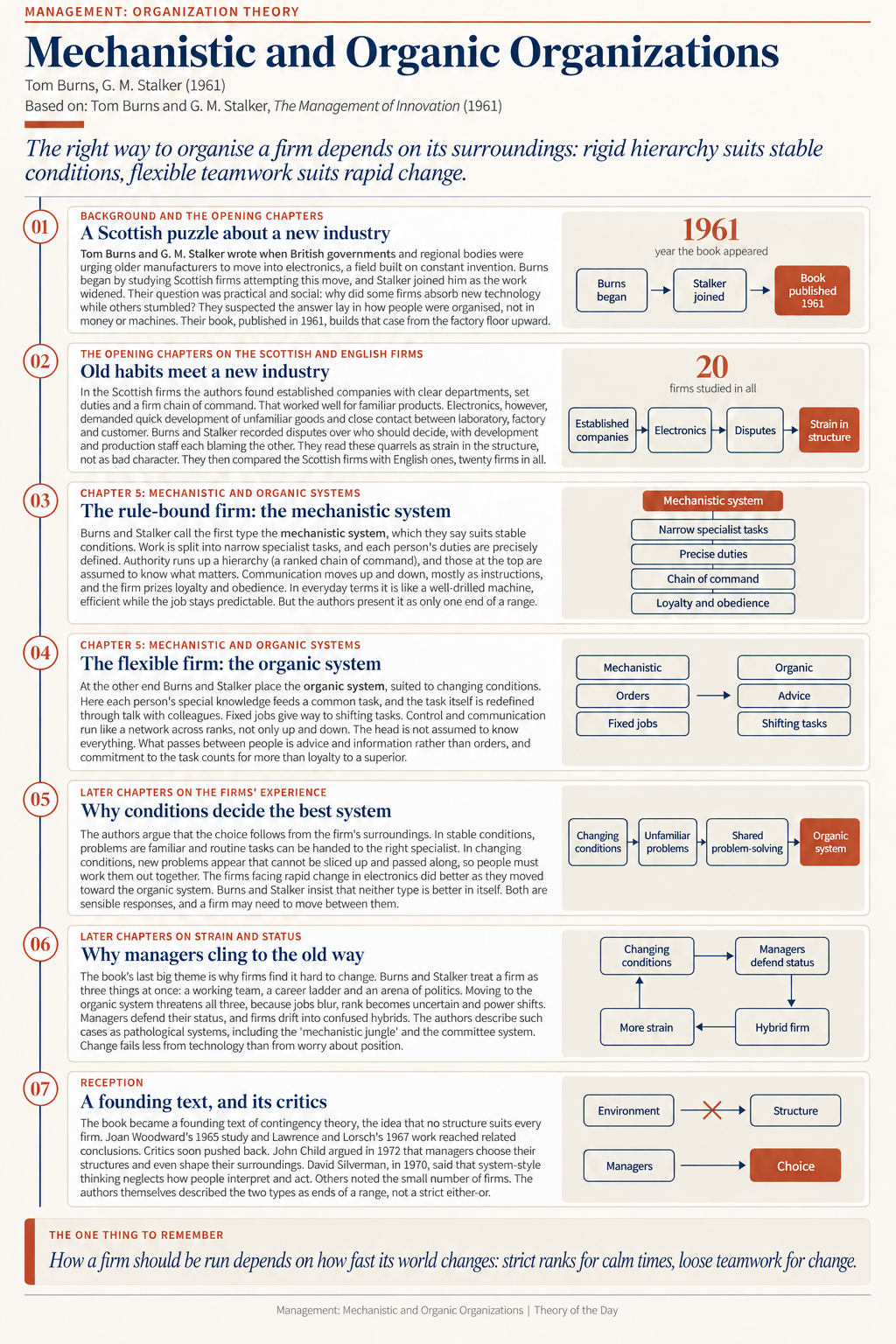
The mechanistic system suits stable conditions. Work is divided into narrow tasks, duties are precisely defined, authority runs up a chain of command, and loyalty and obedience are prized. The organic system suits changing conditions. Knowledge is pooled, tasks are constantly redefined, communication runs sideways as advice, and commitment to the task matters most. The mechanism is simple. When problems are new, they cannot be passed to the right specialist, so people must work them out together. Neither type is better in itself. Both are two ends of a range, and a firm should fit its structure to how fast its world changes.
Burns and Stalker added that a firm is a working team, a career ladder and a political arena all at once. Moving toward the organic form threatens rank and power, so managers defend their status. Firms then drift into confused hybrids, which the authors call pathological systems, such as the 'mechanistic jungle' and the committee system. Joan Woodward's 1965 study of technology and structure, and Lawrence and Lorsch's 1967 work, later helped turn the finding into contingency theory. Henry Mintzberg's later idea of the adhocracy (a flexible, project-based organisation) also owes much to the organic type.
The evidence includes the authors' own comparison of firms, Woodward's South Essex study and Covin and Slevin's 1989 finding that organic structures paid off in hostile small-firm settings. The criticisms are real. John Child argued in 1972 that managers choose their structures and shape their environments. David Silverman, in 1970, said that system thinking neglects how people interpret and act. The sample was small and mostly drawn from electronics, which limits how far the findings travel.
The work still matters because it gave managers a simple question to ask: how stable is our world? It shaped debates about whether start-ups and technology teams should be flat or hierarchical. It also warned that the obstacle to change is often human, in the form of status worries, rather than technical.
The work, part by part
1. A Scottish puzzle about a new industry
Background and the opening chapters
Tom Burns and G. M. Stalker wrote when British governments and regional bodies were urging older manufacturers to move into electronics, a field built on constant invention. Burns began by studying Scottish firms attempting this move, and Stalker joined him as the work widened. Their question was practical and social: why did some firms absorb new technology while others stumbled? They suspected the answer lay in how people were organised, not in money or machines. Their book, published in 1961, builds that case from the factory floor upward.
2. Old habits meet a new industry
The opening chapters on the Scottish and English firms
In the Scottish firms the authors found established companies with clear departments, set duties and a firm chain of command. That worked well for familiar products. Electronics, however, demanded quick development of unfamiliar goods and close contact between laboratory, factory and customer. Burns and Stalker recorded disputes over who should decide, with development and production staff each blaming the other. They read these quarrels as strain in the structure, not as bad character. They then compared the Scottish firms with English ones, twenty firms in all.
3. The rule-bound firm: the mechanistic system
Chapter 5: Mechanistic and Organic Systems
Burns and Stalker call the first type the mechanistic system, which they say suits stable conditions. Work is split into narrow specialist tasks, and each person's duties are precisely defined. Authority runs up a hierarchy (a ranked chain of command), and those at the top are assumed to know what matters. Communication moves up and down, mostly as instructions, and the firm prizes loyalty and obedience. In everyday terms it is like a well-drilled machine, efficient while the job stays predictable. But the authors present it as only one end of a range.
4. The flexible firm: the organic system
Chapter 5: Mechanistic and Organic Systems
At the other end Burns and Stalker place the organic system, suited to changing conditions. Here each person's special knowledge feeds a common task, and the task itself is redefined through talk with colleagues. Fixed jobs give way to shifting tasks. Control and communication run like a network across ranks, not only up and down. The head is not assumed to know everything. What passes between people is advice and information rather than orders, and commitment to the task counts for more than loyalty to a superior.
5. Why conditions decide the best system
Later chapters on the firms' experience
The authors argue that the choice follows from the firm's surroundings. In stable conditions, problems are familiar and routine tasks can be handed to the right specialist. In changing conditions, new problems appear that cannot be sliced up and passed along, so people must work them out together. The firms facing rapid change in electronics did better as they moved toward the organic system. Burns and Stalker insist that neither type is better in itself. Both are sensible responses, and a firm may need to move between them.
6. Why managers cling to the old way
Later chapters on strain and status
The book's last big theme is why firms find it hard to change. Burns and Stalker treat a firm as three things at once: a working team, a career ladder and an arena of politics. Moving to the organic system threatens all three, because jobs blur, rank becomes uncertain and power shifts. Managers defend their status, and firms drift into confused hybrids. The authors describe such cases as pathological systems, including the 'mechanistic jungle' and the committee system. Change fails less from technology than from worry about position.
7. A founding text, and its critics
Reception
The book became a founding text of contingency theory, the idea that no structure suits every firm. Joan Woodward's 1965 study and Lawrence and Lorsch's 1967 work reached related conclusions. Critics soon pushed back. John Child argued in 1972 that managers choose their structures and even shape their surroundings. David Silverman, in 1970, said that system-style thinking neglects how people interpret and act. Others noted the small number of firms. The authors themselves described the two types as ends of a range, not a strict either-or.
The argument in four steps
- Firms entering fast-changing fields such as electronics met problems their familiar structures could not handle.
- Stable conditions suit fixed jobs, a chain of command and orders from above (the mechanistic system).
- Changing conditions need shared problem-solving, flexible roles and advice across ranks (the organic system).
- So no single structure is best: successful firms match their organisation to how fast their conditions change.
Who contributed what
- Tom Burns (1961): In The Management of Innovation, began the Scottish firms study and helped define the mechanistic and organic types.
- G. M. Stalker (1961): In The Management of Innovation, joined the research and helped extend it to English firms and the comparison between them.
The evidence
- Burns and Stalker's 1961 study of twenty firms found those adapting to electronics loosened their hierarchies.
- Woodward's 1965 South Essex study linked production technology to structure, with successful firms matching it.
- Covin and Slevin's 1989 small-firm survey found organic structures paid off in hostile environments.
The criticisms
- Child (1972) argued managers choose structures; environment does not simply dictate them.
- Small sample of firms, mostly electronics, limits general claims.
- Silverman (1970) said it treats firms as systems, ignoring employees' own meanings and actions.
Compared with rival views
- Unlike classical management's one best way, it ties the right structure to conditions.
- Unlike human relations writers, it ties good management to the firm's environment, not to friendly leadership.
Why it matters today
Informs agile software teams and debates about flat versus hierarchical structures in technology start-ups.
Further reading
- Lex Donaldson, The Contingency Theory of Organizations (2001)
- John Child, Organizational Structure, Environment and Performance: The Role of Strategic Choice (1972)
- David Silverman, The Theory of Organisations (1970)