Infographic of: Rationalisation and the Disenchantment of the World
Sociology: Classical Foundations
Rationalisation and the Disenchantment of the World
Max Weber (1917-1919)
Based on: Max Weber, Science as a Vocation (1919)
Modern life swaps magic for calculation, so we can master the world but science cannot tell us how to live.
Max Weber gave "Science as a Vocation" to a student association in Munich in November 1917, during the First World War. It was printed in 1919, a year before his death. The students had asked scholars to speak about intellectual work as a calling; the German word Beruf means both job and vocation. Weber had already described the rationalisation of modern life, including the iron cage of the Protestant ethic, but here he asks something more personal: what is science worth, and can it tell us how to live?
The lecture has no numbered chapters, yet it moves in clear stages. Weber begins with the outward conditions of an academic career. A young German scholar usually starts as a Privatdozent, an unsalaried lecturer paid by student fees, and success depends heavily on chance. German universities, he says, are drifting toward the American model, where big institutes run like businesses and the assistant does not own the tools of research. He then turns to the inner calling: narrow specialisation, passion, and the Einfall, a sudden idea that comes when it pleases, usually after hard work. Next comes intellectualisation, the belief that anything can in principle be mastered by calculation. A tram passenger rarely knows how the tram works, but trusts that nothing mysterious is involved. Weber calls this the disenchantment of the world, the loss of spirits and magic as explanations.
Weber then shows the cost. Science can tell us how to reach a goal and what it will cost, but it cannot prove which goal is right. He quotes Tolstoy, who thought science meaningless because it cannot answer 'What shall we do and how shall we live?' Weber agrees with the fact, not the despair, and credits science with technique, ways of thinking and clarity. Because the ultimate values cannot be proved, they clash. Borrowing John Stuart Mill's remark about polytheism (belief in many gods), Weber says the old gods have returned as impersonal powers fighting for our lives. The teacher must therefore not act as a prophet. In the end, he says, the highest values have retreated from public life into mystical experience and close personal relations.
Others carried the idea further. Weber's wider writings, including Economy and Society (1922), traced rationalisation in law, bureaucracy and religion. Jürgen Habermas, in The Theory of Communicative Action (1981), separated calculating reason from reason based on discussion and agreement, and argued that Weber gave too little weight to the second. Charles Taylor's A Secular Age (2007) recast disenchantment as the story of how belief became one option among many.
Evidence for the broad picture is plentiful. Bryan Wilson's Religion in Secular Society (1966) documented falling church influence in Britain. Norris and Inglehart's Sacred and Secular (2004) used survey data to link economic security with lower religious practice. George Ritzer's The McDonaldization of Society (1993) showed fast-food firms run on efficiency, calculability, predictability and control. Critics push back. Jason Josephson-Storm (2017) argued that modern scholars kept embracing magic and occult ideas, so disenchantment is partly a myth. Habermas said Weber shrank reason to calculation. Leo Strauss attacked Weber's sharp split between facts and values as a road to relativism.
The lecture still matters because it names a problem that has not gone away: we have more power over the world than ever, but no expert can tell us what to want. It shapes arguments about secularisation, about the role of experts, and about whether teachers should preach their politics. Weber's answer is demanding: know your facts, be honest about your values, and do the work in front of you.
The work, part by part
1. A lecture to students in wartime Munich
Background
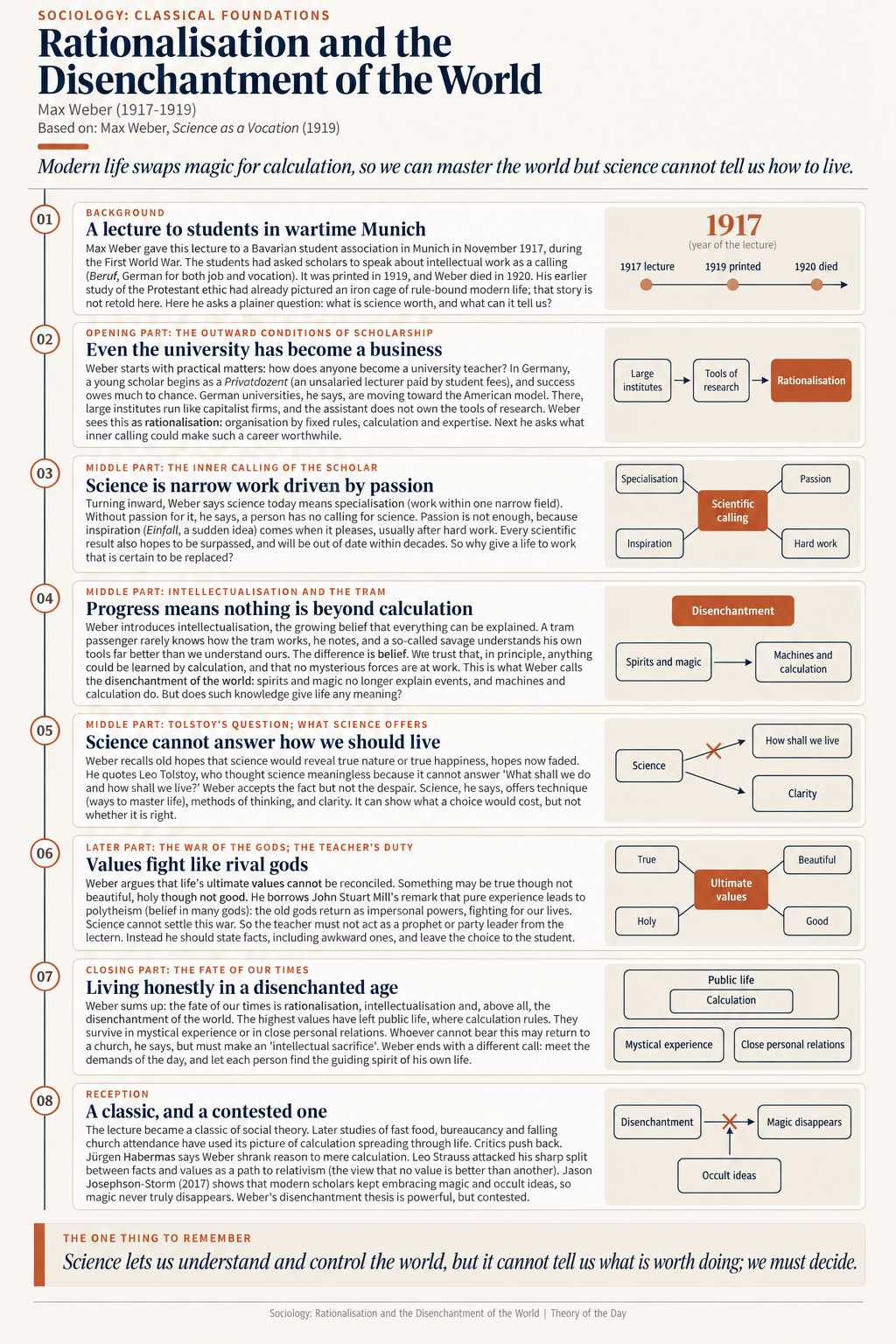
Max Weber gave this lecture to a Bavarian student association in Munich in November 1917, during the First World War. The students had asked scholars to speak about intellectual work as a calling (Beruf, German for both job and vocation). It was printed in 1919, and Weber died in 1920. His earlier study of the Protestant ethic had already pictured an iron cage of rule-bound modern life; that story is not retold here. Here he asks a plainer question: what is science worth, and what can it tell us?
2. Even the university has become a business
Opening part: the outward conditions of scholarship
Weber starts with practical matters: how does anyone become a university teacher? In Germany, a young scholar begins as a Privatdozent (an unsalaried lecturer paid by student fees), and success owes much to chance. German universities, he says, are moving toward the American model. There, large institutes run like capitalist firms, and the assistant does not own the tools of research. Weber sees this as rationalisation: organisation by fixed rules, calculation and expertise. Next he asks what inner calling could make such a career worthwhile.
3. Science is narrow work driven by passion
Middle part: the inner calling of the scholar
Turning inward, Weber says science today means specialisation (work within one narrow field). Without passion for it, he says, a person has no calling for science. Passion is not enough, because inspiration (Einfall, a sudden idea) comes when it pleases, usually after hard work. Every scientific result also hopes to be surpassed, and will be out of date within decades. So why give a life to work that is certain to be replaced?
4. Progress means nothing is beyond calculation
Middle part: intellectualisation and the tram
Weber introduces intellectualisation, the growing belief that everything can be explained. A tram passenger rarely knows how the tram works, he notes, and a so-called savage understands his own tools far better than we understand ours. The difference is belief. We trust that, in principle, anything could be learned by calculation, and that no mysterious forces are at work. This is what Weber calls the disenchantment of the world: spirits and magic no longer explain events, and machines and calculation do. But does such knowledge give life any meaning?
5. Science cannot answer how we should live
Middle part: Tolstoy's question; what science offers
Weber recalls old hopes that science would reveal true nature or true happiness, hopes now faded. He quotes Leo Tolstoy, who thought science meaningless because it cannot answer 'What shall we do and how shall we live?' Weber accepts the fact but not the despair. Science, he says, offers technique (ways to master life), methods of thinking, and clarity. It can show what a choice would cost, but not whether it is right.
6. Values fight like rival gods
Later part: the war of the gods; the teacher's duty
Weber argues that life's ultimate values cannot be reconciled. Something may be true though not beautiful, holy though not good. He borrows John Stuart Mill's remark that pure experience leads to polytheism (belief in many gods): the old gods return as impersonal powers, fighting for our lives. Science cannot settle this war. So the teacher must not act as a prophet or party leader from the lectern. Instead he should state facts, including awkward ones, and leave the choice to the student.
7. Living honestly in a disenchanted age
Closing part: the fate of our times
Weber sums up: the fate of our times is rationalisation, intellectualisation and, above all, the disenchantment of the world. The highest values have left public life, where calculation rules. They survive in mystical experience or in close personal relations. Whoever cannot bear this may return to a church, he says, but must make an 'intellectual sacrifice'. Weber ends with a different call: meet the demands of the day, and let each person find the guiding spirit of his own life.
8. A classic, and a contested one
Reception
The lecture became a classic of social theory. Later studies of fast food, bureaucracy and falling church attendance have used its picture of calculation spreading through life. Critics push back. Jürgen Habermas says Weber shrank reason to mere calculation. Leo Strauss attacked his sharp split between facts and values as a path to relativism (the view that no value is better than another). Jason Josephson-Storm (2017) shows that modern scholars kept embracing magic and occult ideas, so magic never truly disappears. Weber's disenchantment thesis is powerful, but contested.
The argument in four steps
- Science has become a narrow, specialised job, carried out by trained experts inside large, businesslike institutions.
- Progress means that, in principle, anything can be mastered by calculation, so no hidden magical forces are assumed.
- Yet science only says what is the case, so it cannot prove which ultimate values are right.
- So the modern world is disenchanted: each person must choose between rival values without help from science.
Who contributed what
- Max Weber (1917): Science as a Vocation: linked disenchantment to science, which brings mastery but cannot supply values.
- Jürgen Habermas (1981): The Theory of Communicative Action: split rationalisation into calculating and discussion-based reason, defending the second.
- Charles Taylor (2007): A Secular Age: reworked disenchantment as a history of belief becoming one option among many.
The evidence
- Ritzer's 1993 McDonaldization of Society showed fast-food chains run on efficiency, calculability, predictability and control.
- Bryan Wilson's 1966 Religion in Secular Society documented declining church influence in modern Britain.
- Norris and Inglehart's 2004 Sacred and Secular used World Values Survey linking security to lower religiosity.
The criticisms
- Josephson-Storm (2017): modern scholars embraced occult ideas, so disenchantment is partly a myth.
- Habermas says Weber shrank reason to mere calculation and missed reasoned agreement.
- Leo Strauss said Weber's split between facts and values leads to relativism.
Compared with rival views
- Unlike Comte's law of three stages, it sees progress as gaining control but losing shared meaning.
- Unlike Marx, it locates modern life's driving force in calculation itself, not only in capitalism.
Why it matters today
Debates over secularisation, and whether modern societies are 'post-secular', still start from Weber's disenchantment thesis.
Further reading
- Wolfgang Schluchter, The Rise of Western Rationalism: Max Weber's Developmental History (1981)
- Lawrence A. Scaff, Fleeing the Iron Cage: Culture, Politics, and Modernity in the Thought of Max Weber (1989)
- Jason Ā. Josephson-Storm, The Myth of Disenchantment: Magic, Modernity, and the Birth of the Human Sciences (2017)