Infographic of: Neo-Evolutionism and White's Law of Energy
Anthropology: Foundations and Schools of Thought
Neo-Evolutionism and White's Law of Energy
Leslie A. White (1943-1949)
Based on: Leslie A. White, The Science of Culture: A Study of Man and Civilization (1949); Leslie A. White, Energy and the Evolution of Culture, American Anthropologist (1943); Leslie A. White, The Evolution of Culture: The Development of Civilization to the Fall of Rome (1959)
Human societies advance as they harness more energy per person each year, or use that energy more efficiently.
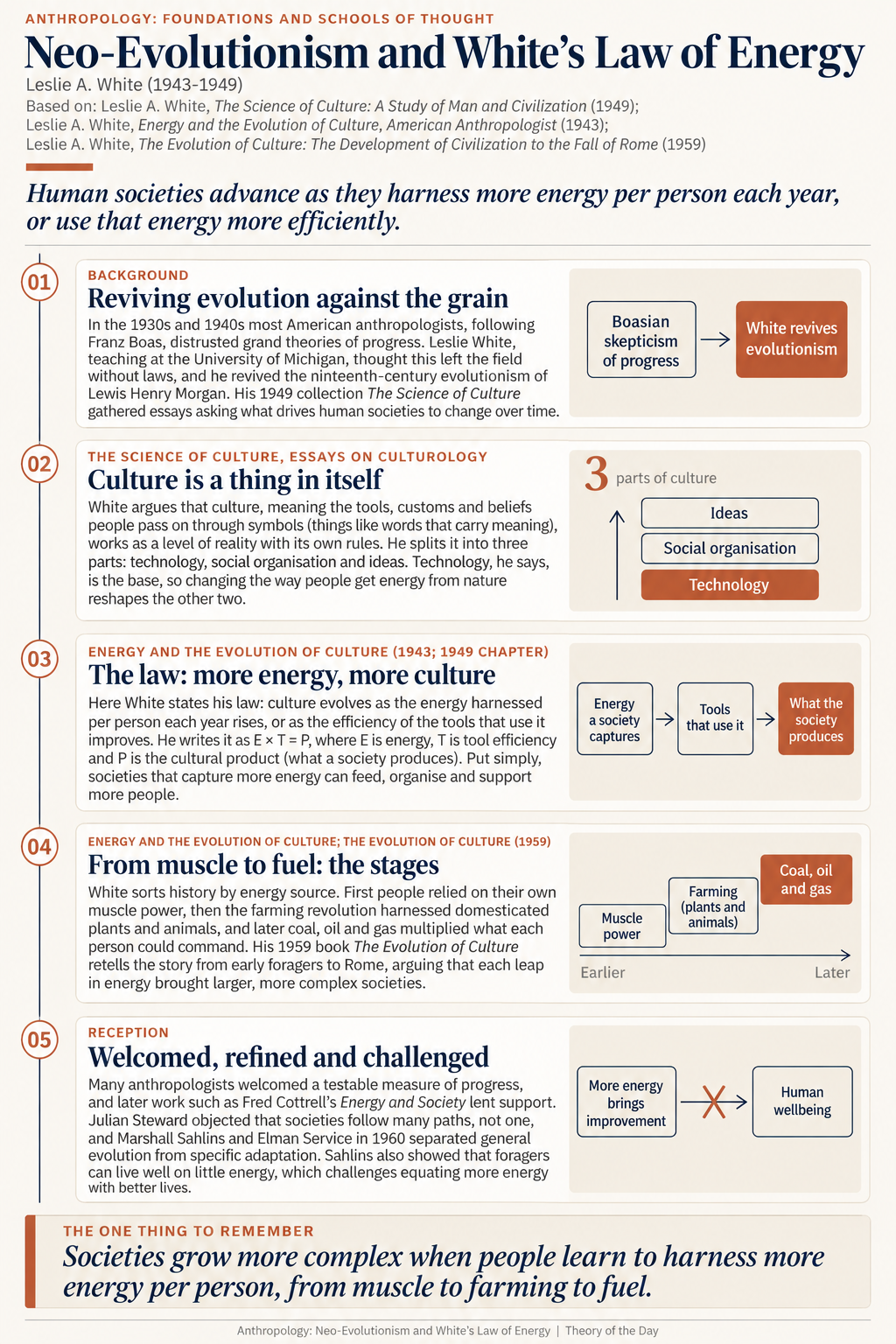
Leslie White taught anthropology at the University of Michigan from 1930, at a time when American anthropology was dominated by Franz Boas and his students. They distrusted sweeping theories of progress and preferred to study each culture on its own terms. White believed this left the discipline without general laws. His collection The Science of Culture (1949) gathers essays from the 1930s and 1940s, and its centrepiece is 'Energy and the Evolution of Culture', first published in American Anthropologist in 1943. The question behind it is simple: why do human societies grow more complex over time?
The book builds its case in steps. Several essays argue for what White called culturology, the study of culture as a level of reality in its own right. By culture he meant tools, customs and beliefs passed on through symbols, which are things such as words that carry meaning. Culture, he said, should be explained by other culture, not by individual psychology or the deeds of great men. He divided it into three parts: technology, social organisation and ideas. The energy chapter then gives culture a direction, and later in the same piece traces the stages of history.
The mechanism is compact. White wrote it as E × T = P. E is the energy harnessed per person each year, T is the efficiency of the tools that put it to work, and P is the cultural product, roughly what a society produces and sustains. Culture advances when E or T rises. Because technology is the base of culture, White held that social organisation and ideas follow it. When people move from relying on muscle to farming, and then to coal, oil and gas, the whole way of life is reshaped. His 1959 book The Evolution of Culture applied this reasoning from early foragers to the fall of Rome.
Others shaped the theory. White openly revived the evolutionism of Lewis Henry Morgan and drew on earlier thinkers about energy, such as the chemist Wilhelm Ostwald. In 1960 Marshall Sahlins and Elman Service edited Evolution and Culture, which separated general evolution, the overall rise in energy capture, from specific evolution, the way particular societies adapt to their settings. This is the move that gave neo-evolutionism its lasting form. Julian Steward offered a rival, multilinear evolution, in which different environments produce different paths. Gerhard Lenski's Power and Privilege (1966) used levels of technology to explain differences in inequality.
Evidence for the broad pattern comes from Fred Cottrell's Energy and Society (1955), Vaclav Smil's Energy in World History (1994) and Ian Morris's Why the West Rules for Now (2010), which all show energy use per person rising across long stretches of history. The criticisms are serious. Steward argued that no single ladder fits every society. Sahlins's Stone Age Economics (1972) showed that foragers with little energy can enjoy leisure and security, so more energy does not simply mean better lives. Many scholars also charge technological determinism, since politics, religion and individual choices clearly shape change too.
White's law still matters because energy is central to today's biggest debates. Historians use energy capture per person to compare societies across millennia, and discussions of fossil fuels and climate change echo his claim that the way a society gets its energy shapes everything else. Few scholars accept the law as a complete theory of history, but it remains a clear, testable yardstick.
The work, part by part
1. Reviving evolution against the grain
Background
In the 1930s and 1940s most American anthropologists, following Franz Boas, distrusted grand theories of progress. Leslie White, teaching at the University of Michigan, thought this left the field without laws, and he revived the nineteenth-century evolutionism of Lewis Henry Morgan. His 1949 collection The Science of Culture gathered essays asking what drives human societies to change over time.
2. Culture is a thing in itself
The Science of Culture, essays on culturology
White argues that culture, meaning the tools, customs and beliefs people pass on through symbols (things like words that carry meaning), works as a level of reality with its own rules. He splits it into three parts: technology, social organisation and ideas. Technology, he says, is the base, so changing the way people get energy from nature reshapes the other two.
3. The law: more energy, more culture
Energy and the Evolution of Culture (1943; 1949 chapter)
Here White states his law: culture evolves as the energy harnessed per person each year rises, or as the efficiency of the tools that use it improves. He writes it as E × T = P, where E is energy, T is tool efficiency and P is the cultural product (what a society produces). Put simply, societies that capture more energy can feed, organise and support more people.
4. From muscle to fuel: the stages
Energy and the Evolution of Culture; The Evolution of Culture (1959)
White sorts history by energy source. First people relied on their own muscle power, then the farming revolution harnessed domesticated plants and animals, and later coal, oil and gas multiplied what each person could command. His 1959 book The Evolution of Culture retells the story from early foragers to Rome, arguing that each leap in energy brought larger, more complex societies.
5. Welcomed, refined and challenged
Reception
Many anthropologists welcomed a testable measure of progress, and later work such as Fred Cottrell's Energy and Society lent support. Julian Steward objected that societies follow many paths, not one, and Marshall Sahlins and Elman Service in 1960 separated general evolution from specific adaptation. Sahlins also showed that foragers can live well on little energy, which challenges equating more energy with better lives.
The argument in four steps
- Culture is a system with its own rules, built on technology, social order and ideas.
- Technology is the base, so changes in how people get energy reshape everything else.
- Culture advances as the energy used per person each year rises or tools use it better.
- So history's great leaps, from farming to fuels, are steps up in the energy people capture.
Who contributed what
- Leslie A. White (1943): In 'Energy and the Evolution of Culture', stated the law: culture advances with energy harnessed per person and tool efficiency.
- Marshall Sahlins (1960): In Evolution and Culture, co-edited with Elman Service, split general evolution from specific adaptation to refine White.
- Gerhard Lenski (1966): In Power and Privilege, used levels of technology to explain differences in inequality between societies.
The evidence
- Cottrell's 1955 Energy and Society linked cheap, concentrated energy sources to the rise of industrial society.
- Smil's 1994 Energy in World History traced rising per-person energy use from foraging to fossil fuels.
- Morris's 2010 Why the West Rules used energy capture per person to measure social development.
The criticisms
- Steward (1955) argued societies follow many paths, not one universal ladder.
- Sahlins (1972) showed hunter-gatherers can live well on little energy.
- Critics charge technological determinism, ignoring politics, belief and individual choice.
Compared with rival views
- Unlike Morgan's ladder from savagery to civilization, it measures progress by energy captured per person, not inventions.
- Unlike Boas's historical particularism, it defends universal laws and general stages of cultural development.
Why it matters today
Ian Morris's measure of social development and debates on energy transitions use energy captured per person, White's yardstick, to compare societies.
Further reading
- Robert L. Carneiro and Gertrude E. Dole (eds.), Essays in the Science of Culture in Honor of Leslie A. White (1960)
- Marvin Harris, The Rise of Anthropological Theory (1968)
- William J. Peace, Leslie A. White: Evolution and Revolution in Anthropology (2004)