Infographic of: Class, Status and Party
Sociology: Classical Foundations
Class, Status and Party
Max Weber (1922)
Based on: Max Weber, Class, Status, Party (the section of Economy and Society on the distribution of power within the political community) (1922)
Inequality has three separate sources: market wealth, social honour, and organised political power.
Max Weber (1864-1920) never finished his huge work Economy and Society. After his death his widow, Marianne Weber, helped prepare the manuscripts, and the book appeared in 1921-22. One section deals with the distribution of power within the political community. English readers know it as "Class, Status, Party", the heading Hans Gerth and C. Wright Mills gave it in their 1946 translation. The question it answers is whether inequality is only about money. Many socialists of Weber's day said it was. Weber, who respected Marx but rejected economic determinism, set out to show that it is not.
The section opens with power, which Weber defines as the chance of getting your own way even when others resist. He says power in a community is spread through different orders. He then takes up classes, which belong to the economic order. A class situation is a person's typical chance of income and a decent life, set by the property or skills they can sell in a market. Owners and the propertyless therefore stand in very different positions. Weber adds that sharing a class situation does not by itself produce shared action. People act together only when the cause of their hardship is visible, when an opponent is near at hand, and when leaders give them a goal. He traces how the central conflict moved from debtors and creditors to wage disputes in the labour market.
Next come status groups, which belong to the social order of honour. People in a status group share a level of prestige and a style of life, and they guard it by choosing whom they marry, dine and mix with. Weber says classes are ranked by how they earn goods and status groups by how they consume them. Caste in India is the extreme case. Honour and the market pull against each other, since the market ignores personal standing. Weber also notes that in stable times status ranking flourishes, while rapid economic change pushes class to the front. The last part treats parties. They live in the house of power and aim to influence communal action. They may be built on class interests, status interests or neither.
The mechanism is therefore a set of three channels through which advantage is won and kept: market position, social honour and organised political action. They overlap but none can be reduced to another. A rich newcomer may be shut out of high society, and an old family may be honoured though poor.
Later scholars developed the idea. David Lockwood's The Blackcoated Worker (1958) separated market, work and status situations in a study of British clerks. Anthony Giddens used Weber's market capacity in his 1973 account of class. Frank Parkin's Marxism and Class Theory (1979) turned Weber's hints into a theory of social closure, in which groups hoard advantages by excluding outsiders. John Goldthorpe and Robert Erikson built class schemes on employment relations, and Pierre Bourdieu's Distinction (1979) showed how taste marks status in France.
Critics have pushed back. Erik Olin Wright argued that a market-based idea of class overlooks exploitation in production. Joan Acker argued in 1973 that class schemes ignored women by treating the male breadwinner as the family's position. Others note the text is an unfinished fragment, so it is unclear how independent the three dimensions really are. Even so, the essay still shapes how researchers measure inequality. Official class schemes, such as the UK's NS-SEC, descend from its approach, and it reminds us that being rich, respected and politically organised are different things.
The work, part by part
1. Power has more than one face
Opening paragraphs; Background
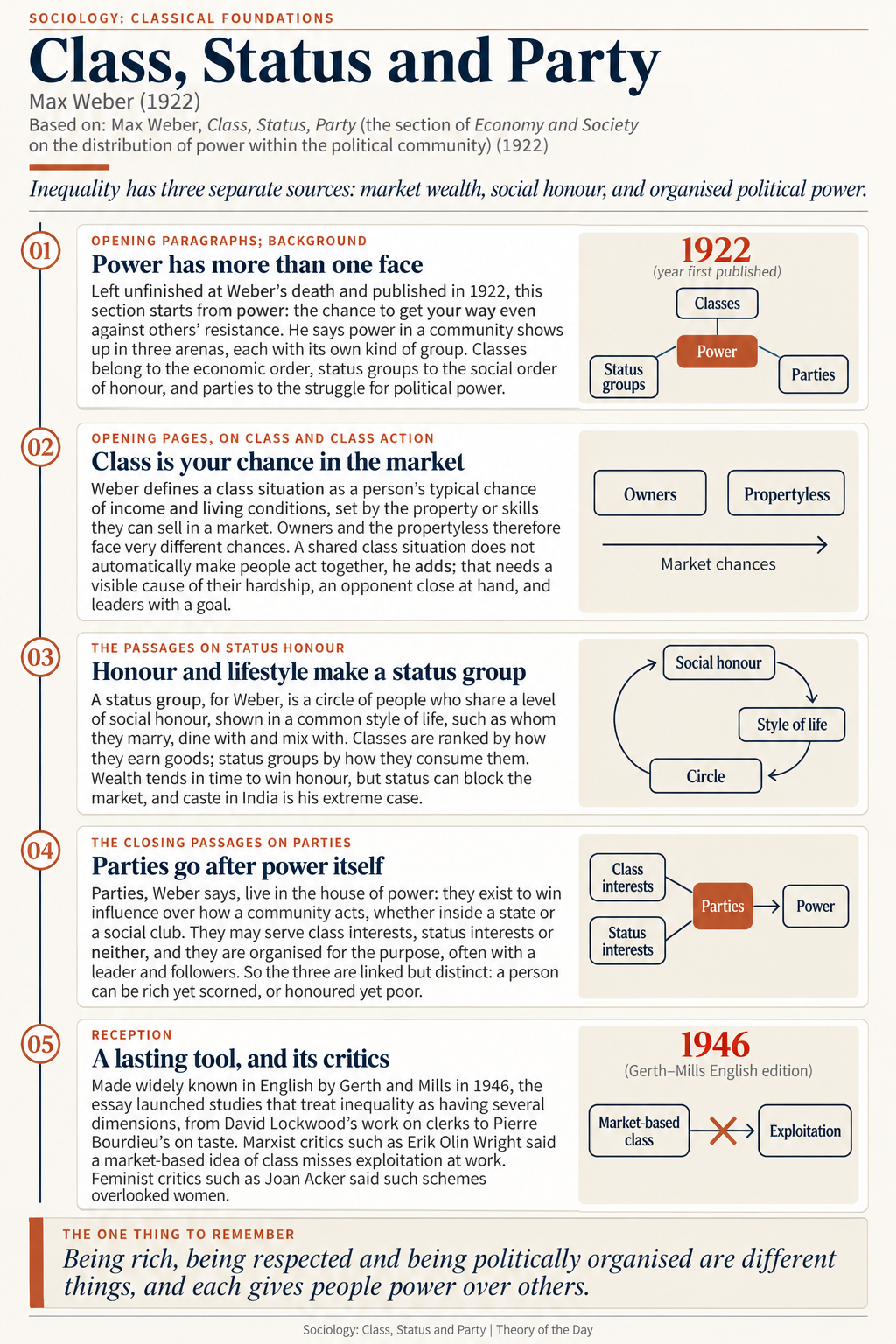
Left unfinished at Weber's death and published in 1922, this section starts from power: the chance to get your way even against others' resistance. He says power in a community shows up in three arenas, each with its own kind of group. Classes belong to the economic order, status groups to the social order of honour, and parties to the struggle for political power.
2. Class is your chance in the market
Opening pages, on class and class action
Weber defines a class situation as a person's typical chance of income and living conditions, set by the property or skills they can sell in a market. Owners and the propertyless therefore face very different chances. A shared class situation does not automatically make people act together, he adds; that needs a visible cause of their hardship, an opponent close at hand, and leaders with a goal.
3. Honour and lifestyle make a status group
The passages on status honour
A status group, for Weber, is a circle of people who share a level of social honour, shown in a common style of life, such as whom they marry, dine with and mix with. Classes are ranked by how they earn goods; status groups by how they consume them. Wealth tends in time to win honour, but status can block the market, and caste in India is his extreme case.
4. Parties go after power itself
The closing passages on parties
Parties, Weber says, live in the house of power: they exist to win influence over how a community acts, whether inside a state or a social club. They may serve class interests, status interests or neither, and they are organised for the purpose, often with a leader and followers. So the three are linked but distinct: a person can be rich yet scorned, or honoured yet poor.
5. A lasting tool, and its critics
Reception
Made widely known in English by Gerth and Mills in 1946, the essay launched studies that treat inequality as having several dimensions, from David Lockwood's work on clerks to Pierre Bourdieu's on taste. Marxist critics such as Erik Olin Wright said a market-based idea of class misses exploitation at work. Feminist critics such as Joan Acker said such schemes overlooked women.
The argument in four steps
- Inequality has more than one root: money, social honour and organised power each give people advantage.
- Class comes from market chances: what property or skills a person can sell for income.
- Status comes from honour and lifestyle, which can rank people differently from their wealth.
- Therefore class, status and party are three separate, overlapping sources of power in society.
Who contributed what
- Max Weber (1922): In his section of Economy and Society, separated class (market), status (honour) and party (power) as distinct dimensions of inequality.
- David Lockwood (1958): In The Blackcoated Worker, split class position into market, work and status situations, using British clerks.
- Frank Parkin (1979): In Marxism and Class Theory, built on Weber's ideas to develop social closure: groups hoarding advantages by excluding others.
The evidence
- Lockwood's 1958 clerks study showed status and work situation, not pay alone, shaped class outlook.
- Bourdieu's 1979 Distinction showed French tastes and lifestyles track education and occupation, marking status divisions.
- Erikson and Goldthorpe's 1992 Constant Flux used employment-based classes to compare social mobility across nations.
The criticisms
- Erik Olin Wright: market-based class overlooks exploitation in production.
- Joan Acker (1973): class schemes treated the male breadwinner as the family's position.
- Unfinished fragment: scholars dispute whether the three dimensions are truly independent.
Compared with rival views
- Unlike Marx, it ties class to market chances, not only to ownership of production.
- Unlike purely economic accounts, it treats honour and political organisation as separate sources of power.
Why it matters today
The UK's official NS-SEC class scheme descends from Goldthorpe's Weber-inspired employment classes.
Further reading
- Anthony Giddens, The Class Structure of the Advanced Societies (1973)
- Frank Parkin, Max Weber (1982)
- Erik Olin Wright (ed.), Approaches to Class Analysis (2005)