Infographic of: Mintzberg's Organizational Configurations
Management: Organization Theory
Mintzberg's Organizational Configurations
Henry Mintzberg (1979)
Based on: Henry Mintzberg, The Structuring of Organizations: A Synthesis of the Research (1979); Henry Mintzberg, Structure in 5's: A Synthesis of the Research on Organization Design, Management Science (1980)
Organizations work best when their structure, main coordinating method and setting fit together into one of five coherent types.
Henry Mintzberg, a Canadian management scholar at McGill University, published The Structuring of Organizations in 1979. By then there were many studies of how organizations are built, but they pointed in different directions. Classical writers such as Henri Fayol offered principles meant to suit every firm. Joan Woodward, Tom Burns and G. M. Stalker, the Aston group in Britain, and Paul Lawrence and Jay Lorsch showed that good design depends on technology, environment and size. Mintzberg set out to pull this scattered research into one picture. His question was simple: how do organizations arrange their work, and why do they come in a few recognisable shapes?
The book builds its case in stages. It begins with basic concepts: structure is the sum of the ways an organization divides work into tasks and then coordinates them. Mintzberg splits any organization into five parts: the strategic apex (top managers), the middle line (managers between top and workers), the operating core (people who do the basic work), the technostructure (analysts who design and standardize work) and the support staff (units such as legal or catering). He also names five coordinating mechanisms: mutual adjustment (informal talk), direct supervision, and standardizing work processes, outputs or skills. He then catalogues design parameters, the choices designers make, such as how specialised jobs are, how many rules govern behaviour, how units are grouped and how far decision power is spread. Next come situational factors: age and size, technology, environment and power. The closing chapters assemble these into five configurations. His 1980 article, Structure in 5's, repackaged the argument for a wider audience.
The mechanism is fit. Each configuration has one dominant coordinating mechanism, one key part and one typical setting. Mintzberg says each part pulls the organization its own way. The strategic apex pulls toward centralized control, giving the simple structure of a boss and a few helpers. The technostructure pulls toward standardized work, giving the machine bureaucracy of mass production or the postal service. The operating core pulls toward professional skill, giving hospitals and universities. The middle line pulls toward semi-independent divisions, giving large diversified corporations. The support staff pulls toward collaboration, giving the flexible project teams of the adhocracy. Organizations that match their levers to each other and to their situation work well; mismatches cause trouble.
Mintzberg built on others. Woodward tied structure to technology, Burns and Stalker contrasted rigid and flexible forms, Lawrence and Lorsch stressed matching structure to environment, and Alfred Chandler traced the rise of the divisional form. Later, Danny Miller and Peter Friesen tested configurational ideas statistically in their 1984 book. In 1983 Mintzberg himself added two further forms, the missionary and the political organization.
Support comes from the studies Mintzberg drew on, from Miller and Friesen's finding that firms cluster into recurring patterns, and from Doty, Glick and Huber's 1993 test, in which fit to configurations predicted effectiveness better than simple contingency fit. Criticism is also real. Lex Donaldson argues that organizations vary along continuous dimensions rather than in discrete types. Many real organizations are hybrids. And the book is mainly a synthesis of earlier research, not a tested causal theory.
The framework still matters because it gives managers a quick diagnostic language. Consultants and students use it to ask why a hospital, a start-up or a corporation is organised as it is, and what pulls would make it drift. The central lesson holds up: there is no single best way to organize, and a structure should match how the work is done.
The work, part by part
1. Too many studies, no picture of structure
Introduction and background
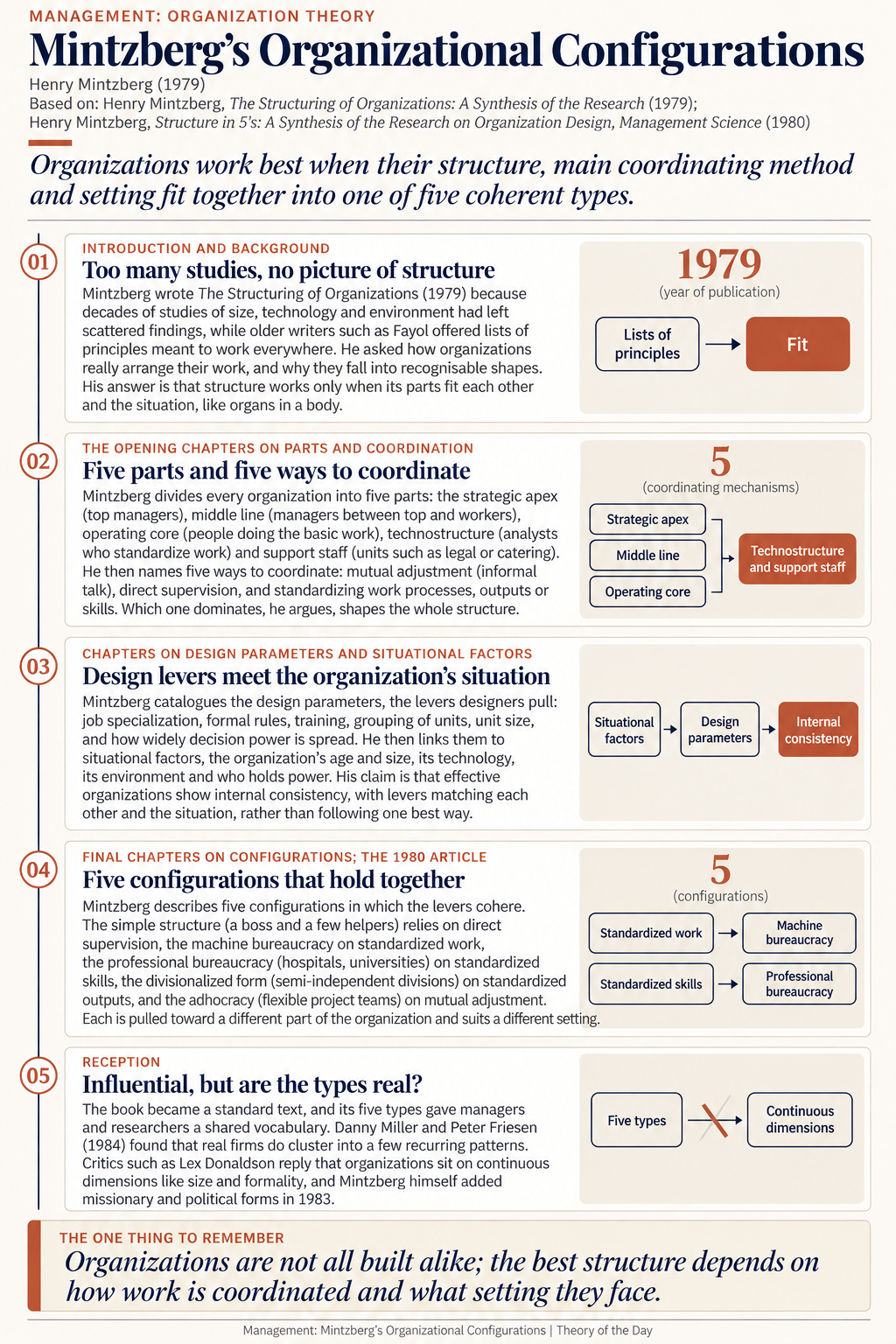
Mintzberg wrote The Structuring of Organizations (1979) because decades of studies of size, technology and environment had left scattered findings, while older writers such as Fayol offered lists of principles meant to work everywhere. He asked how organizations really arrange their work, and why they fall into recognisable shapes. His answer is that structure works only when its parts fit each other and the situation, like organs in a body.
2. Five parts and five ways to coordinate
The opening chapters on parts and coordination
Mintzberg divides every organization into five parts: the strategic apex (top managers), middle line (managers between top and workers), operating core (people doing the basic work), technostructure (analysts who standardize work) and support staff (units such as legal or catering). He then names five ways to coordinate: mutual adjustment (informal talk), direct supervision, and standardizing work processes, outputs or skills. Which one dominates, he argues, shapes the whole structure.
3. Design levers meet the organization's situation
Chapters on design parameters and situational factors
Mintzberg catalogues the design parameters, the levers designers pull: job specialization, formal rules, training, grouping of units, unit size, and how widely decision power is spread. He then links them to situational factors, the organization's age and size, its technology, its environment and who holds power. His claim is that effective organizations show internal consistency, with levers matching each other and the situation, rather than following one best way.
4. Five configurations that hold together
Final chapters on configurations; the 1980 article
Mintzberg describes five configurations in which the levers cohere. The simple structure (a boss and a few helpers) relies on direct supervision, the machine bureaucracy on standardized work, the professional bureaucracy (hospitals, universities) on standardized skills, the divisionalized form (semi-independent divisions) on standardized outputs, and the adhocracy (flexible project teams) on mutual adjustment. Each is pulled toward a different part of the organization and suits a different setting.
5. Influential, but are the types real?
Reception
The book became a standard text, and its five types gave managers and researchers a shared vocabulary. Danny Miller and Peter Friesen (1984) found that real firms do cluster into a few recurring patterns. Critics such as Lex Donaldson reply that organizations sit on continuous dimensions like size and formality, and Mintzberg himself added missionary and political forms in 1983.
The argument in four steps
- Every organization must divide work among people and then coordinate it again.
- Coordination happens in a few ways, and one method usually dominates the others.
- The dominant method pulls power toward one part of the organization and fits a particular setting.
- So effective organizations form five coherent configurations, each pairing a coordinating method, a powerful part and a setting.
Who contributed what
- Henry Mintzberg (1979): The Structuring of Organizations synthesized research into five parts, five coordinating mechanisms and five configurations.
- Danny Miller (1984): Organizations: A Quantum View, with Peter Friesen, found empirically that firms cluster into recurring configurations.
- D. Harold Doty (1993): Fit, Equifinality study with Glick and Huber: configuration fit predicted effectiveness better than contingency fit.
The evidence
- Woodward's 1965 study of south Essex firms linked production technology to organization structure.
- Chandler's 1962 Strategy and Structure showed big American firms adopting divisions as they diversified.
- Pugh and colleagues' 1969 Aston studies found larger firms more specialized and formalized.
The criticisms
- Critics like Lex Donaldson say organizations vary continuously, not in five discrete types.
- Many real organizations are hybrids that fit no single type neatly; Mintzberg conceded this.
- A synthesis of earlier studies, it was never a fully tested causal theory.
Compared with rival views
- Unlike classical principles of Fayol and Taylor, it denies any single best structure suits all organizations.
- Unlike simple contingency theory, it stresses whole bundles of traits, not one factor at a time.
Why it matters today
Consultants and business students use the five configurations to diagnose why a hospital, start-up or corporation is organised as it is.
Further reading
- Danny Miller and Peter Friesen, Organizations: A Quantum View (1984)
- D. Harold Doty, William H. Glick and George P. Huber, Fit, Equifinality, and Organizational Effectiveness: A Test of Two Configurational Theories (1993)
- Lex Donaldson, The Contingency Theory of Organizations (2001)