Infographic of: The Cognitive Theory of Multimedia Learning
Education: Memory, Study and How Learning Sticks
The Cognitive Theory of Multimedia Learning
Richard E. Mayer, Roxana Moreno (2001)
Based on: Richard E. Mayer, Multimedia Learning (2001); Richard E. Mayer and Roxana Moreno, Nine Ways to Reduce Cognitive Load in Multimedia Learning, Educational Psychologist (2003)
People learn more deeply from words and pictures together, if lessons are designed so they do not overload the mind.
Richard Mayer, an educational psychologist at the University of California, Santa Barbara, published Multimedia Learning in 2001. By then computers, CD-ROMs and the web made it easy to mix printed words, narration, pictures and animation, and many designers assumed that more media meant more learning. Mayer asked a plainer question: do people learn more from words and pictures together than from words alone, and under what conditions?
The book moves in three steps. Its opening chapters define multimedia learning and contrast two ways of designing lessons: starting from what the technology can do, or starting from how people learn. It then sets out the cognitive theory itself. Most later chapters take one design principle each and report experiments. Mayer calls these the multimedia, contiguity, coherence, modality, redundancy and individual-differences principles. In plain terms: words plus pictures beat words alone; related words and pictures should sit close together and appear together; interesting but irrelevant extras should be cut; animations are better narrated than captioned; printed text that repeats narration should be dropped; and design effects are stronger for beginners.
The mechanism rests on three assumptions. First, people have two channels for processing, one for verbal material and one for pictorial material, an idea Allan Paivio developed as dual coding. Second, each channel handles only a small amount at a time, so working memory (the mental workspace where we hold and think about things) is easily overloaded. Third, learning is active. Mayer describes the learner selecting relevant words and images, organising them into a verbal model and a pictorial model (two separate mental sketches of the idea), and then integrating these with knowledge stored in long-term memory. Good design saves effort at each step, so scarce capacity goes into understanding rather than into ignoring clutter.
Mayer's theory combined earlier ideas. Paivio supplied dual coding, Alan Baddeley's model of working memory supplied separate, limited stores, John Sweller and colleagues supplied cognitive load theory, and Merlin Wittrock's work on generative learning supplied the stress on active sense-making. Roxana Moreno worked with Mayer on many experiments. In 2003 they published 'Nine Ways to Reduce Cognitive Load in Multimedia Learning' in Educational Psychologist. It separated the effort needed to grasp a lesson from effort wasted on poor design, and offered fixes such as breaking lessons into segments, teaching key terms beforehand and signalling what matters. Mayer later extended the list of principles in the 2005 Cambridge Handbook and a second edition of the book in 2009.
Mayer's evidence comes mainly from controlled experiments. Students studied a short lesson, on lightning, brakes or a bicycle pump, in one of two versions. They then took tests of memory and of transfer (using ideas to solve new problems). Moreno and Mayer's 1999 work on narration and Mayer, Heiser and Lonn's 2001 work on irrelevant extras were typical. Critics note that lessons were short, tests came soon afterwards, and many participants were college students new to the topic. Kalyuga, Ayres, Chandler and Sweller found an expertise reversal, where guidance that helps beginners hinders experienced learners. Schnotz and Bannert proposed a rival model that divides material by type of representation rather than by sensory channel, and Ton de Jong argued that cognitive load is hard to measure independently.
The theory still matters because so much teaching now happens on screens. Its rules shape how slides, lecture videos and online courses are built: matching pictures to spoken words, trimming decoration, and not reading slides aloud. It also warns against assuming that richer media automatically teach better, and it treats design as a question to be tested rather than a matter of taste.
The work, part by part
1. Do pictures really help people learn?
Introduction and opening chapters
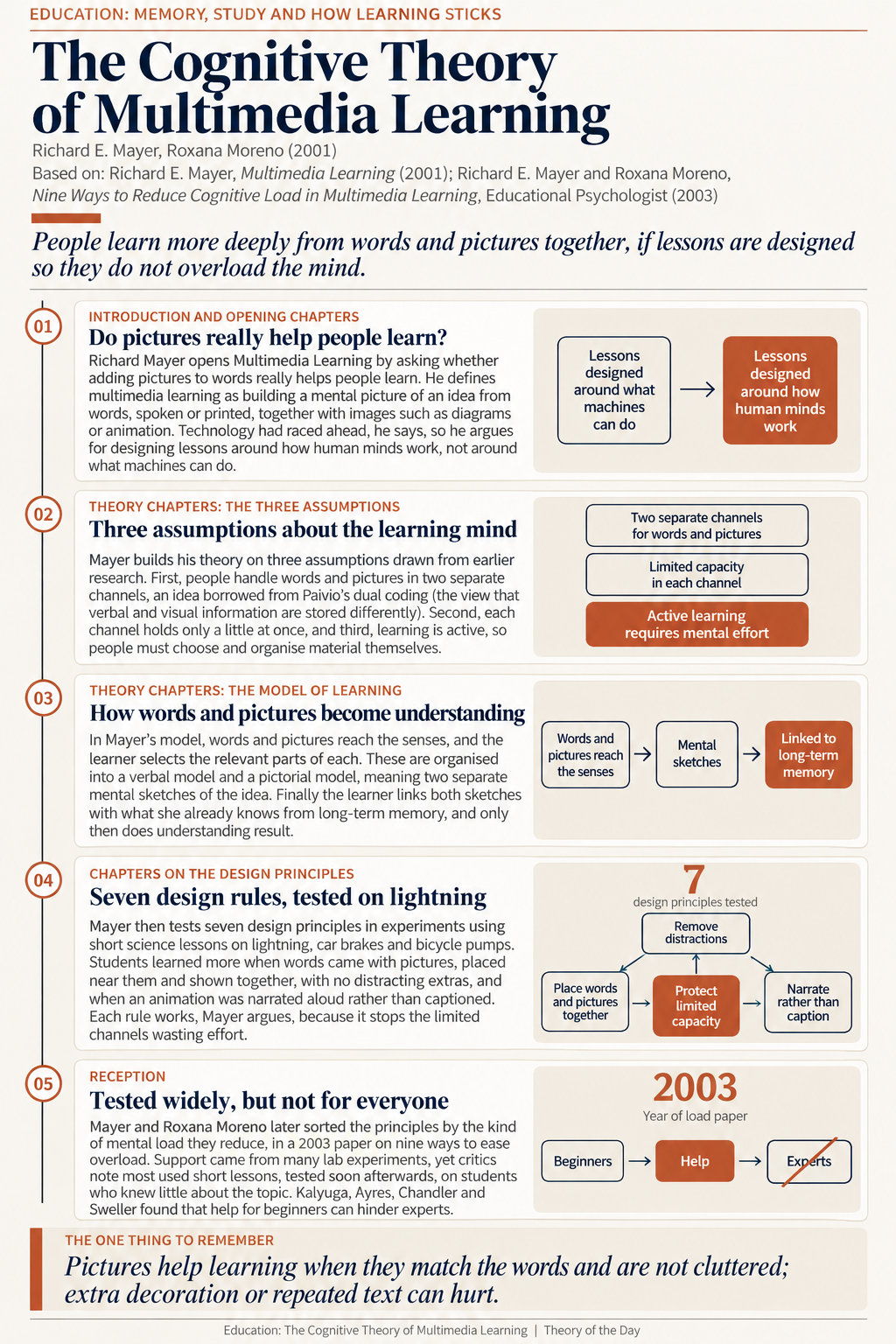
Richard Mayer opens Multimedia Learning by asking whether adding pictures to words really helps people learn. He defines multimedia learning as building a mental picture of an idea from words, spoken or printed, together with images such as diagrams or animation. Technology had raced ahead, he says, so he argues for designing lessons around how human minds work, not around what machines can do.
2. Three assumptions about the learning mind
Theory chapters: the three assumptions
Mayer builds his theory on three assumptions drawn from earlier research. First, people handle words and pictures in two separate channels, an idea borrowed from Paivio's dual coding (the view that verbal and visual information are stored differently). Second, each channel holds only a little at once, and third, learning is active, so people must choose and organise material themselves.
3. How words and pictures become understanding
Theory chapters: the model of learning
In Mayer's model, words and pictures reach the senses, and the learner selects the relevant parts of each. These are organised into a verbal model and a pictorial model, meaning two separate mental sketches of the idea. Finally the learner links both sketches with what she already knows from long-term memory, and only then does understanding result.
4. Seven design rules, tested on lightning
Chapters on the design principles
Mayer then tests seven design principles in experiments using short science lessons on lightning, car brakes and bicycle pumps. Students learned more when words came with pictures, placed near them and shown together, with no distracting extras, and when an animation was narrated aloud rather than captioned. Each rule works, Mayer argues, because it stops the limited channels wasting effort.
5. Tested widely, but not for everyone
Reception
Mayer and Roxana Moreno later sorted the principles by the kind of mental load they reduce, in a 2003 paper on nine ways to ease overload. Support came from many lab experiments, yet critics note most used short lessons, tested soon afterwards, on students who knew little about the topic. Kalyuga, Ayres, Chandler and Sweller found that help for beginners can hinder experts.
The argument in four steps
- The mind handles words and pictures in two channels, and each channel holds very little at once.
- Understanding needs active work: choosing key material, organising it into mental sketches, and linking it to prior knowledge.
- Badly designed lessons waste scarce effort on clutter, mismatched timing or duplicated words, leaving less for understanding.
- So lessons that pair words with pictures and cut wasted effort produce deeper learning than words alone.
Who contributed what
- Richard E. Mayer (2001): Multimedia Learning set out three assumptions, a five-step model of learning and seven design principles tested in experiments.
- Roxana Moreno (2003): With Mayer, 'Nine Ways to Reduce Cognitive Load' tied design fixes to three kinds of mental load.
The evidence
- Mayer and Anderson's 1992 pump studies showed narrated animation beat narration alone or sequential presentation.
- Moreno and Mayer's 1999 study showed narration beat on-screen text beside animation, boosting transfer.
- Mayer, Heiser and Lonn's 2001 lightning lessons showed interesting but irrelevant additions reduced understanding.
The criticisms
- Kalyuga, Ayres, Chandler and Sweller found principles can reverse for experienced learners (expertise reversal).
- Schnotz's integrated model says text and pictures differ by representation, not by sensory channel.
- De Jong argued cognitive load is hard to measure independently of results.
Compared with rival views
- Unlike simple 'more media is better' views, it says extra pictures or sound can hinder learning.
- Unlike learning-styles theories, it assumes everyone has the same limited channels, not different preferences.
Why it matters today
Guides the design of online courses, slide presentations and educational videos, such as cutting on-screen text that merely repeats narration.
Further reading
- Richard E. Mayer (ed.), The Cambridge Handbook of Multimedia Learning (2005)
- Roxana Moreno and Richard E. Mayer, Interactive Multimodal Learning Environments (2007)
- John Sweller, Paul Ayres and Slava Kalyuga, Cognitive Load Theory (2011)