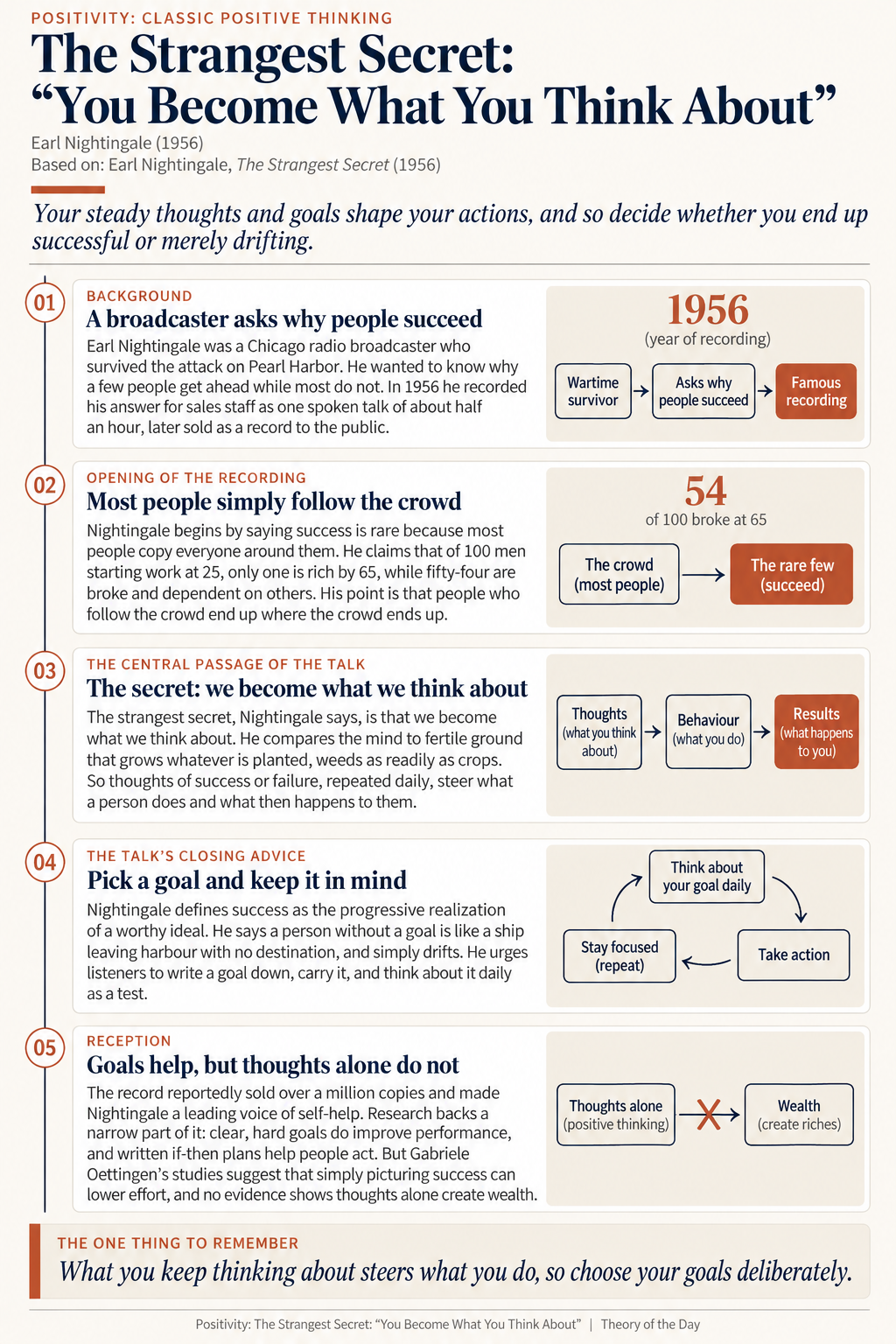
Infographic of: The Strangest Secret: "You Become What You Think About"
Positivity: Classic Positive Thinking
The Strangest Secret: "You Become What You Think About"
Earl Nightingale (1956)
Based on: Earl Nightingale, The Strangest Secret (1956)
Your steady thoughts and goals shape your actions, and so decide whether you end up successful or merely drifting.
The Strangest Secret began as a talk, not a book. Earl Nightingale was a Chicago radio broadcaster and a survivor of the attack on Pearl Harbor. In 1956 he recorded a spoken message of about half an hour for sales staff, setting out what he had learned from years of reading about success. It was then released as a record and sold in very large numbers, reportedly over a million copies. The question he set himself was simple: why do so few people achieve real success?
The talk has no chapters, but it moves through clear stages. It opens with a claim about the crowd. Nightingale says that most people copy those around them, and he cites a figure that of 100 men starting work at 25, only one is rich by 65 while more than half are broke. He treats this as proof that going with the crowd leads to an ordinary or poor result. The central passage then reveals the "secret" of the title, that we become what we think about. The closing advice turns this into a practice: choose a worthy goal, write it down, carry it and think about it every day.
The mechanism he proposes is easy to follow. He compares the mind to fertile ground that grows whatever is planted in it, whether useful crops or weeds. Thoughts held again and again steer what a person does, and what a person does shapes what happens next. A person with no goal is like a ship leaving harbour with no destination, and drifts wherever the weather takes it. A person with a clear goal is like a ship with a course set. Nightingale defines success as the steady carrying out of a worthy goal of one's own, so success does not depend on money alone.
Nightingale was the main voice, but he drew on older self-help ideas, including those in Napoleon Hill's Think and Grow Rich. The goal advice later gained support from other researchers. Edwin Locke and Gary Latham, in their 1990 book on goal setting, showed that specific, difficult goals raise performance. Gabriele Oettingen, in work summed up in Rethinking Positive Thinking in 2014, added an important correction. She found that daydreaming about success can reduce effort, and she proposed a method called WOOP that pairs a wish with a plan for obstacles.
The evidence supports only part of the message. Locke and Latham found that clear, hard goals beat vague ones. Peter Gollwitzer and Paschal Sheeran's 2006 review found that if-then plans help people act on their goals. Yet Oettingen and Gabriele's colleague Doris Mayer found in 2002 that positive fantasies about the future predicted worse results. No research shows that thoughts alone create wealth, and claims of this kind, such as the Law of Attraction, have no scientific support. Barbara Ehrenreich has argued that this style of thinking blames individuals for outcomes shaped by luck, inherited advantage and wider forces. The famous statistics about the crowd are also not documented in the talk.
The talk still matters because it popularised the habit of setting and writing down goals. That habit survives in sales training, coaching and workplace goal-setting, now usually combined with tested methods. Nightingale and Lloyd Conant founded the audio publisher Nightingale-Conant in 1960, which spread many similar messages. The sound core of the talk is that clear goals and steady effort matter. The weak part is the suggestion that thinking alone is enough.
The work, part by part
1. A broadcaster asks why people succeed
Background
Earl Nightingale was a Chicago radio broadcaster who survived the attack on Pearl Harbor. He wanted to know why a few people get ahead while most do not. In 1956 he recorded his answer for sales staff as one spoken talk of about half an hour, later sold as a record to the public.
2. Most people simply follow the crowd
Opening of the recording
Nightingale begins by saying success is rare because most people copy everyone around them. He claims that of 100 men starting work at 25, only one is rich by 65, while fifty-four are broke and dependent on others. His point is that people who follow the crowd end up where the crowd ends up.
3. The secret: we become what we think about
The central passage of the talk
The strangest secret, Nightingale says, is that we become what we think about. He compares the mind to fertile ground that grows whatever is planted, weeds as readily as crops. So thoughts of success or failure, repeated daily, steer what a person does and what then happens to them.
4. Pick a goal and keep it in mind
The talk's closing advice
Nightingale defines success as the progressive realization of a worthy ideal. He says a person without a goal is like a ship leaving harbour with no destination, and simply drifts. He urges listeners to write a goal down, carry it, and think about it daily as a test.
5. Goals help, but thoughts alone do not
Reception
The record reportedly sold over a million copies and made Nightingale a leading voice of self-help. Research backs a narrow part of it: clear, hard goals do improve performance, and written if-then plans help people act. But Gabriele Oettingen's studies suggest that simply picturing success can lower effort, and no evidence shows thoughts alone create wealth.
The argument in four steps
- Most people copy the crowd, and few of them end up financially secure.
- The mind grows whatever is planted in it, whether helpful or harmful.
- A person with a clear written goal directs thoughts and actions towards it.
- So we become what we think about, and a chosen goal shapes our lives.
Who contributed what
- Earl Nightingale (1956): The Strangest Secret recording: stated "we become what we think about" and urged a written personal goal.
- Edwin A. Locke and Gary P. Latham (1990): A Theory of Goal Setting and Task Performance: showed specific, difficult goals raise performance, giving the goal advice firm support.
- Gabriele Oettingen (2014): Rethinking Positive Thinking: showed dreaming of success alone cuts effort; proposed WOOP, planning around obstacles.
The evidence
- Locke and Latham's 1990 goal-setting research found specific, hard goals beat "do your best" goals.
- Gollwitzer and Sheeran's 2006 meta-analysis found if-then plans helped people reach their goals.
- Oettingen and Mayer's 2002 studies found positive fantasies about the future predicted worse results.
The criticisms
- No evidence that thoughts alone bring wealth; Law of Attraction lacks scientific support.
- Oettingen argues that dwelling on success can reduce effort and hide obstacles.
- Barbara Ehrenreich's Bright-sided says it blames individuals for outcomes shaped by wider forces.
Compared with rival views
- Unlike Hill's Think and Grow Rich, it is a short talk with one idea.
- Unlike Peale's Power of Positive Thinking, it stresses goals more than religious faith.
Why it matters today
Sales-training and coaching programmes still use its written-goal exercise, alongside evidence-based goal-setting methods such as Oettingen's WOOP.
Further reading
- Barbara Ehrenreich, Bright-sided: How Positive Thinking Is Undermining America (2009)
- Gabriele Oettingen, Rethinking Positive Thinking: Inside the New Science of Motivation (2014)
- Donald Meyer, The Positive Thinkers (1965)