Infographic of: The Capability Approach
Politics: Political Philosophy
The Capability Approach
Amartya Sen, Martha Nussbaum (1979-2000)
Based on: Amartya Sen, Equality of What? (1979); Amartya Sen, Development as Freedom (1999); Martha Nussbaum, Women and Human Development: The Capabilities Approach (2000)
A good society is judged by what people are actually able to do and be, not by income.
The capability approach began with a question about fairness. In May 1979 the economist and philosopher Amartya Sen gave a Tanner Lecture at Stanford called 'Equality of What?'. He was responding to a debate in which utilitarians judged societies by total happiness, and John Rawls, in A Theory of Justice, judged them by the spread of 'primary goods' such as income, rights and opportunities. Sen asked what exactly we should try to make equal if we care about equality at all.
His lecture argues that both answers look at the wrong thing. A disabled person, a pregnant woman or a child needs different resources to achieve the same ordinary activities, so equal income does not mean equal chances. Happiness is also unreliable, because people who have always been deprived may learn to want little. Sen proposed 'basic capability equality': attention to what people are actually able to do and be. Twenty years later, in Development as Freedom (1999), he extended the idea into a theory of development. Its early chapters treat freedom both as the goal of development and as a means to it. Sen names five instrumental freedoms: political freedoms, economic facilities, social opportunities, transparency guarantees and protective security.
The middle chapters apply the idea. Poverty is redefined as capability deprivation, meaning a lack of real chances to live a decent life, of which low income is only one cause. Sen argues that famines come from people losing the means to obtain food, as in Bengal in 1943, and that working democracies with a free press have not suffered them, because leaders must respond to public pressure. He also gives weight to women's agency, the ability to act on goals one values, as a driver of change.
The mechanism is a shift of focus from resources to what people can do with them. Sen distinguishes functionings, the things a person actually does or is, such as being well fed, from capabilities, the real freedom to choose among such options. Resources matter only through their conversion into these freedoms, and conversion varies with health, age, sex, society and environment.
Martha Nussbaum developed a different version. In Women and Human Development (2000) she defended universal values against cultural relativism and argued for a specific list of ten central capabilities, including life, bodily health, bodily integrity, practical reason and control over one's environment. She argued that every government should secure a minimum threshold of each, and she used the list as a basis for constitutional guarantees. Sen has kept his own version open, preferring public reasoning to a fixed list.
Evidence for the approach includes Sen's study of the Bengal famine in Poverty and Famines (1981), his 1990 work on 'missing women', and the cross-national rankings of the UN's Human Development Report from 1990, which show that income alone gives a poor guide to health and education. Critics include G. A. Cohen, who said Sen mixes up goods and their benefits, and Robert Sugden, who said capabilities are hard to weigh and compare. Others say Nussbaum's list risks imposing one culture's values. The approach still matters because it underpins the Human Development Index and the Multidimensional Poverty Index, and it shapes how governments and charities define success.
The work, part by part
1. Equal in what? Not income or happiness
Equality of What? (1979 lecture), the whole argument
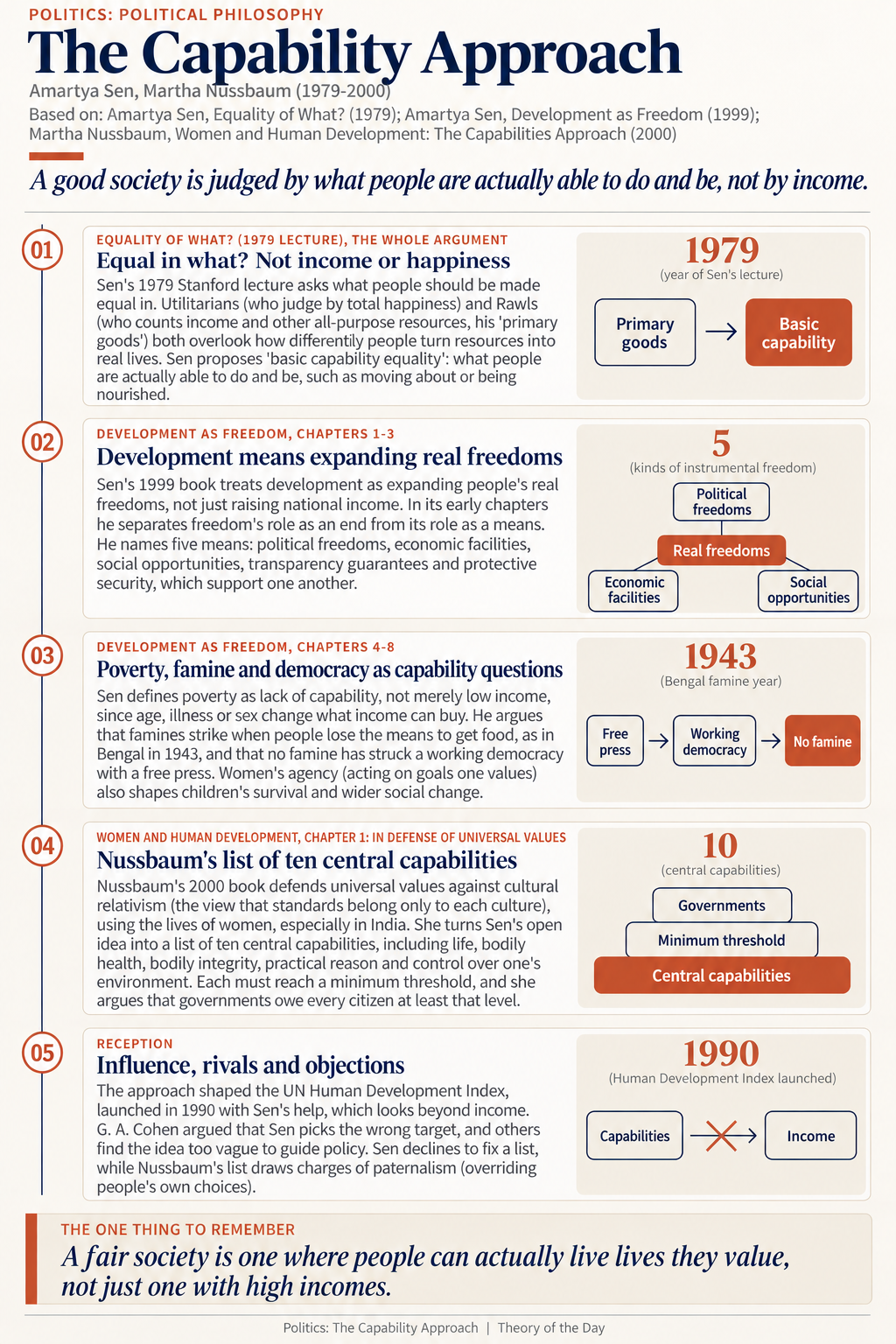
Sen's 1979 Stanford lecture asks what people should be made equal in. Utilitarians (who judge by total happiness) and Rawls (who counts income and other all-purpose resources, his 'primary goods') both overlook how differently people turn resources into real lives. Sen proposes 'basic capability equality': what people are actually able to do and be, such as moving about or being nourished.
2. Development means expanding real freedoms
Development as Freedom, Chapters 1-3
Sen's 1999 book treats development as expanding people's real freedoms, not just raising national income. In its early chapters he separates freedom's role as an end from its role as a means. He names five means: political freedoms, economic facilities, social opportunities, transparency guarantees and protective security, which support one another.
3. Poverty, famine and democracy as capability questions
Development as Freedom, Chapters 4-8
Sen defines poverty as lack of capability, not merely low income, since age, illness or sex change what income can buy. He argues that famines strike when people lose the means to get food, as in Bengal in 1943, and that no famine has struck a working democracy with a free press. Women's agency (acting on goals one values) also shapes children's survival and wider social change.
4. Nussbaum's list of ten central capabilities
Women and Human Development, Chapter 1: In Defense of Universal Values
Nussbaum's 2000 book defends universal values against cultural relativism (the view that standards belong only to each culture), using the lives of women, especially in India. She turns Sen's open idea into a list of ten central capabilities, including life, bodily health, bodily integrity, practical reason and control over one's environment. Each must reach a minimum threshold, and she argues that governments owe every citizen at least that level.
5. Influence, rivals and objections
Reception
The approach shaped the UN Human Development Index, launched in 1990 with Sen's help, which looks beyond income. G. A. Cohen argued that Sen picks the wrong target, and others find the idea too vague to guide policy. Sen declines to fix a list, while Nussbaum's list draws charges of paternalism (overriding people's own choices).
The argument in four steps
- Two people with the same income can have very different real chances in life.
- Age, health, sex and surroundings change how far resources turn into things people can do.
- What matters is the freedom to do and be what people have reason to value.
- Therefore justice and development should be judged by people's capabilities, not by income or satisfaction.
Who contributed what
- Amartya Sen (1979): In 'Equality of What?' he introduced basic capability and criticised income and happiness as measures of equality.
- Martha Nussbaum (2000): In Women and Human Development she proposed ten central capabilities with minimum thresholds as a basis for constitutional rights.
The evidence
- Sen's 1981 Poverty and Famines showed the 1943 Bengal famine occurred without a large fall in food supply.
- Sen's 1990 essay on 'missing women' estimated over 100 million fewer women alive than expected.
- The UNDP's 1990 Human Development Report ranked countries by health, schooling and income, showing rankings differ from income alone.
The criticisms
- G. A. Cohen argued capability mixes up what people have with what they gain.
- Robert Sugden said Sen never specifies how capabilities should be weighed or compared.
- Critics say Nussbaum's fixed list imposes one culture's values, which Sen avoids.
Compared with rival views
- Unlike utilitarianism, it judges lives by what people can do, not by their satisfaction.
- Unlike Rawls's primary goods, it asks what people can actually do with their resources.
Why it matters today
The UN's Human Development Index and Multidimensional Poverty Index measure national progress by health, education and living standards, drawing directly on the approach.
Further reading
- Ingrid Robeyns, Wellbeing, Freedom and Social Justice: The Capability Approach Re-Examined (2017)
- Sabina Alkire, Valuing Freedoms: Sen's Capability Approach and Poverty Reduction (2002)
- Flavio Comim, Mozaffar Qizilbash and Sabina Alkire (eds.), The Capability Approach: Concepts, Measures and Applications (2008)