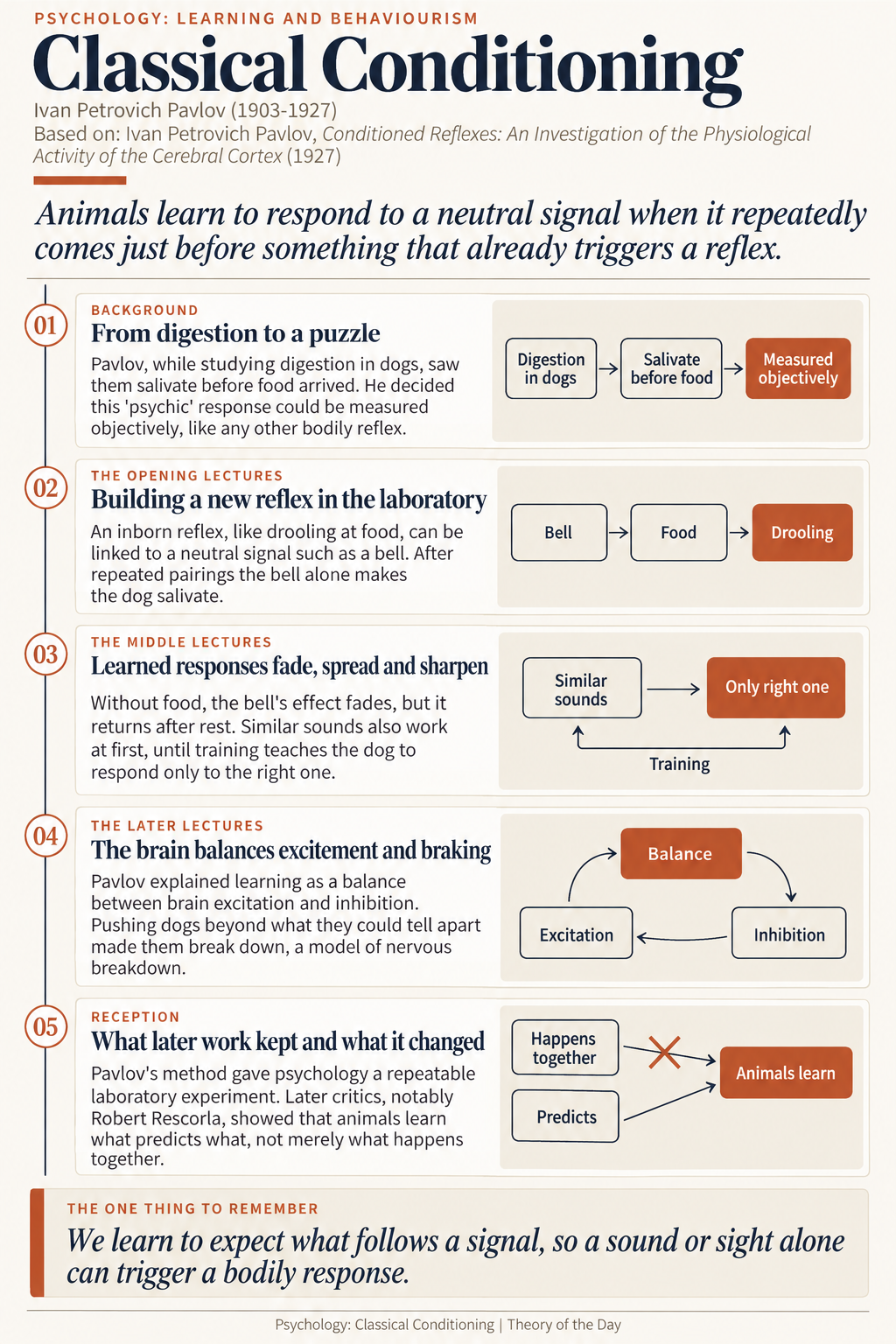
Infographic of: Classical Conditioning
Psychology: Learning and Behaviourism
Classical Conditioning
Ivan Petrovich Pavlov (1903-1927)
Based on: Ivan Petrovich Pavlov, Conditioned Reflexes: An Investigation of the Physiological Activity of the Cerebral Cortex (1927)
Animals learn to respond to a neutral signal when it repeatedly comes just before something that already triggers a reflex.
Ivan Pavlov was a Russian physiologist who won the 1904 Nobel Prize in Physiology or Medicine for his research on digestion. While measuring digestive secretions in dogs, he noticed that the animals salivated at the sight of the keeper or the sound of footsteps, before any food arrived. Many physiologists of the time dismissed such 'psychic' responses as unmeasurable. Pavlov chose to make them the subject of rigorous experiment. Conditioned Reflexes, published in English in 1927 in G. V. Anrep's translation, gathers twenty-five lectures and asks whether learning can be studied by measuring the reflexes of the brain.
The book builds its case in stages. The opening lectures explain the method and draw the key distinction between the unconditioned reflex, an inborn response such as salivating at food, and the conditioned reflex, a learned response to a signal. Dogs were tested in sound-proofed rooms, and a small surgical opening in the cheek let saliva be counted drop by drop. The middle lectures chart what happens to learned responses over time: they fade when the signal is no longer followed by food, partly return after rest, spread to similar signals, and sharpen with training. The later lectures turn to the brain itself, covering higher-order conditioning, sleep, differences between dogs' nervous types, and breakdown under strain.
The mechanism Pavlov proposes is simple. A neutral signal, such as a bell, repeatedly comes just before food, and timing close to the food generally works best. After enough pairings the signal alone sets off the response, because a new connection has formed in the cerebral cortex, the brain's outer layer. Two opposed processes, excitation and inhibition, govern these connections. Excitation starts a response, while inhibition brakes it. Extinction and differentiation are, in his account, active braking rather than simple forgetting.
Pavlov was not the only contributor. Vladimir Bekhterev in Russia and Edwin Twitmyer in the United States reported related findings around the same time. John B. Watson then carried the idea into American behaviourism and, with Rosalie Rayner in 1920, applied it to human emotion. John Garcia and Koelling showed in 1966 that animals learn some pairings, such as taste and illness, far more readily than others. Robert Rescorla argued in 1967 that conditioning depends on the signal predicting the outcome.
The main evidence is Pavlov's own dog experiments, repeated in countless laboratories since, together with Watson and Rayner's report of conditioned fear in an infant. The criticisms are fair ones. Rescorla showed that pairing alone is not enough. Garcia's work challenged the claim that any signal can be linked to any outcome. Pavlov's explanations in terms of brain processes were inferred from behaviour rather than observed directly. Cognitive psychologists add that the theory underplays expectation and mental representation.
The theory still matters because it showed that learning could be studied objectively. Exposure therapy for phobias applies extinction, and researchers on addiction use conditioning to explain why cues linked to drug use provoke cravings. Advertisers also lean on learned associations between products and pleasant feelings. Modern accounts have revised the mechanism, but the basic discovery stands.
The work, part by part
1. From digestion to a puzzle
Background
Pavlov won the 1904 Nobel Prize for his work on digestion, which involved measuring how dogs' glands respond to food. He noticed that his dogs began to salivate before food reached the mouth, at the sight of the keeper or the sound of footsteps. He decided this 'psychic secretion' (a response triggered by expectation) could be measured objectively, and Conditioned Reflexes sets out how.
2. Building a new reflex in the laboratory
The opening lectures
Pavlov separates the unconditioned reflex (inborn, such as salivating at food) from the conditioned reflex (learned, formed when a neutral signal such as a bell or metronome repeatedly comes just before food). Dogs were tested in sound-proofed rooms, and a small surgical opening in the cheek let saliva be counted in drops. After several pairings the signal alone produced saliva, which he took to show that a new link had formed in the brain. Higher-order conditioning lets one learned signal train another.
3. Learned responses fade, spread and sharpen
The middle lectures
Pavlov showed that a conditioned reflex is not permanent. If the bell sounds again and again without food, the response fades, which he called extinction, though it partly returns after a rest. Tones similar to the original also trigger the response at first, but with training the dog learns differentiation, meaning it reacts only to the tone that is followed by food.
4. The brain balances excitement and braking
The later lectures
Later lectures argue that the cerebral cortex (the brain's outer layer) works by balancing excitation (a process that starts activity) and inhibition (a process that brakes it). Pavlov explained sleep as inhibition spreading across the cortex. Dogs forced to tell near-identical shapes apart broke down, which he offered as a model of nervous breakdown.
5. What later work kept and what it changed
Reception
Pavlov's method gave psychology a repeatable laboratory experiment, and John B. Watson built American behaviourism on it. Robert Rescorla argued in 1967 that animals learn what the signal predicts, not merely what happens near it in time. John Garcia and Koelling's 1966 taste-aversion work showed that not every pairing is equally learnable, and critics note that Pavlov's brain explanations were speculative.
The argument in four steps
- Some responses, such as salivating at food, are inborn and automatic.
- A neutral signal repeatedly paired with food comes to trigger the same response by itself.
- The learned link lives in the brain, shaped by excitation and inhibition, which explain fading and sharpening.
- So learning can be studied as measurable reflexes, and the workings of the brain inferred from behaviour.
Who contributed what
- Ivan Petrovich Pavlov (1927): In Conditioned Reflexes, described conditioned reflexes in dogs, with extinction, generalisation, differentiation and inhibition.
- John Garcia (1966): With Koelling, showed rats form taste-illness links after one pairing, challenging the idea that all signals condition equally.
- Robert A. Rescorla (1967): Argued that conditioning depends on the signal predicting the outcome, not on simple pairing.
The evidence
- Pavlov's 1927 dog experiments showed a bell paired with food came to produce salivation alone.
- Watson and Rayner's 1920 study reported an infant's fear conditioned to a white rat.
- Garcia and Koelling's 1966 study showed rats link nausea to taste, not to lights or sounds.
The criticisms
- Rescorla (1967) showed mere pairing is not enough; the signal must predict the outcome.
- Pavlov's brain explanations were speculative, resting on inferred cortical processes, not direct measurement.
- Cognitive psychologists say it understates expectation and mental representation in learning.
Compared with rival views
- Unlike Thorndike's law of effect, it concerns reflexes set off by signals, not behaviour shaped by consequences.
- Unlike introspective psychology, it measures objective responses instead of relying on reports of conscious experience.
Why it matters today
Exposure therapy for phobias uses extinction: repeated safe contact with a feared object weakens the learned fear response.
Further reading
- Daniel P. Todes, Ivan Pavlov: A Russian Life in Science (2014)
- Daniel P. Todes, Pavlov's Physiology Factory: Experiment, Interpretation, Laboratory Enterprise (2002)
- Robert A. Rescorla, Pavlovian conditioning: It's not what you think it is (1988)