Infographic of: Cultural Materialism
Anthropology: Foundations and Schools of Thought
Cultural Materialism
Marvin Harris (1968-1979)
Based on: Marvin Harris, Cultural Materialism: The Struggle for a Science of Culture (1979)
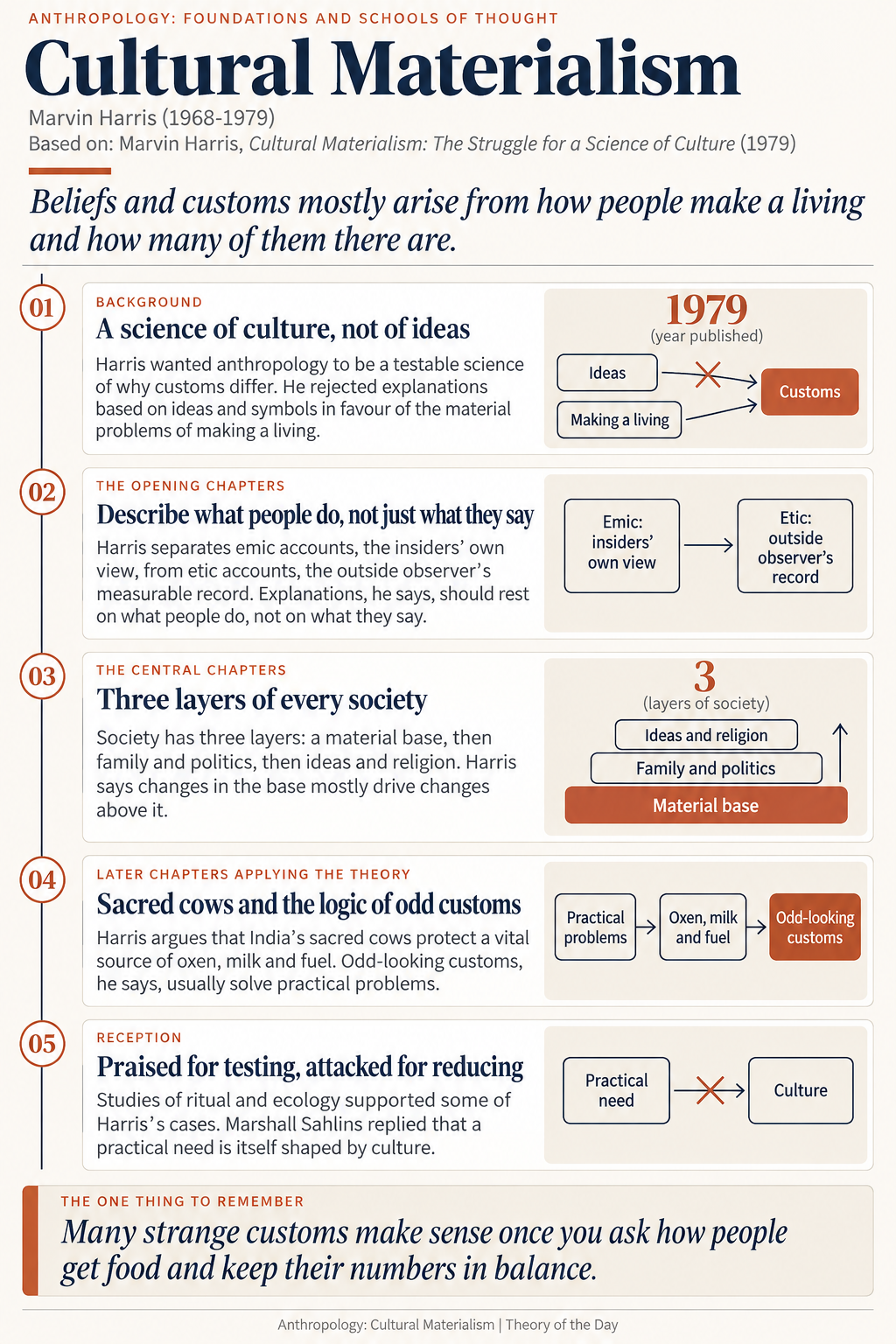
Beliefs and customs mostly arise from how people make a living and how many of them there are.
Marvin Harris was an American anthropologist who taught for many years at Columbia University. In 1979 he published Cultural Materialism: The Struggle for a Science of Culture. The book tries to answer a very old question: why do human societies have such different customs, and why do similar customs appear again and again in unrelated places? Harris had already named his approach in The Rise of Anthropological Theory (1968), a history of the field. By the 1970s many anthropologists were turning toward meaning, symbols and the structure of the mind. Harris thought this turn abandoned explanation altogether.
The 1979 book builds its case in stages. It first criticises the rival schools and defends the idea that anthropology can be a science. It then sets out its method and its model of society, and finally applies them to puzzling customs. I name no chapter titles here because the argument is easier to follow by stage than by number.
The method rests on a distinction Harris borrowed from the linguist Kenneth Pike. Emic descriptions use the categories that the people themselves recognise. Etic descriptions use categories chosen by the observer, which other researchers can check. Harris argues that explanations should be built on etic records of what people actually do, such as births, meals and hours of work, not on what they say or believe.
The model divides every society into three layers. The base, which Harris calls infrastructure, is how people produce food and goods and how they limit or expand their numbers. Above it lies structure, meaning family life, politics and the wider economy. At the top is superstructure, meaning art, religion and ideas. His principle of infrastructural determinism says that when the base changes, the layers above tend to change with it. The mechanism he proposes is that groups under pressure from growing numbers and limited resources adopt whatever practices cost least and benefit most in the long run. Customs that look strange often turn out to be such solutions.
Harris did not work alone. Leslie White had earlier argued that culture advances with the energy people harness, and Julian Steward had studied how environments shape societies. Roy Rappaport's study of ritual among the Tsembaga of New Guinea showed customs regulating pig herds and land use. Harris applied the same logic to India's sacred cattle, to warfare in small societies, and, in a related book, to Aztec sacrifice.
The approach has been criticised on several grounds. Marshall Sahlins argued in 1976 that what counts as practical is itself shaped by culture. Bernard Ortiz de Montellano disputed the claim that Aztec sacrifice met a need for protein. Interpretive anthropologists say the theory ignores meaning, and others say that its determinism is hard to test and leaves little room for individual choice.
The theory still matters because it insists that cultural explanations should be open to checking against evidence. Its explanations of food taboos remain argued over, and its emic and etic terms are standard vocabulary in anthropology.
The work, part by part
1. A science of culture, not of ideas
Background
Harris wrote the book in 1979 to argue that anthropology should be a science that explains why customs differ and recur. He thought rival schools, which explain customs by ideas, symbols or the structure of the mind, could not be tested. His alternative, first named in his 1968 history of the field, starts from the material problems of making a living.
2. Describe what people do, not just what they say
The opening chapters
Harris insists that a science of culture must separate two kinds of description. Emic accounts, a term borrowed from the linguist Kenneth Pike, use the categories that the people themselves find meaningful. Etic accounts use the observer's categories, which other researchers can check, and Harris argues that explanations should rest on these records of actual behaviour such as births, food and labour.
3. Three layers of every society
The central chapters
Harris sets out a universal pattern of society in three layers. The base, called infrastructure, covers how people make a living and control their numbers; structure covers family and politics; superstructure covers art, religion and ideas. His principle of infrastructural determinism says changes in the base mostly drive changes in the layers above it.
4. Sacred cows and the logic of odd customs
Later chapters applying the theory
Harris tests the model on customs that look irrational. He argues that India's sacred cows are protected because they supply oxen, milk and dung fuel, so religion guards a vital resource. He reads war among small farming and foraging peoples in a similar way, as a means of keeping numbers in balance with food.
5. Praised for testing, attacked for reducing
Reception
The book was widely read and fiercely argued over. Supporters pointed to ecological studies such as Roy Rappaport's Pigs for the Ancestors (1968), which showed ritual regulating pig herds and land use in New Guinea. Marshall Sahlins, in Culture and Practical Reason (1976), replied that what counts as a practical need is itself shaped by culture, so culture cannot be explained away as mere practicality.
The argument in four steps
- Scientific explanation must rest on observable behaviour that outsiders can measure, not on what people say they think.
- Every society must feed itself and keep its numbers in check, and these needs set limits on how people live.
- Family life, politics and religion are shaped by how a society meets those needs, not the reverse.
- So odd customs usually solve material problems, and change in the material base drives change in ideas.
Who contributed what
- Leslie White (1949): In The Science of Culture, ranked cultures by energy harnessed, giving materialist evolution its base.
- Roy Rappaport (1968): In Pigs for the Ancestors, showed Tsembaga ritual regulating pigs, land and warfare.
- Marvin Harris (1979): In Cultural Materialism, fused etic/emic method and the three-layer model into one research strategy.
The evidence
- Rappaport's 1968 Pigs for the Ancestors showed Tsembaga ritual regulating pig herds, land use and warfare.
- Harris's 1966 article on India's sacred cattle showed cows supplied oxen, dung fuel and milk.
- Divale and Harris's 1976 cross-cultural study linked warfare to skewed child sex ratios.
The criticisms
- Sahlins (1976) said what counts as practical is itself culturally defined.
- Ortiz de Montellano disputed Harris's claim that Aztec sacrifice supplied needed protein.
- Interpretive anthropologists say it ignores meaning, and its determinism is hard to test.
Compared with rival views
- Unlike Geertz's interpretive anthropology, it explains customs by material conditions, not by reading their meanings.
- Unlike Marx's historical materialism, it stresses population and environment and drops the dialectic.
Why it matters today
Harris's materialist explanations of food taboos, such as pork and beef avoidance, remain a live debate in the anthropology of food.
Further reading
- Marshall Sahlins, Culture and Practical Reason (1976)
- Jerome Lett, The Human Enterprise: A Critical Introduction to Anthropological Theory (1987)
- Bernard R. Ortiz de Montellano, Aztec Medicine, Health, and Nutrition (1990)