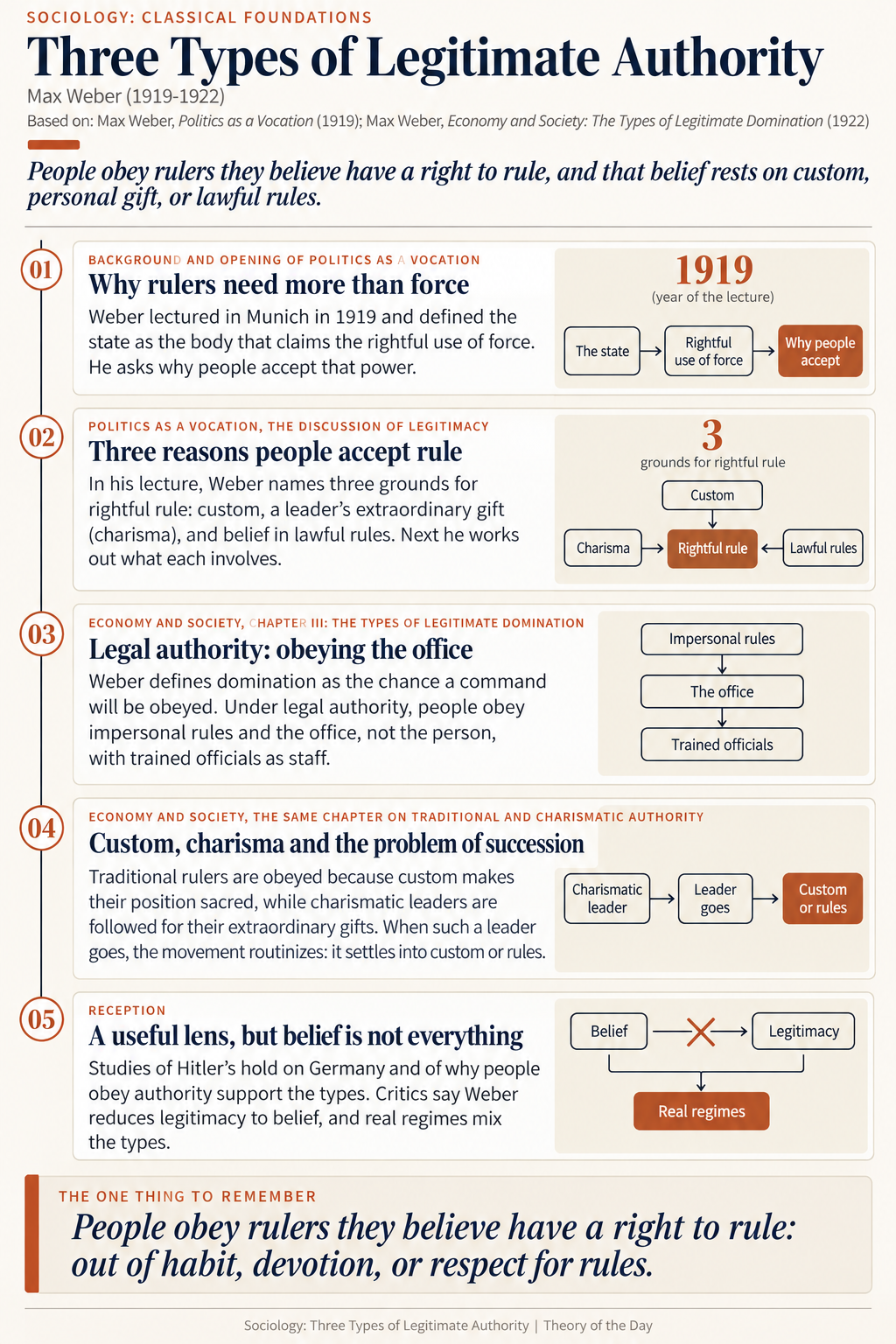
Infographic of: Three Types of Legitimate Authority
Sociology: Classical Foundations
Three Types of Legitimate Authority
Max Weber (1919-1922)
Based on: Max Weber, Politics as a Vocation (1919); Max Weber, Economy and Society: The Types of Legitimate Domination (1922)
People obey rulers they believe have a right to rule, and that belief rests on custom, personal gift, or lawful rules.
Max Weber gave "Politics as a Vocation" as a lecture to a students' association in Munich on 28 January 1919, weeks after Germany's defeat in the First World War and amid revolution. His underlying question was why people obey those who rule them. He answered it more fully in the chapter on the types of legitimate domination in Economy and Society, which was unfinished when he died in 1920 and was published in 1922 under the editorship of his widow, Marianne Weber.
The lecture defines the state by its means rather than its goals: it is the community that successfully claims a monopoly on the legitimate, or rightful, use of physical force in a territory. Weber then asks what makes such power accepted as rightful. He names three grounds: the 'eternal yesterday' (custom made sacred by age), charisma (an extraordinary personal gift that inspires devotion), and legality (belief in lawful rules and official competence). The Economy and Society chapter works this out. It defines domination as the chance that a command will be obeyed, then treats legal, traditional and charismatic authority in turn, and ends with how charisma changes over time.
The mechanism is belief. Weber holds that rulers rarely rely on force or self-interest alone, so every system of rule tries to cultivate belief in its right to command. The kind of belief shapes the administration. Under legal authority people obey impersonal rules and offices, served by trained officials. Under traditional authority they obey a person whose position custom has made sacred, served by personal dependants. Under charismatic authority they follow a leader seen as extraordinary, served by devoted disciples. Charisma is fragile because the leader must keep proving the gift, so after the leader goes it undergoes routinization, settling into tradition or law. Weber stressed that these are pure types, deliberate simplifications, and that real regimes mix them.
Weber was the sole author, but later scholars shaped how the types are read. Talcott Parsons and A. M. Henderson translated part of the chapter in The Theory of Social and Economic Organization (1947), bringing the types to English readers. Reinhard Bendix's Max Weber: An Intellectual Portrait (1960) placed them at the centre of English-language readings of Weber. Guenther Roth and Claus Wittich's 1968 edition of Economy and Society gave the full English text, and editors still debate how the book's parts were meant to fit together.
Later studies support the approach. Ian Kershaw's The 'Hitler Myth' (1987) showed how belief in Hitler as the nation's saviour sustained Nazi rule. Tom Tyler's Why People Obey the Law (1990) found that perceived fairness mattered more than fear of punishment, and Seymour Martin Lipset (1959) linked democratic stability to legitimacy as well as wealth. Critics object that Weber reduces legitimacy to belief: David Beetham argued that it also depends on whether rules are justified. Clifford Geertz argued that charisma attaches to symbolic centres and institutions, not only individuals, and real regimes seldom match the pure types.
The scheme still matters because it asks why obedience is given, not only how it is enforced. Scholars of populism, organisations and policing use it to analyse leaders who win personal devotion, and to explain why citizens comply with some authorities and resist others.
The work, part by part
1. Why rulers need more than force
Background and opening of Politics as a Vocation
Weber gave Politics as a Vocation as a lecture to students in Munich in January 1919, in a country shaken by defeat and revolution. He defines the state as the body that successfully claims a monopoly on the legitimate (rightful) use of physical force in a territory. That raises his real question: why do people accept such power as rightful?
2. Three reasons people accept rule
Politics as a Vocation, the discussion of legitimacy
Weber names three grounds for rightful rule. One is the 'eternal yesterday' (custom made sacred by age), another is charisma (an extraordinary personal gift that inspires devotion, as in a prophet or war hero), and the last is legality (belief in lawful rules and official competence). Next, his longer Economy and Society chapter works out what each involves.
3. Legal authority: obeying the office
Economy and Society, Chapter III: The Types of Legitimate Domination
Here Weber defines domination (Herrschaft) as the chance that a command will be obeyed, and says that stable domination rests on belief in its legitimacy. In legal authority, people obey impersonal rules, and the officeholder commands only within the limits of his office, never as a private person. Its purest form is a bureaucracy (a staff of trained officials with fixed duties, who answer to written rules).
4. Custom, charisma and the problem of succession
Economy and Society, the same chapter on traditional and charismatic authority
In traditional authority, people obey the person of the master because custom makes his position sacred, and his staff are personal dependants rather than officials. Charismatic authority rests on devotion to someone seen as extraordinary, and it lapses if the leader stops proving the gift. After the leader goes, Weber says, the movement 'routinizes' (settles into everyday custom or rules), turning charisma into tradition or law.
5. A useful lens, but belief is not everything
Reception
Ian Kershaw (1987) showed how belief in Hitler as the nation's saviour bound Germans to the Nazi regime, and Tom Tyler (1990) found that people obey authorities they see as fair more than ones they fear. Critics such as David Beetham say Weber reduces legitimacy to belief and ignores whether rules are actually justified. Weber himself stressed that real regimes mix the pure types.
The argument in four steps
- Rulers who rely on force alone are unstable; lasting rule needs people to believe it is rightful.
- That belief rests on one of three grounds: custom, a leader's extraordinary gifts, or lawful rules.
- Each ground shapes the ruler's staff: inherited retainers, devoted followers, or trained officials working by fixed rules.
- So rule lasts only when believed rightful, and each kind of belief builds its own kind of government.
Who contributed what
- Max Weber (1919): Politics as a Vocation and Economy and Society: set out custom, charisma and legality, plus routinization.
- Talcott Parsons (1947): Co-translated the chapter in The Theory of Social and Economic Organization, bringing the types to English readers.
- Guenther Roth (1968): Co-edited Economy and Society with Claus Wittich, giving the full English text of Weber's chapter.
The evidence
- Kershaw's 1987 The 'Hitler Myth' showed belief in Hitler as saviour sustained Nazi rule.
- Tyler's 1990 Why People Obey the Law found perceived fairness mattered more than fear of punishment.
- Lipset's 1959 study linked democratic stability to a regime's legitimacy as well as wealth.
The criticisms
- Beetham (1991) says Weber reduces legitimacy to belief and ignores whether rules are justified.
- Real regimes mix the types, so the pure types seldom fit actual cases.
- Geertz (1977) argued charisma belongs to symbolic centres and institutions, not just exceptional individuals.
Compared with rival views
- Unlike Marx's class-interest account, it treats belief in rightful rule as a force in itself.
- Unlike Hobbes's social contract, it describes why people actually obey, not why they rationally should.
Why it matters today
Scholars of populism use Weber's idea of charismatic authority to analyse how modern leaders win personal devotion from followers.
Further reading
- Reinhard Bendix, Max Weber: An Intellectual Portrait (1960)
- Wolfgang J. Mommsen, The Age of Bureaucracy: Perspectives on the Political Sociology of Max Weber (1974)
- David Beetham, The Legitimation of Power (1991)