Infographic of: Population Ecology of Organizations
Management: Organization Theory
Population Ecology of Organizations
John Freeman, Michael T. Hannan (1977)
Based on: Michael T. Hannan and John Freeman, The Population Ecology of Organizations, American Journal of Sociology (1977); Michael T. Hannan and John Freeman, Structural Inertia and Organizational Change, American Sociological Review (1984); Michael T. Hannan and John Freeman, Organizational Ecology (1989)
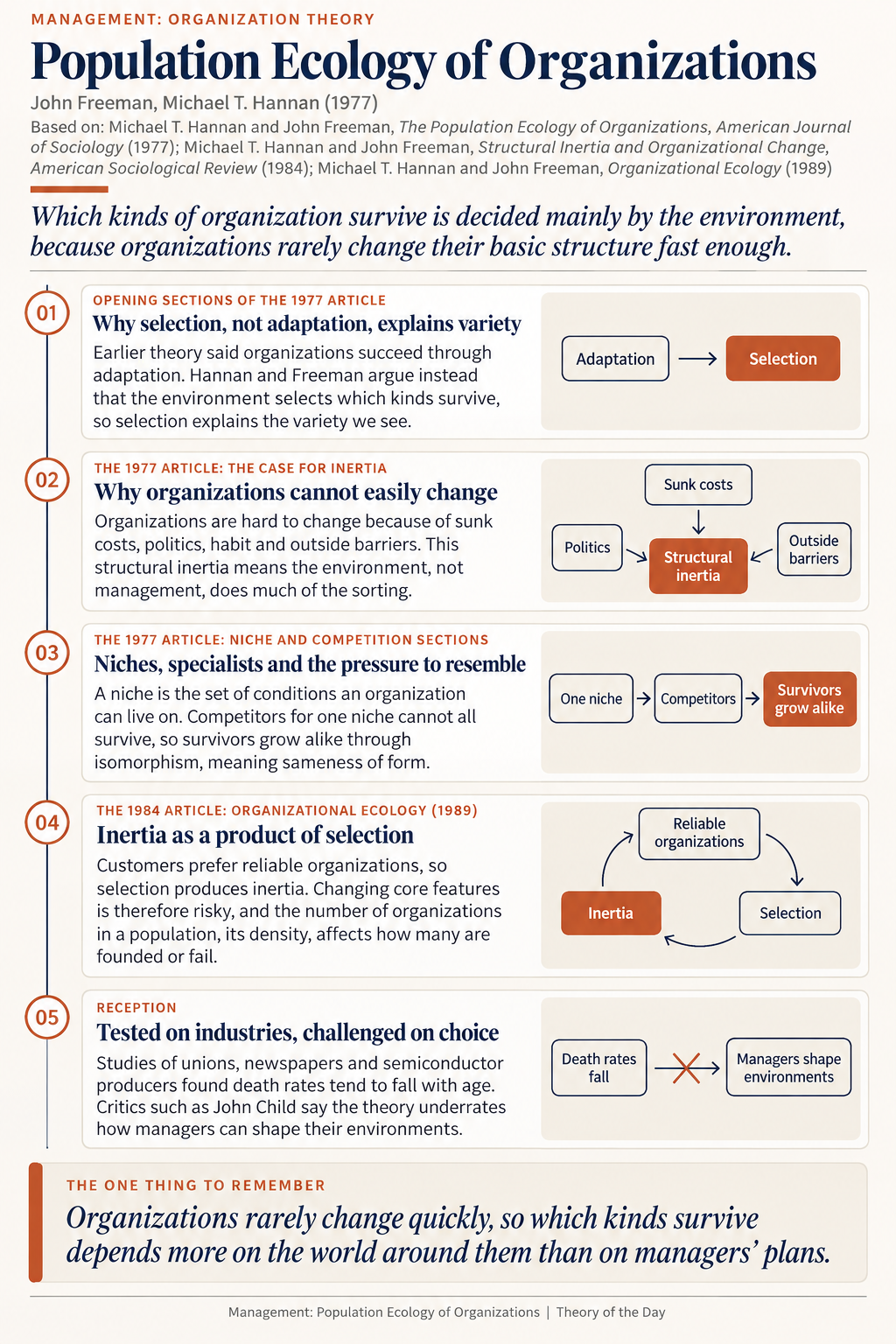
Which kinds of organization survive is decided mainly by the environment, because organizations rarely change their basic structure fast enough.
In 1977 Michael Hannan and John Freeman published "The Population Ecology of Organizations" in the American Journal of Sociology. At the time, the dominant view in organization theory was that organizations survive by adapting to their circumstances, an idea found in contingency theory (the claim that the best structure depends on the situation). Hannan and Freeman asked a different question: why are there so many kinds of organization, and why do some kinds disappear? They proposed answering it by studying whole populations, as biologists do, rather than single firms.
The article, about thirty-six pages long, begins by criticising adaptation theories. It then sets out reasons why organizations change slowly, turns to the biological idea of a niche (the set of conditions on which a kind of organization can survive), and discusses specialists and generalists, competition, and the way competition makes survivors alike. Their 1984 article "Structural Inertia and Organizational Change", in the American Sociological Review, argued that inertia is itself produced by selection. Their 1989 book Organizational Ecology gathered the ideas and the evidence.
The mechanism has three steps. First, organizations are hard to change. Inside, money is sunk into buildings, equipment and skills, information is limited, internal politics resist change, and past practice becomes a norm. Outside, laws, markets and the need for public acceptance (legitimacy) constrain them. Second, customers, investors and regulators favour organizations that act reliably and can explain what they do, and reliability requires stable routines. Third, when conditions shift, organizations that fit the new conditions are more likely to survive, while mismatched ones fail. Because changing core features such as goals, authority, technology and marketing strategy is risky in the short run, the mix of organizational forms shifts mainly through births and deaths.
Several people shaped the theory. Amos Hawley's 1968 work in human ecology (the study of how communities relate to their surroundings) supplied the idea of isomorphism, and Arthur Stinchcombe's 1965 chapter on the liability of newness (the higher risk of failure for new organizations) supplied a key testable claim. The biologists G. Evelyn Hutchinson and Richard Levins supplied the niche and the specialist-generalist ideas. Freeman, Carroll and Hannan tested age dependence in 1983, and Hannan and Glenn Carroll's 1992 book developed density dependence: founding rises as an industry gains legitimacy, then falls as competition grows.
Evidence came from detailed histories of whole industries. Carroll and Delacroix studied Argentine and Irish newspapers in 1982, and Freeman, Carroll and Hannan examined labour unions, newspapers and semiconductor producers in 1983. Critics have pushed back. John Child argued in 1972 that managers make strategic choices that shape their environments, so organizations are not helpless. Haveman's 1992 study of savings and loans found that change could help survival. Others say the biological analogy is loose, since organizations learn, merge and imitate one another. Hannan and Freeman accepted that organizations do change, but argued that changes in core features are slow and risky, so much of the variety still comes from selection.
The theory still matters because it changed what scholars ask about organizations. Instead of asking only how a firm should adapt, researchers ask how crowded an industry is, how old its members are and what niche they occupy. Studies of craft breweries, for example, use these ideas to explain why a few giant producers and many small specialists can thrive together while middling firms struggle. For managers, the lesson is sobering but practical: change is costly, timing matters, and survival depends partly on forces beyond any one firm's control.
The work, part by part
1. Why selection, not adaptation, explains variety
Opening sections of the 1977 article
Hannan and Freeman open their 1977 article in the American Journal of Sociology by asking why there are so many kinds of organization. The dominant view, found in contingency theory (the idea that good organizations fit their circumstances), explained variety as managers adapting to their surroundings. They propose a rival view borrowed from biology: look at whole populations of organizations, and ask which kinds the environment selects for survival.
2. Why organizations cannot easily change
The 1977 article: the case for inertia
Hannan and Freeman argue that organizations are far less flexible than adaptation theories assume. Inside, they list money already sunk into buildings and equipment, limited information, internal politics, and the pull of past habits; outside, they list legal and economic barriers and the need for public acceptance. This resistance, called structural inertia (difficulty changing basic structure), means the environment, not management, does much of the sorting.
3. Niches, specialists and the pressure to resemble
The 1977 article: niche and competition sections
Borrowing from ecology, the authors define a niche (the range of resources and conditions on which a kind of organization can survive). Following Richard Levins, they contrast specialists, which are efficient in one setting, with generalists, which cope with change at a cost. Organizations competing for one niche cannot all survive, so the survivors come to resemble each other, a process called isomorphism (sameness of form).
4. Inertia as a product of selection
The 1984 article; Organizational Ecology (1989)
In their 1984 article, Hannan and Freeman argue that inertia is the result of selection, because customers and investors prefer organizations that act reliably. Changing core features (goals, authority, technology, strategy) therefore raises the short-run risk of dying. Their 1989 book adds that density (the number of organizations in a population) shapes how many are founded and how many fail.
5. Tested on industries, challenged on choice
Reception
The article became widely cited, and researchers tested it on newspapers, labour unions, semiconductor producers and other populations. Freeman, Carroll and Hannan found in 1983 that death rates tend to fall as organizations age. Critics such as John Child, with his strategic choice view (managers can shape their environments), say the theory underrates human choice.
The argument in four steps
- Organizations are slow to change because of sunk costs, internal politics, habit and outside legal and economic barriers.
- Because they change slowly, they cannot keep matching a shifting environment, and mismatched ones lose resources.
- Each kind of organization fits a niche, and competitors for the same niche cannot all survive.
- So the mix of organizational forms changes mainly as some kinds die and others are founded.
Who contributed what
- John Freeman (1983): With Carroll and Hannan, 'The Liability of Newness' tested how organizational death rates vary with age.
- Michael T. Hannan (1992): With Glenn Carroll, Dynamics of Organizational Populations modelled how density affects founding and failure through legitimacy and competition.
The evidence
- Freeman, Carroll and Hannan's 1983 study found organizational death rates depend on age.
- Carroll and Delacroix's 1982 study of Argentine and Irish newspapers linked deaths to niche width.
- Hannan and Carroll's 1992 book found founding rates first rise then fall as industries grow crowded.
The criticisms
- John Child's strategic choice school: managers shape environments and structures, so inertia is overstated.
- Haveman's 1992 savings-and-loans study found change could aid survival, challenging the inertia claim.
- Critics of the biological analogy note organizations learn, merge and imitate, unlike species.
Compared with rival views
- Unlike contingency theory (Lawrence and Lorsch), it says organizations rarely adapt, so selection explains diversity.
- Unlike strategic choice (Child), it treats environments as selecting organizations, not managers choosing environments.
Why it matters today
Applied in studies of industries such as craft breweries, where density-dependence models track how crowding changes founding and failure rates.
Further reading
- Jitendra V. Singh and Charles J. Lumsden, Theory and Research in Organizational Ecology (1990)
- Glenn R. Carroll and Michael T. Hannan, The Demography of Corporations and Industries (2000)
- Howard E. Aldrich and Martin Ruef, Organizations Evolving (2006)