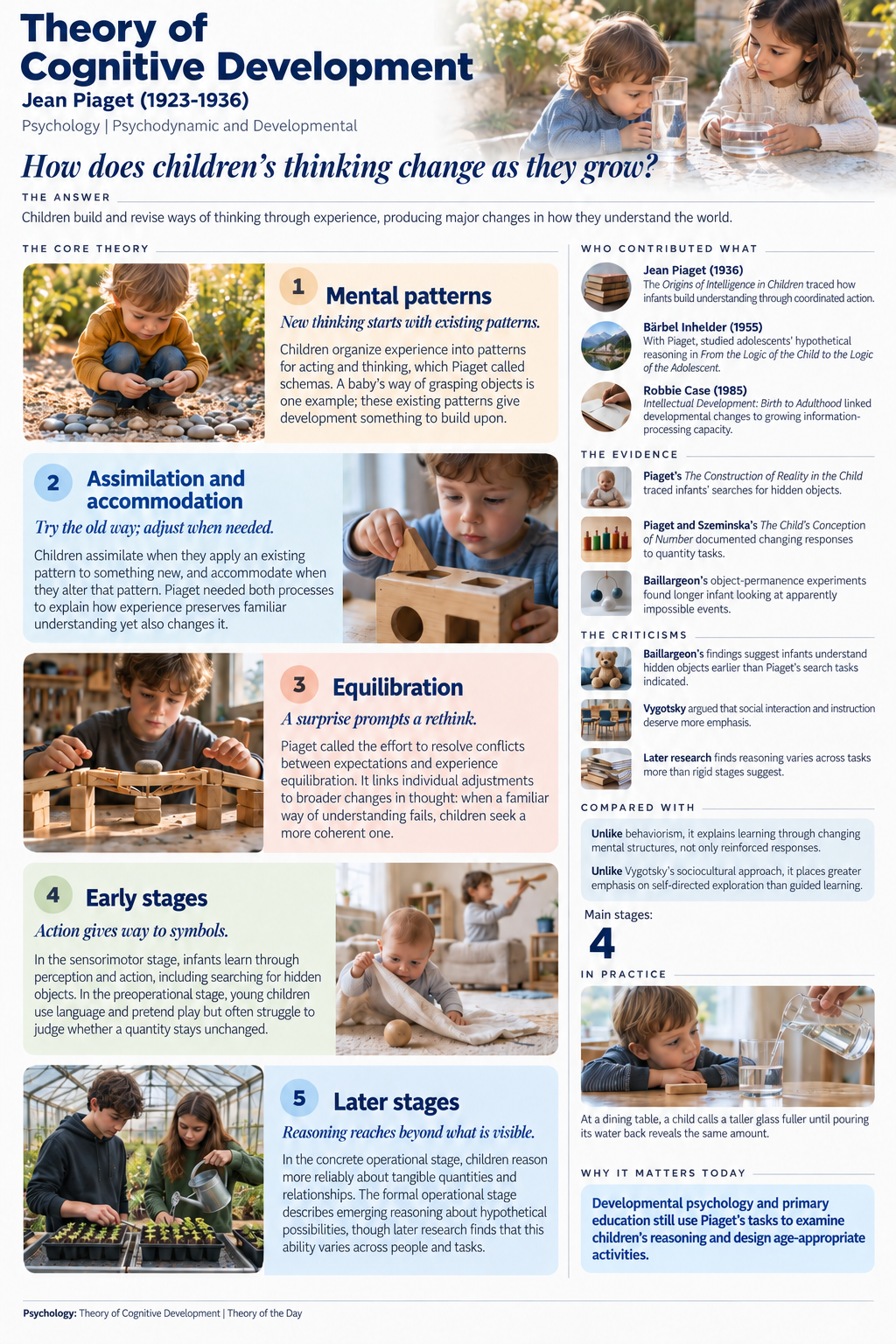
Infographic of: Theory of Cognitive Development
Psychology: Psychodynamic and Developmental
Theory of Cognitive Development
Jean Piaget (1923-1936)
Children build and revise ways of thinking through experience, producing major changes in how they understand the world.
Jean Piaget developed his theory of cognitive development while studying how children explain the world and solve problems. His early books appeared in the 1920s, and his 1936 study of infant intelligence helped establish his account of how thinking develops from action. At a time when children’s mistakes were often treated as signs of incomplete adult knowledge, Piaget proposed that children reason in ways that have their own structure. He asked not just what children know, but how they come to understand objects, quantities, and relationships.
For Piaget, children actively build knowledge rather than simply receive it. They organize experience into patterns of action and thought, called schemas. Assimilation means using an existing pattern to interpret something new; accommodation means changing the pattern when it does not fit. Piaget called the search for a more coherent understanding equilibration. He described four broad stages: sensorimotor, preoperational, concrete operational, and formal operational. These move from learning through action, through symbolic thought, toward more reliable reasoning about tangible situations and, eventually, hypothetical possibilities. The familiar age ranges are approximations, not a timetable every child follows.
Piaget supplied the original framework through observations, interviews, and tasks designed to reveal children’s reasoning. Bärbel Inhelder extended this work with him, notably by examining how adolescents approach problems involving possible outcomes and the systematic testing of variables. Later, Robbie Case developed a neo-Piagetian account that retained the idea of changing forms of thought while giving a larger role to information-processing capacity. These are distinct contributions: Inhelder helped investigate later reasoning within the framework, whereas Case reformulated parts of its explanation.
Classic research made otherwise hidden thinking observable. In work published in 1937, Piaget described how infants’ searches for concealed objects change with development. His 1941 work with Alina Szeminska used number and quantity tasks to investigate how children judge amounts when appearances change. Such tasks helped establish that children’s answers are often systematic rather than random. They also created opportunities to test Piaget’s conclusions: Renée Baillargeon’s 1987 experiments found that young infants looked longer at events that appeared to violate object permanence, suggesting earlier expectations about hidden objects than manual-search tasks had indicated.
Piaget’s proposed stages and methods have been substantially questioned. Looking longer at an event does not necessarily demonstrate the same understanding as successfully searching for an object, so findings from different tasks require careful interpretation. Margaret Donaldson and other researchers showed that children often perform better when questions and settings make sense to them. Lev Vygotsky emphasized language, social interaction, and instruction more strongly than Piaget did. Later research also finds uneven development across skills and situations; hypothetical reasoning is not a universal achievement that appears at a fixed age. These findings revise Piaget’s timetable without making his central questions obsolete.
The theory still matters because it changed how psychologists study children: researchers ask what a child’s answer reveals about their way of reasoning, not merely whether it is correct. Object-hiding and quantity tasks remain useful research tools, provided their demands are considered carefully. In education, the theory encourages opportunities to handle materials, test expectations, and explain conclusions, while later research cautions against assigning activities solely by age or withholding challenging ideas until a presumed stage arrives.
The argument in four steps
- Children begin with ways of acting and thinking built from earlier encounters.
- They interpret new experiences through existing patterns or change those patterns to fit.
- When old patterns fail, children reorganize their thinking to restore a workable understanding.
- So increasingly coordinated ways of thinking transform children’s understanding of objects, quantities, and possibilities.
How it works
- Repeated play and observation give a child expectations about objects and events.
- Surprising results reveal gaps in those expectations; familiar situations encourage the child to keep using them.
- The child’s developing abilities and the task’s demands shape which new understanding takes hold.
Who contributed what
- Jean Piaget (1936): The Origins of Intelligence in Children traced how infants build understanding through coordinated action.
- Bärbel Inhelder (1955): With Piaget, studied adolescents’ hypothetical reasoning in From the Logic of the Child to the Logic of the Adolescent.
- Robbie Case (1985): Intellectual Development: Birth to Adulthood linked developmental changes to growing information-processing capacity.
Compared with rival views
- Unlike behaviorism, it explains learning through changing mental structures, not only reinforced responses.
- Unlike Vygotsky’s sociocultural approach, it places greater emphasis on self-directed exploration than guided learning.
Further reading
- Jean Piaget, La naissance de l’intelligence chez l’enfant (1936)
- Herbert Ginsburg and Sylvia Opper, Piaget’s Theory of Intellectual Development (1969)
- Margaret Donaldson, Children’s Minds (1978)