Infographic of: Structural Functionalism
Anthropology: Foundations and Schools of Thought
Structural Functionalism
Alfred Reginald Radcliffe-Brown (1922-1940)
Institutions help sustain society by maintaining the relationships and obligations that make up its social structure.
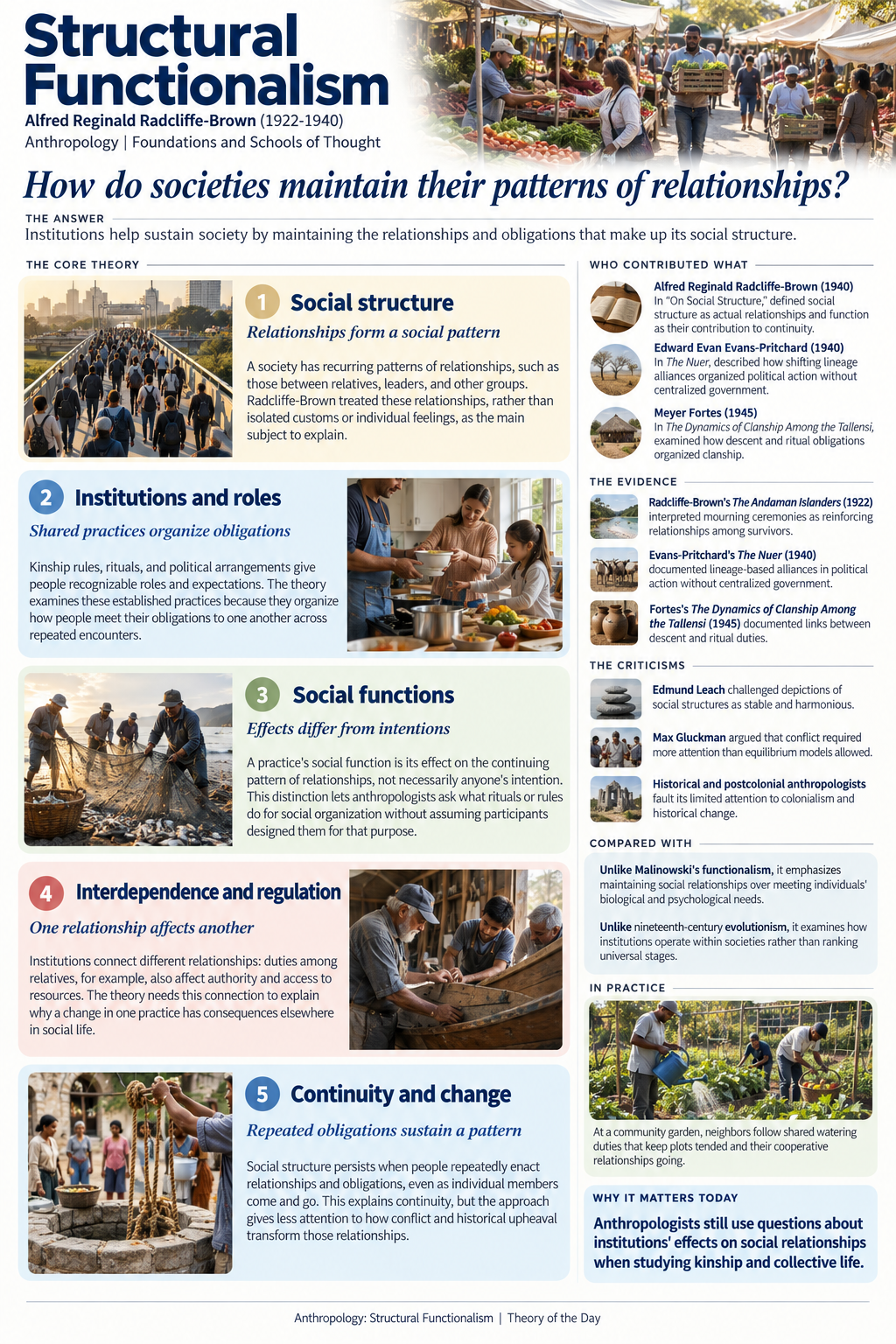
Structural functionalism developed in British social anthropology during the early twentieth century, when researchers increasingly used fieldwork to study societies as organized wholes. Alfred Reginald Radcliffe-Brown drew especially on Émile Durkheim's earlier work about social facts and solidarity. In The Andaman Islanders (1922), he examined how ceremonial practices related to social life; in “On Social Structure” (1940), he set out his approach more explicitly. The date 1952 refers to a collection of his essays, not the theory's first appearance.
The central idea is that a society consists of recurring relationships among people and groups. Kinship, ritual, and political institutions shape those relationships by assigning obligations and guiding conduct. To ask about an institution's function is to ask what effect it has on the continuing pattern of social relationships. That effect need not be what participants consciously intend. The approach therefore studies how practices work together to sustain social organization, rather than treating each custom as an isolated belief or simply a response to individual needs.
Radcliffe-Brown supplied the central account of social structure and function. His contemporary Bronisław Malinowski also studied functions, but focused more on how institutions met people's biological and psychological needs; the two approaches should not be collapsed into one. Edward Evan Evans-Pritchard extended structural analysis in The Nuer (1940), describing how lineage relationships shaped political action without a centralized government. Meyer Fortes's The Dynamics of Clanship Among the Tallensi (1945) closely examined descent, clanship, and ritual obligations. Both developed the approach through detailed studies of particular societies.
These works offered ethnographic interpretations rather than controlled tests of a universal law. Radcliffe-Brown interpreted Andamanese mourning ceremonies in relation to continuing bonds among survivors. Evans-Pritchard documented the changing alliances through which Nuer lineage groups acted together or opposed one another. Fortes traced how Tallensi descent relationships and ritual duties organized social life. Such studies showed why kinship and ceremony mattered politically and socially, although observing a practice's effects does not by itself prove that those effects explain why the practice exists.
Critics challenged the approach's tendency to emphasize continuity and integration. Edmund Leach's Political Systems of Highland Burma (1954) portrayed political arrangements as shifting rather than settled into one stable structure. Max Gluckman's work placed conflict more firmly within the analysis of social relationships. Historical and postcolonial scholars also argued that accounts focused on the present could neglect colonial rule, economic inequality, and change over time. More broadly, an institution can benefit some people while disadvantaging others; it should not automatically be described as serving society as a whole.
Structural functionalism remains useful as a way of asking how practices connect people and shape their obligations. It directs attention to relationships that endure beyond any one person's participation and to the wider effects of seemingly small routines. In studying a family duty, a ceremony, or a community organization, anthropologists can still ask whose relationships the practice sustains. They now commonly pair that question with others about power, disagreement, and history, rather than assuming that every established institution promotes a stable social order.
The argument in four steps
- People live within recurring relationships of kinship, authority, exchange, and cooperation.
- Rules and institutions shape what people do within those relationships.
- Repeated practices reinforce some obligations and regulate tensions between people and groups.
- So practices that sustain these relationships help reproduce a society's social structure.
How it works
- People enter existing relationships and learn the duties attached to their positions.
- Rituals, kinship rules, and other practices coordinate those duties and manage tensions.
- Their effects on continuing relationships determine whether they sustain the social structure.
Who contributed what
- Alfred Reginald Radcliffe-Brown (1940): In “On Social Structure,” defined social structure as actual relationships and function as their contribution to continuity.
- Edward Evan Evans-Pritchard (1940): In The Nuer, described how shifting lineage alliances organized political action without centralized government.
- Meyer Fortes (1945): In The Dynamics of Clanship Among the Tallensi, examined how descent and ritual obligations organized clanship.
Compared with rival views
- Unlike Malinowski's functionalism, it emphasizes maintaining social relationships over meeting individuals' biological and psychological needs.
- Unlike nineteenth-century evolutionism, it examines how institutions operate within societies rather than ranking universal stages.
Further reading
- A. R. Radcliffe-Brown, On Social Structure (1940)
- Edmund Leach, Political Systems of Highland Burma (1954)
- Adam Kuper, Anthropology and Anthropologists: The Modern British School (1973)