Infographic of: Collective Effervescence and the Sacred
Sociology: Classical Foundations
Collective Effervescence and the Sacred
Émile Durkheim (1912)
Shared rituals generate intense group feeling that makes collective symbols seem sacred and binds people into a moral community.
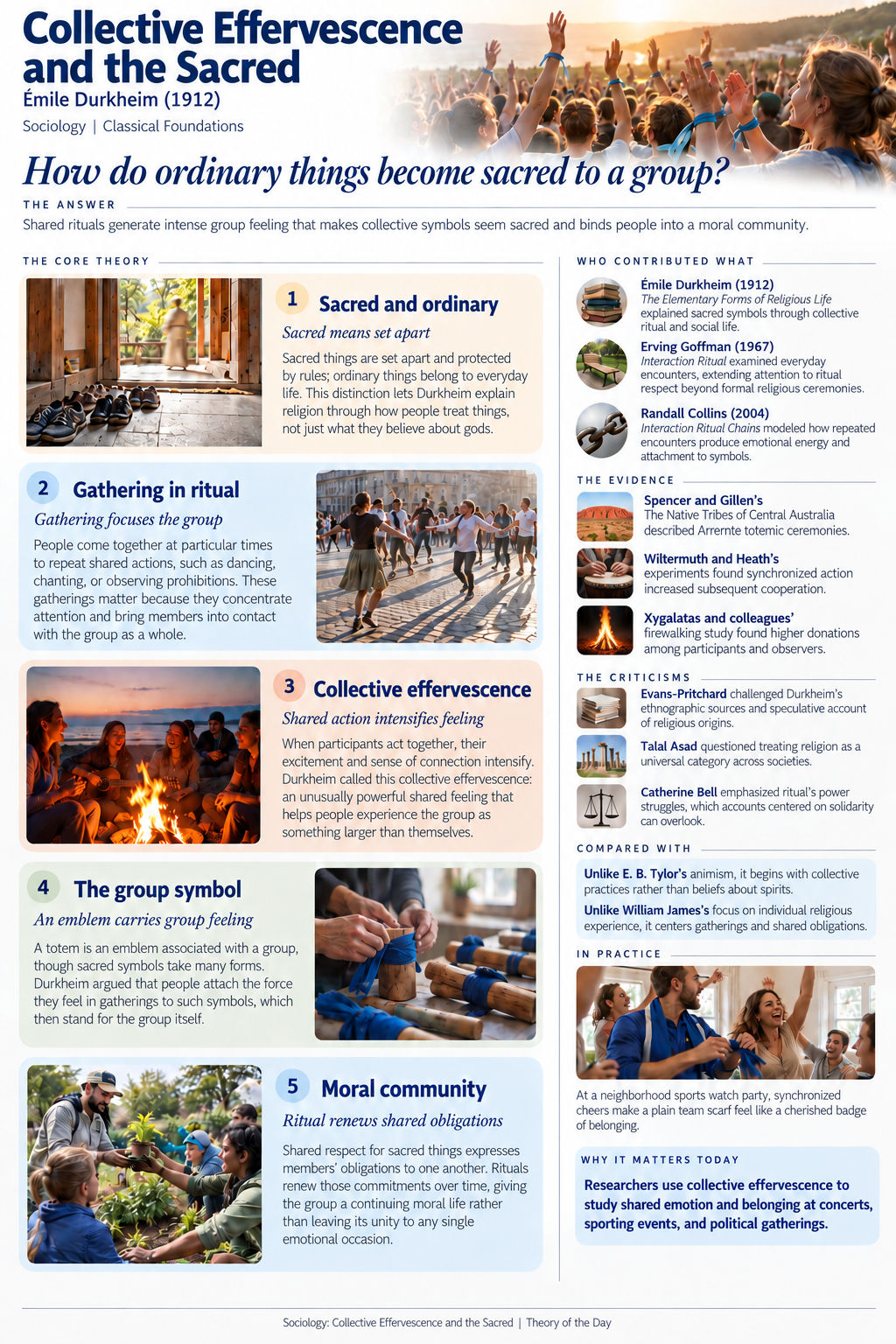
Émile Durkheim developed this account in The Elementary Forms of Religious Life, published in 1912. He wanted to explain what makes religion a social institution and why people experience some objects, actions, and places as set apart from ordinary life. Drawing heavily on published accounts of Aboriginal Australian totemic practices, he sought what he considered relatively simple forms of religious organization. His broader question was how a society creates and maintains a sense of shared moral authority.
Durkheim distinguished the sacred from the profane, meaning the domain of ordinary life. Sacred does not necessarily mean good or supernatural: it means treated as special and protected by rules. When people gather for ceremonies, they focus on common symbols and act together. Their coordinated activity produces an unusually strong shared emotion, which Durkheim called collective effervescence. Participants experience that force as greater than themselves and associate it with the symbols before them. In his account, respect for those symbols also expresses respect for the group they represent.
Durkheim originated the argument about ritual, sacred symbols, and the moral community formed around them. Later scholars developed different parts of it rather than jointly originating it. In Interaction Ritual, published in 1967, Erving Goffman examined the small ceremonies of everyday encounters, including how people show respect for one another. Randall Collins's Interaction Ritual Chains, published in 2004, connected repeated encounters to lasting attachment, symbols, and what he called emotional energy. These extensions took ritual analysis beyond Durkheim's main focus on religion.
Durkheim's original evidence was interpretive, not an experiment. He relied in part on Baldwin Spencer and Francis Gillen's 1899 account of totemic ceremonies in central Australia, among other sources. Later research has tested narrower parts of the proposed mechanism. Experiments by Scott Wiltermuth and Chip Heath in 2009 found that acting in synchrony increased subsequent cooperation. A 2013 study by Dimitris Xygalatas and colleagues found higher donations among participants in, and observers of, an intense firewalking ritual. Such findings support links between shared action and social behavior, not every claim Durkheim made about religion.
The theory's historical claims are contested. E. E. Evans-Pritchard questioned the ethnographic foundations of Durkheim's account and its attempt to identify religion's origins. Talal Asad later challenged the assumption that religion has a single universal definition. Catherine Bell's work on ritual drew attention to power and conflict: ceremonies can mark exclusion and reinforce inequalities as well as build solidarity. Researchers also distinguish temporary shared excitement from durable commitments; feeling united during an event does not, by itself, prove lasting moral agreement.
The theory still offers a way to ask why a crowd's shared actions give ordinary objects unusual importance. A scarf, song, or emblem can come to stand for relationships people feel strongly during a gathering and remember afterward. Sociologists use this insight when studying religious ceremonies, concerts, sport, and political events. Durkheim's enduring contribution is to show why collective emotion and symbolic meaning belong in an explanation of social bonds, even when the original account needs qualification.
The argument in four steps
- People live in groups that depend on common rules and shared identity.
- Gatherings bring members together around shared symbols, gestures, and prohibitions.
- Coordinated action heightens emotion, which participants attribute to forces represented by those symbols.
- Therefore, the group treats its symbols as sacred and renews its moral bonds.
How it works
- Before ceremonies, familiar emblems and boundaries tell participants where to gather and how to behave.
- During coordinated singing or movement, mutual attention and bodily rhythm amplify emotion; distraction weakens it.
- Afterward, repeated encounters and remembered symbols help determine whether that feeling becomes a lasting obligation.
Who contributed what
- Émile Durkheim (1912): The Elementary Forms of Religious Life explained sacred symbols through collective ritual and social life.
- Erving Goffman (1967): Interaction Ritual examined everyday encounters, extending attention to ritual respect beyond formal religious ceremonies.
- Randall Collins (2004): Interaction Ritual Chains modeled how repeated encounters produce emotional energy and attachment to symbols.
Compared with rival views
- Unlike E. B. Tylor's animism, it begins with collective practices rather than beliefs about spirits.
- Unlike William James's focus on individual religious experience, it centers gatherings and shared obligations.
Further reading
- Émile Durkheim, The Elementary Forms of Religious Life (1912)
- Erving Goffman, Interaction Ritual: Essays on Face-to-Face Behavior (1967)
- Randall Collins, Interaction Ritual Chains (2004)